It’s widely accepted that the South China Sea is a geopolitical flashpoint that could inadvertently trigger a regional, even international conflict.
But how did it get to this point?
Broadly speaking the South China Sea dispute boils down to the question of how borders should be delineated in the absence of bilateral agreement between two countries. This discussion is given further impetus by the importance of the region. The South China Sea is as economically lucrative as it is geographically significant. There are hundreds of billions in mineral and energy wealth locked away under its waters, and the South China Sea is both a key global trade conduit and a gateway into China’s backyard. Given the economic and geopolitical stakes, it’s not surprising that the region has become a volatile frontier of global competition.
This series will examine the claimants in the South China Sea dispute: China, Taiwan, Vietnam, Malaysia, Brunei, Indonesia, and the Philippines. Now we move on to Malaysia, a country that has so far been able to advance its own claim while remaining in the good graces of the Chinese government. This dynamic may be about to change however with the defeat of former prime minister Najib Razak, a close friend of Beijing who may soon become the target of a wide-ranging anti-corruption investigation.
Background
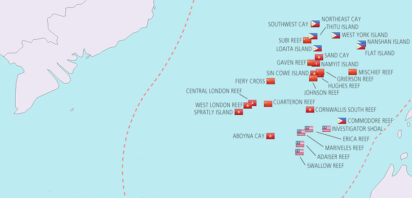
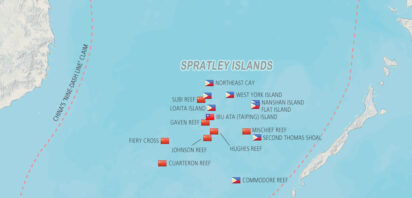
Malaysia has two territories bordering the South China Sea: Peninsular Malaysia (Malaya), which runs south from the Gulf of Thailand, and the island of Borneo, which extends a claim northward that overlaps with both China’s nine-dash line and several features in the Spratly Islands claimed by Vietnam and the Philippines. In all, Malaysia’s claim encompasses 12 features in the Spratlys, and the country maintains a military presence on five major features: Swallow Reef, Ardasier Reef, Erica Reef, Mariveles Reef, and Investigator Shoal.
In terms of island-building, the country’s largest footprint can be found on Swallow Reef, which houses approximately 70 soldiers, a 15-km airstrip, and a three-star diving and birdwatching resort called Layang-Layang.
Malaysia’s claim relies less on a deep dive into the maps and journal entries of bygone centuries, such as the case with Vietnam and China, and more on the jurisprudence of UN conventions in the post-WWII international order. In fact, Malaysia is the only claimant to make its case without pointing to historical record, and the country’s direct intervention in the Spratly Islands came only in 1979 after it submitted a continental shelf claim and published a map reflecting its own interpretation. The claim was then followed up with more direct action by Malaysian government: Swallow Reef was occupied in 1983; the Mariveles and Ardasier reefs were occupied in 1986; and Investigator Shoal and Erica Reef were occupied in 1999.