With less than two weeks to go before much-anticipated presidential elections in Indonesia, the race between Joko “Jokowi” Widodo and Prabowo Subianto is closer than anyone would have imagined. Where once there was no doubt that Jokowi would become Indonesia’s next president, now polls are suggesting that the contest is too close to call, owing in large part to a brilliant campaign by Prabowo. As the race tightens, the competing coalitions have been delving into new areas of policy to reach out to potential new supporters. This has led to a surprisingly strong position from Jokowi regarding the future of Indonesia’s armed forces, one that might come to influence the wider balance of power in the region.
Two Coalitions, Too Close to Call
After legislative elections earlier this year, no party garnered the necessary minimum number of seats to nominate a presidential candidate, setting the now familiar stage for a frenzy of coalition-forming. After the dust settled, there were two blocks: PDI-P, NasDem, and Hanura in support of Jokowi, and his biggest opponents, Golkar and Gerindra, joining together with PAN, PKS, PPP, and PBB in support of Prabowo.
The vice presidential candidate running with Jokowi is Jusuf Kalla, a surprisingly establishment figure for the reform-minded, ‘new guard’ candidate that is Jokowi. He was selected perhaps to add a dash of political experience to the bid. Kalla served as vice president from 2004 to 2009, and has been involved in the highest posts in the country for some time. He left Golkar to become Jokowi’s running-mate, however, if he wins the number two spot he may end up taking the Golkar chairmanship from its unpopular current leader, Aburizal Bakrie, and have it switch coalitions.
Prabowo Subianto is running with Hatta Rajasa as his vice presidential candidate. Hatta is a career politician and the chairman of PAN, a moderate Islamic party. He brings experience in multiple council and cabinet roles, and also the support of some smaller Islamic parties and their voters.
The Military Factor
One of the most interesting issues in play during this election season is the role of, and plans for, the Indonesian military. Despite a strong commitment to civilian rule, the military tends to feature prominently in domestic politics. In the last three elections, for example, there have been military figures running for office.
Despite an avowed commitment to civilian rule among the general populace, there still persists a measure of respect for the military persona on an individual level. Surveys indicate that while support for civilian government is high, character traits such as decisiveness, firmness, and strength are still associated with military figures. Meanwhile, civilian governments have been exceedingly corrupt in Indonesia. So while democracy and civilian rule is still the preference, on a personal level, there is deep skepticism about civil servants and a lingering admiration for the military strongman.
It was initially believed that Jokowi would choose a military figure for vice president for these exact reasons. It was thought that some military presence on the Jokowi ticket would neutralize the advantage enjoyed by Prabowo, an ex-general. General Moeldoko, the commander-in-chief of the Indonesian National Armed Forces (TNI), was tipped as a possible choice. However, Jokowi himself had always publicly ruled out a choice based on electoral strategy and insisted that whomever he chose could be from any group or vocation, so long as the two held compatible beliefs and personalities.
We now know that he went in another direction with Kalla as the second name on his ticket. So if Jokowi is to compete with Prabowo’s strongman image without a strongman of his own, he will have to demonstrate that he is no slouch when it comes to matters of national defense.
Jokowi’s Proposed Buildup
Jokowi has been proposing some sizable expansions to the Indonesian National Armed Forces (TNI) in his policy statements. Current President Susilo Bambang Yudhoyono first initiated in 2005 a plan to expand the TNI to a ‘minimum essential force’ (MEF) by 2024. This involves large-scale upgrades and procurements. It was initially unclear whether a victorious Jokowi – who began his campaign with personality, not policy – would be on board to continue this plan. However, since pairing with Kalla he has made several policy statements on the military front, including:
• preparing the defense sector to deal with cyber and “hybrid” threats
• acquiring and deploying drones to protect Indonesia’s natural resources from illegal fishing and logging
• increasing the military budget from 1% of GDP to 1.5% within five years
• increasing the domestic production of military assets
• establishing a national security council
• expanding and modernizing the Indonesian navy
Of these promises, the pledge to increase Indonesia’s military spending from 1% of its GDP to 1.5% is the most significant. While not an enormous sum of money, it reflects dissatisfaction with the relatively low military spending of the past, particularly vis-à-vis some of Indonesia’s neighbors. The largest previous surge in spending was announced by Yudhoyono last year as part of the MEF commitment. That Jokowi is pledging a similar surge sends a clear signal: he intends to pursue the same modernization and expansion plan.
The proposed defense surge also carries a tone of economic optimism. Indonesia’s economy is expected to grow substantially over the next decade, and some forecasts have it surpassing the economies of the UK and Germany by 2030. Average growth has been consistently high in recent years, a trend that is expected to continue.
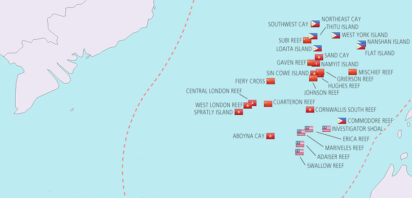
Additionally, the pledge reassures Indonesians who are increasingly concerned about China’s border ambitions. China’s claims to coastlines and islands, such as Indonesia’s Natuna Islands, continue to be a worry and major security concern of several Southeast Asian states. Jokowi’s military pledge is not only a message of economic confidence, but a demonstration that he intends to defend Indonesia from bullying – an appealing sentiment for certain voter blocs.
This confidence – in Indonesia’s economic prospects and its ability to defend its resources and borders – is in sync with the country’s longstanding tradition of non-alignment. Indonesia has resisted jumping on the bandwagon of superpowers like China or the United States, instead choosing to pursue regional alliances with ASEAN and Australia.
Jokowi surprised many of the pundits when he opted not to take on a military figure as his running-mate. With Prabowo narrowing the gap in the polls, it was assumed that Jokowi would be looking for ways to chip away at his rival’s base. Instead, he chose a Megawati-era figure to stand with him, and together, they have embarked on a pro-military spending pro-defense platform, gambling that it was a lack of public confidence in his ability to address these issues that was allowing the grand and experienced Prabowo to catch up.
Voters will make their own choice on the matter in less than two weeks.