The Yarlung Zangbo dam project represents a watershed moment in China’s emergence as a hydro-hegemon capable of manipulating water flows across multiple international boundaries for its own strategic advantage. While Beijing frames the initiative as part of its renewable energy transition and Tibet development plan, the project’s location, scale, and timing reveal concerning and calculated geopolitical motivations that extend well beyond energy security considerations alone.
Premier Li Qiang’s formal inauguration of the Yarlung Zangbo hydropower initiative constitutes a concerted geopolitical maneuver that transforms water into a strategic weapon across South Asia. The project, which will eclipse the Three Gorges Dam and produce roughly 70 gigawatts of power, emerges at a moment of heightened regional tensions and marks Beijing’s most audacious attempt to consolidate control over the communities populating the Tibetan Plateau, as well as the region’s vast water resources.
The sheer scope of the project demonstrates China’s willingness to undertake massive geological interventions to achieve its strategic aims. Engineers propose excavating numerous 20-kilometer passages beneath the Namcha Barwa massif to redirect river flows through a series of five stepped generating facilities. This “straightening” work, as Xinhua describes it, represents one of the most ambitious mountain engineering projects in human history. The technical complexity and estimated cost of 1.2 trillion yuan ($167 billion) underscore Beijing’s commitment to the project despite enormous logistical challenges in transporting materials and workers to such a remote location.
China’s primary motivations for the Yarlung Zangbo project cut across multiple strategic dimensions. One of the most immediate drivers stems from President Xi Jinping’s “xidiandongsong” policy—literally “sending western electricity eastwards”—which seeks to harness the hydropower potential of Tibet’s steep valleys and mighty rivers to supply electricity to China’s bustling eastern metropolises. Tibet contributes roughly a third of China’s aggregate hydroelectric capacity, making it an indispensable component of Beijing’s renewable energy expansion. The project is expected to generate enough clean energy annually to equal the total consumption of the UK, positioning it as a cornerstone of China’s green transition.
The enthusiastic response from financial markets to the dam announcement, which saw notable gains in construction and power generation, reflects investors’ recognition of the project’s economic significance. Firms like Dongfang Electric, Sieyuan Electric, Pinggao Group, and XJ Electric stand to gain significantly from contracts, while the broader construction industry anticipates massive demand for concrete, industrial explosives, and construction supplies. Economic forecasters project the initiative could enhance China’s GDP growth by 0.1 percentage points during its inaugural construction phase.
Pacification through Development in Tibet
However, behind this economic rationale also lie deeper strategic calculations. The formation of the China Yajiang Group as a state-controlled corporation exclusively to manage this initiative indicates the CCP’s recognition of the dam’s national security implications. Vice Premier Zhang Guoqing’s emphasis that the company’s creation represents “a comprehensive approach to national and energy security under the new strategy” illustrates Beijing’s understanding of the dam as serving multiple functions beyond solely power generation. The project anchors an extraordinary surge of industrial and infrastructure development in Tibet, deepening the CCP’s control over this politically sensitive region, while simultaneously creating a situation on the ground that complicates territorial disputes with India.
China’s construction campaign in Tibet is characterized by a methodical approach for resource exploitation and strategic territorial consolidation, of which the Yarlung Zangbo project is the latest manifestation. From 2000 onward, Beijing has built or authorized no fewer than 193 hydroelectric installations in Tibet, with approximately 80 percent categorized as major or massive-scale projects; over 60 percent of these developments remain in planning or preliminary phases, yet if realized, they would displace more than 1.2 million residents and eliminate countless sacred locations. This infrastructure blitz coincides with extensive mining operations targeting Tibet’s abundant reserves of lithium, copper, gold, and rare earth minerals, thus creating a comprehensive framework for resource extraction that serves China’s broader economic and strategic interests.
The human cost of this development strategy has been severe for Tibetan communities. Thousands have been compulsorily resettled to make way for infrastructure developments and mining enterprises, while customary pastoral lands have been inundated or compromised, resulting in the extensive destruction of livelihoods. Revered sites have been rendered unreachable, furthering the ongoing destruction of Tibetan cultural identity which is a hallmark of China’s infrastructure colonization of the region. The Chinese government’s crackdown on protesters opposing the Kamtok Dam project in 2024, which resulted in hundreds of arrests, is one stark example that illuminates Beijing’s determination to suppress local opposition to its agenda. In the case of such massive infrastructure projects, the CCP does not see the erasure of Tibetan heritage as merely a fortunate side effect or by-product, but rather as a central objective driving such efforts in the first place.
Downriver States Face Water Scarcity, Environment Risks
The timing of the announcement to build the dam—coming mere months after India’s suspension of the Indus Water Treaty with Pakistan following the terrorist attack in Jammu and Kashmir by the Pakistani militant outfit known as The Resistance Front (TRF)—has major regional implications. China’s decision to proceed with construction reflects a keen understanding of the evolving dynamics of water diplomacy in South Asia, where transboundary river systems have become increasingly weaponized tools of statecraft. The CCP recognizes that in an era of climate change and growing water scarcity, control over upstream sources provides unique leverage over downstream nations, particularly when they happen to be geopolitical rivals.
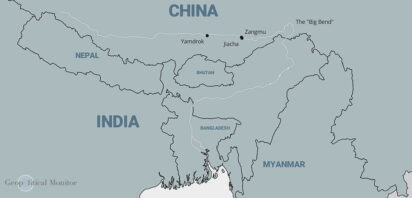
The location of the dam reveals its geostrategic significance. Situated just 30 kilometers from China’s contested frontier with India within the globe’s most profound and extensive canyon system, the facility sits at the confluence of multiple geopolitical fault lines. The Yarlung Zangbo bends around the Namcha Barwa mountain where it descends significantly in altitude over a 50-kilometer distance. This natural phenomenon creates optimal conditions for hydropower generation, but also provides China with an unprecedented chokehold over water flows to downstream nations.
The downstream implications of China’s dam construction extend across multiple countries and affect hundreds of millions of people. The Yarlung Zangbo transforms into the Brahmaputra upon entering India, where it sustains approximately 130 million inhabitants and six million hectares of agricultural land throughout Assam, Arunachal Pradesh, and additional northeastern provinces; in Bangladesh, the waterway supplies 55 percent of irrigation needs while maintaining vital fisheries supporting two million fishermen.
Academic studies highlight the environmental hazards created by large-scale dam projects in seismically unstable areas such as the Himalayas. Research from 2023 demonstrated that major dams disrupt sediment movement patterns, causing riverbed deterioration and declines in fish populations. The Yarlung Zangbo Basin’s sensitivity to environmental disruption, combined with the region’s history of seismic activity—including the 8.6 magnitude Assam-Tibet seismic event in 1950 that occurred merely 300 miles from the proposed dam location—raises serious questions about the project’s long-term safety and environmental sustainability.
A New Kind of Regional Water Politics
China’s decision to move forward with the Yarlung Zangbo dam in spite of these concerns reflects a broader shift in South Asian water diplomacy, wherein increasingly adversarial strategies are being employed. The timing—following India’s suspension of the Indus Water Treaty with Pakistan—signals Beijing’s awareness that water resources are becoming key tools of geopolitical leverage. Rather than merely reacting, China appears to be proactively asserting control over transboundary flows. With the dam project scheduled for completion during the 2030s, Beijing can shorten the extended construction timeline to entrench its position now before new diplomatic constraints can emerge.
India’s response through the planned Siang Upper Multipurpose Project demonstrates New Delhi’s recognition that defensive measures have become essential, but such reactive strategies face significant limitations; India’s own project faces environmental opposition and local resistance, for example, highlighting the democratic constraints that are less prominent in authoritarian countries like China. Additionally, the 11,000-megawatt dam planned for Arunachal Pradesh, while substantial, cannot fully counteract China’s upstream advantages. The fundamental asymmetry between China’s position as an upstream hegemon and India’s defensive posture suggests that Beijing will therefore retain strategic advantages regardless of any Indian countermeasures.
The precedent established by the Yarlung Zangbo project also extends beyond South Asia to other arenas where China controls upstream water sources. Similar dynamics could emerge in regions like Southeast Asia, where management of the Mekong River remains contentious. In fact, China’s track record here acts as an alarming warning for the Yarlung Zangbo project’s potential effects on downstream countries. Research has shown that China’s 11 massive dams on the upper Mekong have intensified drought frequency and severity downstream over the past two decades, limiting water access to Thailand, Vietnam, and Cambodia while damaging ecosystems and causing riverbank erosion. China’s pattern of operating dams to serve its electricity needs while disregarding natural flow patterns suggests similar challenges could await Bangladesh and India. China’s success in asserting control through infrastructure development thus provides a blueprint for water weaponization that can then be replicated across multiple theaters.
The Yarlung Zangbo dam ultimately represents more than an infrastructure project or even a point of bilateral tension between China and India; it embodies a fundamental challenge to the international order governing shared natural resources. Beijing’s willingness to proceed despite objections signals a broader rejection of multilateral constraints. As water scarcity intensifies globally, China’s hydro-hegemonic model seems to be laying the foundation for future conflict over humanity’s most essential resource.
*This article was originally published on August 5, 2025.