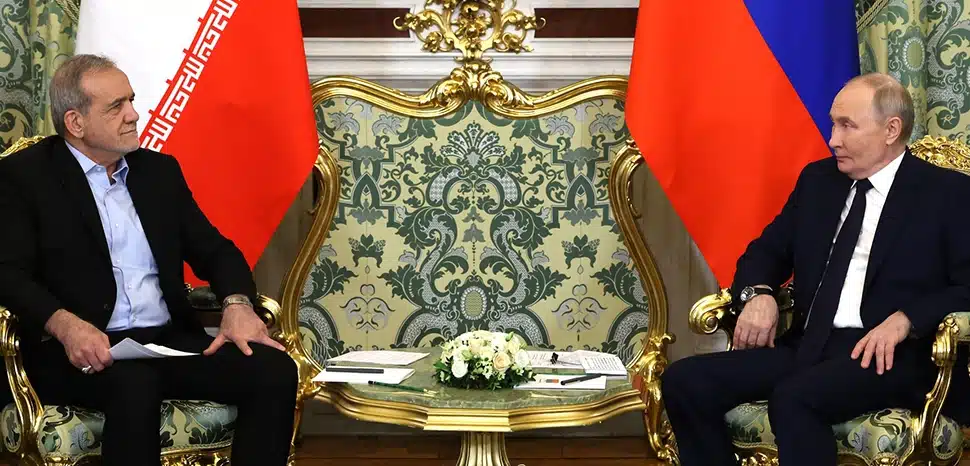
For decades, the strategic relationship between Russia and Iran has been an important aspect of Eurasian geopolitics. But recent events, including the Ukraine war, rising tensions in the Middle East, and shifts in great power competition, have given rise to questions over how strong and long-lasting this bilateral cooperation will be.
Iran: Russia’s Southern Strategic Anchor
Iran’s importance to the Russian Federation stems from geography and ideology. The country forms a natural barrier against Western influence along Russia’s weak southern border, and the Islamic Republic has long stood as a counterweight to NATO expansion in the area. Iran has also been a window into the Middle East and Eurasia, allowing Russia goal to spread its power and influence across these vital regions.
If the United States were to enact regime change in Iran and install a pro-Western government, Russia would not only lose a key ally in the region, but it would also be strategically surrounded from the south, putting important Russian interests in the Caspian Sea, Central Asia, and the Caucasus at risk. Thus, from a conventional balance-of-power point of view, it makes sense that Moscow would stand behind the Islamic Republic against enemies like the United States, Israel, and GCC states.
The S-400 Problem: Balancing Strategic Goals and Industrial Limits.
Given the regime’s geopolitical importance to Moscow, it follows that the Kremlin would be looking to shore it up Iran’s air defense against potential attacks by Israel. Yet Russia has not sent its most powerful surface-to-air missile system, the S-400. At first, the prevailing logic was that Russia was being politically cautious and worried about its relationship with Israel. However, a closer look shows that there are more important factors at play, namely that Russia continues to lack the industrial capacity to send Iran S-400 systems at this point in time. This is due to the following:
- Dependence on Western Parts. Several of the S-400’s subsystems depend on components targeted by Western sanctions. Since the full-scale invasion of Ukraine in 2022, it has become harder and harder for Moscow to source them, increasing the value of remaining inventories.
- Production Problems. Russia had trouble meeting its contracts even before the Ukraine war broke out. The 2018 deal to export the S-400 to India is one example. Even with four years to prepare, Moscow was unable to meet delivery deadlines. The issue was raised when Indian Prime Minister Narendra Modi visited Moscow in 2024, but his concerns were met with additional delays, with remaining deliveries now set for 2026.
- Other Export Priorities. Moscow has prioritized other export markets, namely Turkey. Following a 2017 deal, Russia deployed most of its S-400 production capacity to deliver systems to Turkey. The move had major and ongoing geopolitical consequences. In giving Turkey the S-400 in 2020, Moscow was able to get Ankara out of the F-35 fighter plane program.
A (Temporary) Strategic Divorce?
Although Iran is undeniably important to Russia’s regional strategy, there are some signals that Moscow is reevaluating the costs and benefits of openly siding with Tehran. Four possible reasons for this include:
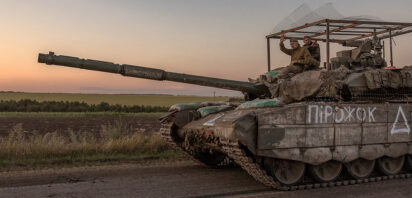
- War Opportunism: Using the Israel-Iran Conflict to Advance in Ukraine War. Russia is heavily enmeshed in the Ukraine war and has used the Iran-Israel conflict as an excuse to ramp up activities in the Donbas and southern Ukraine. The Kremlin views this moment as a unique chance to make more advances on the battlefield without having to deal with the immediate political fallout that would come from it. From a tactical point of view, being too close to Iran at this moment risks triggering additional Western sanctions or NATO support for Kyiv.
- Energy Windfalls from Gulf Instability. Threats to close the Strait of Hormuz, together with the Red Sea crisis and tensions in the Gulf, creates upward pressure on global energy prices. This is a big money maker for Russia, which is the world’s second-largest oil exporter. Such revenues are desperately needed to keep the Russian war economy going and make up for economic losses from sanctions. From Moscow’s point of view, Iran’s temporary instability is good for the domestic economy.
- Deepening China’s Reliance on Russian Energy. Iran’s oil shipments are at risk due to rising geopolitical tensions in the Gulf, which in turn has the effect of making China more dependent on Russian energy supplies. Beijing has been increasing its oil imports from Russia, generally at lower prices, as Iranian exports have faced increased maritime insecurity. This growing economic reliance gives Moscow more power over China and strengthens their strategic alignment.
- Sending Signals to Washington (and Trump). Russia’s careful signals to Washington, especially after Trump’s return in 2025, are probably the most overlooked issue here. Kremlin strategists know that a second Trump presidency could help US-Russia relations improve. Open support for Iran, especially during times of increased regional tensions, will only make this path more difficult. Putin could be trying to minimize any perception of supporting Tehran so as to avoid angering Trump or Republican hawks.
A High Stakes Balancing Act
Russia’s ties to Iran remain important, but they appear to be weakening. As Moscow deals with the demands of a long war in Ukraine, global sanctions, and shifting alliances in Asia and the Middle East, it has to change the order of its priorities and resources. There is no doubt of Iran’s strategic relevance, but right now Russia is making cold calculations based on factors like industrial output, diplomatic timing, economic gain, and the possibility of a limited improvement of relations with Washington.
This doesn’t mean that Russia has given up on Iran for good. Rather, it is putting off important investments in Tehran and using the recent volatility for its advantage. In doing so, Moscow navigates a fine line between benefitting from Iran’s turmoil and avoiding a more complete bilateral break in the future.
For security strategists, the lesson is clear: Russia’s actions around the world are more and more influenced by short-term goals and real-time restrictions, not only ideology or long-term partnerships. Iran is an example of how Moscow’s geopolitical chessboard is always changing, even at the expense of its most important partners.