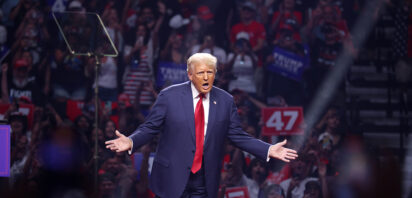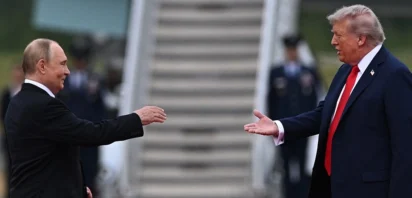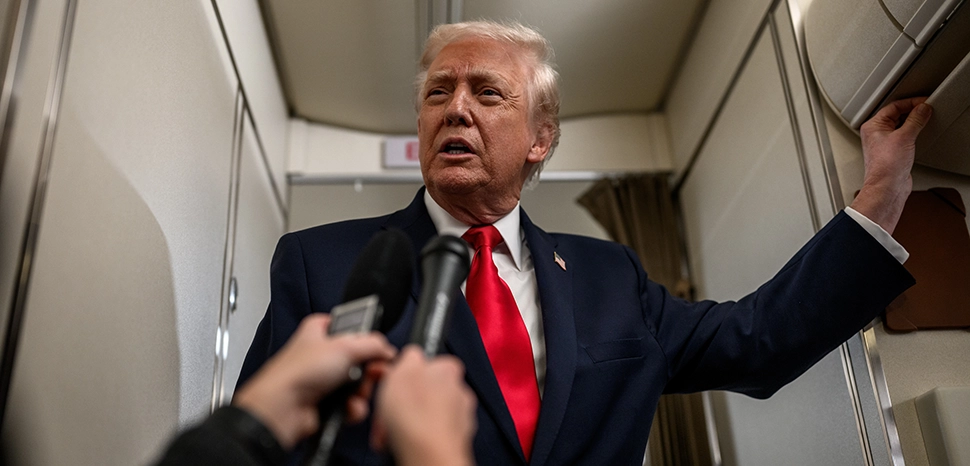
President Trump says he wants a “quick peace deal” in Ukraine. But according to The Telegraph, what’s really on the table isn’t peace — it’s surrender. He’s reportedly prepared to recognize Russia’s control over large swaths of Ukrainian territory, not just Crimea, but also Donetsk, Luhansk, Zaporizhzhia, and Kherson. In effect, he’s signaling a willingness to confer legitimacy on conquest.
That may fly in Moscow. But here? There’s a problem. And not the one most people think.
Many assume Congress has already tied the president’s hands, that US law flatly prohibits recognition of Russian land grabs. But that’s not quite true. Over the last decade, Congress passed several statutes, including the Support for the Sovereignty, Integrity, Democracy, and Economic Stability of Ukraine Act (SSIDES, 2014), the Ukraine Freedom Support Act (UFSA, 2014), and the Countering America’s Adversaries Through Sanctions Act (CAATSA, 2017), which reflect strong bipartisan support for Ukraine’s sovereignty and territorial integrity, and impose sanctions on Russian aggression. But none of them explicitly prohibit a president from recognizing Russian control over Ukrainian territory.
In other words: Congress built policy. But it never built a firewall.
SSIDES and UFSA empower the executive to sanction Russian individuals and entities involved in undermining Ukraine’s territorial integrity. CAATSA makes certain sanctions mandatory and ties the president’s hands in lifting them. But there is no statutory language that makes recognition of Russian-held Ukrainian territory itself illegal. These are deterrents — not prohibitions.
Until now, that legal nuance may have seemed academic. But it no longer is. Trump’s reported willingness to formalize Russia’s land grabs, including regions annexed after 2022, has exposed a gap that could carry global consequences. According to Telegraph and Reuters, the peace plan under consideration is not an American initiative alone. It reportedly drew heavily from a Russian-origin proposal. A leaked transcript published by Bloomberg shows Trump’s envoy, Steve Witkoff, advising a Kremlin official on how to frame Russian war aims for the US administration. The result is a document that reportedly pressures Ukraine to cede territory, essentially laundering Moscow’s position through an American voice.
Call it what you want – a diplomatic pivot, a pragmatic compromise. What it actually is: a legal gray zone Congress never thought to close.
If the president were to issue a recognition proclamation tomorrow, there would be no law clearly stopping him. Sanctions would remain on the books and lifting them would require either overturning a standing executive order or triggering a congressional review under CAATSA, both of which would be politically explosive and face resistance even within Trump’s own party. But the symbolic and strategic damage would be swift and severe. A formal shift in US policy would invite other countries to follow suit. It would fracture Western unity. And it would undermine decades of precedent that the United States does not legitimize borders changed by force.
Some in Congress have raised an alarm. Senators Roger Wicker and Mitch McConnell have warned against legitimizing Russian aggression. Representative Don Bacon went further, accusing Witkoff of sounding like “a Russian paid agent.” But expressions of concern aren’t enough. If Congress wants to defend its own foreign policy framework, it needs to do more than object. It needs to act.
And it’s not just lawmakers. Trump’s position increasingly diverges from the views of Republican voters themselves. A November Harvard-Harris poll found that 86% of Republicans support increasing financial pressure on Russia to end the war, not legitimizing its gains. The president may be speaking loudly, but he’s not speaking for the majority of his party.
It’s time for Congress to close the loophole.
Lawmakers should pass emergency legislation making it explicitly illegal for any US official, including the president, to formally recognize Russian sovereignty over any part of Ukraine. That prohibition should apply to Crimea, the Donbas, Kherson, Zaporizhzhia, and any territory seized by force. It should ban formal diplomatic recognition, prohibit changes to official US documents, and deny funding for any recognition-related action. It should also reinforce sanctions until Ukraine’s territorial sovereignty is fully restored.
This law would not be redundant. It would be a necessary upgrade. When SSIDES and CAATSA were written, lawmakers assumed the president would exercise self-restraint. They assumed a baseline commitment to US alliances and international law. They didn’t imagine a president willing to adopt, let alone formalize, the Kremlin’s position. But that moment has arrived.
This isn’t about relitigating the Ukraine war. It’s about protecting the architecture of US foreign policy. When Ukraine gave up its nuclear arsenal in 1994, the United States provided security assurances as a signatory to the Budapest Memorandum. If Washington now legitimizes Russia’s territorial conquests, that promise is shattered. And it won’t just be Kyiv that feels the impact. The message will echo in Taipei, Tallinn, Seoul, and far beyond: US guarantees are fickle. Temporary. Subject to reinterpretation. If a president can abandon allies, override sanctions, and legitimize aggression, all without breaking the law, then the law must change.
President Trump can make promises. He can hold press conferences. But as things stand, he may be able to recognize Russian land grabs and face no immediate legal consequences.
Congress must change that.
Recognition wouldn’t secure peace — it would ratify surrender, embolden future wars, and destabilize the world in places far beyond Ukraine. Congress must draw the line before it’s too late.
The views expressed in this article belong to the author(s) alone and do not necessarily reflect those of Geopoliticalmonitor.com.