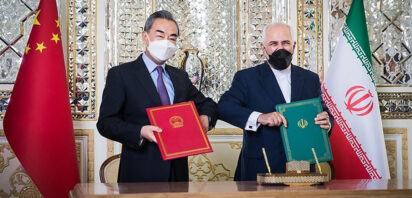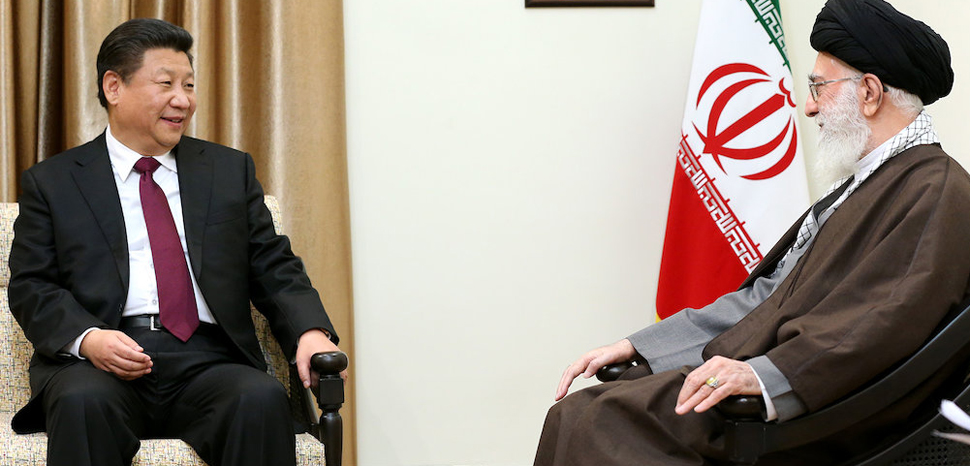
The leaders of China and Iran agreed on a $400 billion economic and security deal last week, establishing a 25-year roadmap for deepened cooperation.
The agreement amounts to a diplomatic and economic lifeline for Iran, which has languished for years under the weight of US sanctions. For China, it announces the rising power’s arrival in a highly strategic region, and its growing willingness to engage directly in regional politics.
Does the China-Iran deal mark the beginning of the end of US hegemony in the Middle East, or is this another case of a moonshot investment accord whose projects never actually see the light of day?
Background
The final text of the deal has not been made public in either Iran or China, but it is believed to closely resemble an 18-page version that leaked in July of last year.
Though it isn’t being overtly marketed as such by either side, in many ways the deal seems to mirror Belt and Road mega-projects like the China-Pakistan Economic Corridor (CPEC), complete with eye-watering price tag, big-picture cross-sectoral cooperation, and precious few details on individual projects – all of which is obfuscated by a completely opaque negotiating process.
The figure now being floated is $400 billion in Chinese investments in Iran over the next 25 years. By way of comparison, CPEC was said to be worth $50 billion when it was announced in 2015, $44 billion of which had been allocated as of 2020.
The new deal will see Chinese investment into Iranian banking, information technology, nuclear power, telecommunications, as well as infrastructure like ports and rail. In exchange, China will receive regular shipments of Iranian oil. Though the exact price and terms of the oil sales, like the text of the agreement itself, remain a secret, one anonymous Iranian official quoted by the New York Times has said that it will be sold at a heavily discounted rate.