The years immediately following the fall of Muammar Gaddafi might have been tense and chaotic, but everyone involved was committed to ensuring the oil kept flowing. Indeed in the period from January 2012 to March 2013, Libyan oil exports bounced back admirably, even flirting with their Gaddafi-era highs of over 1.6 million bpd. Back then there was an unspoken agreement between tribal and political antagonists that, despite all of the disagreements separating them, it was still in everyone’s best interest to protect the economic lifeblood of the nation, the source of virtually all government expenditures from military and infrastructure to civil servant salaries.
Lately this oil infrastructure détente has broken down, perhaps due to the emergence of Islamic State on the battlefields of Libya, or maybe because the last flames of post-Revolution hope have finally died down. Either way, Libya’s oil industry is going from bad to worse, and current output is hovering between 400,000 to 600,000 bpd, a far cry from the levels seen in the Gaddafi era.
Only a few fields remain online
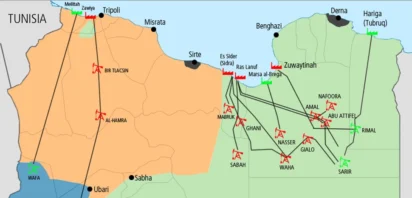
Libya’s oil industry is beset by several major problems that defy easy solution. First of which is the repeated attacks and general degradation of the country’s pipeline infrastructure. There has also been an exodus of foreign workers and expertise, particularly since Islamic State became a player in the Libyan civil war, making it even more difficult to repair offline pipelines. Libya’s ports and tanker terminals have also been targeted over the past year, most notably in the Libya Dawn attack on the Sidra tanker terminal in December 2014. The resulting fire took nine days for firefighters to put out and the terminal remains offline to this day.
In fact, at time of writing all of Libya’s tanker terminals are offline except the Hariga port at Tubruq, which likely contributed to the internationally-recognized government’s decision to base itself there. The Hariga port, and the pipeline running south to the Sarir field, are far away from the frontline and have thus far remained online where many other sites have been shuttered.
Petroleum refining has also been a problem, as most of Libya’s five refineries are currently offline due to the fighting. Libya usually has a refining capacity of around 378,000 bpd.
Oil Infrastructure Role Call
The situation is fluid, volatile, and unpredictable, but at time of writing here is a list of what’s running and what’s not.
Sarir (eastern Libya)
Owned by: AGOCO (state-owned)
Status: Online
Current Production: 270,000 bpd (approx.)
El Feel (Elephant Field, southwestern Libya, west cluster of al-Sharara fields on the map)
Owned by: Joint venture between Italy’s ENI and state-owned NOC
Status: Offline (labor action by security personnel)
Production Capacity: 85,000 – 125,000 bpd (approx.)
El-Sharara (east cluster of al-Sharara fields on the map)
Owned by: Spain’s Repsol S.A.
Status: Offline (shut down earlier in the following closure of pipeline by Zintan militiamen)
Production Capacity: 300,000 bpd (approx.)
Oil Crescent
Exports from this critical oil-producing region south of Sidra have been hobbled by pipeline attacks and the export terminals in Sidra and Ras Lanuf going offline due to fighting. Fields within the Oil Crescent have also suffered direct attacks within recent months, including the Mabruk, Bahi, Dahra, and Ghani fields. The Libya Dawn government in Tripoli has threatened further attacks in the Oil Crescent region if the Tubruq government ignores a UN-brokered agreement and engages in direct oil sales, something it will almost surely do in the months ahead. The Oil Crescent should be considered the frontlines of the Libyan civil war, and it will remain highly susceptible to attacks by Libya Dawn or Islamic State.

[/RegUserOnly]