Numbering somewhere between 30 and 40 million people, the Kurds are the largest ethnic group in the Middle East without a sovereign state of their own. Yet it may come as a surprise that many Kurds don’t want a separate nation-state for themselves. Instead, many of the better-known Kurdish groups, like the YPG and PKK in Syria and Türkiye respectively, have been fighting for greater autonomy within current nation-state boundaries. The reasons for this are two-fold: a lack of political will for full independence (outside of Iraq) and a pragmatic assessment of the enormous challenge setting up an independent state entails.
Toward a Different Model
With regards to the political ideology driving both the PKK and the YPG, the unique thread is an adherence to an ideology known as democratic confederalism. Formulated by PKK leader Abdullah Ocalan, this ideology advocates for a libertarian-socialist form of society that stands in contrast to both traditional state socialism and capitalism. Under Ocalan’s ideal form of government, councils would be organized at the district or municipal level, which then elect delegates to higher-level bodies at the confederal level. Unlike representatives who create laws, higher-level committees would exist mostly to coordinate policy among their members and could be recalled at any time by the municipal-level commune.
Though the goal of democratic confederalism is to replace traditional state structures, in practice, its supporters generally tolerate the existence of neighboring states so long as they don’t interfere with the affairs of the confederation. Ocalan’s ideology is also explicitly multicultural, due in part to its rejection of the nation-state and its embracement of libertarian, yet anti-capitalist political values.
Turkey and Syria
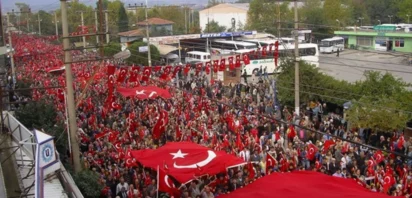
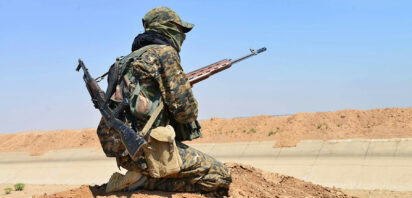
Kurdish groups in Syria and Türkiye have long been sympathetic to Ocalan’s ideology. The US-backed Syrian Democratic Forces (SDF) are mostly made up of militias affiliated with the YPG, or People’s Protection Units, who are ideologically aligned with Ocalan. Though officially separate organizations, the YPG maintained close links with the Kurdistan Workers’ Party in Türkiye prior to the latter’s dissolution in 2025, following a peace deal being reached with the Turkish government. In Türkiye, the current People’s Democratic Party (HDP) has its roots in a party founded in 2008 called the Peace and Democracy Party (BDP), which organized around Kurdish interests. Over time, the formation of the HDP, in coalition with other left-wing parties in the Labor and Freedom Alliance, saw Kurdish and other minority interests lumped together in a single bloc in the Turkish parliament.
Meanwhile, in Syria, following the fall of Bashar al-Assad in late 2024, Syrian Kurds have been active in attempting to create a more democratic Syria, though their status in a future Syria remains uncertain. Syrian Interim President Ahmed al-Sharaa has stated that he would welcome a deal with the Kurds, but distrust runs deep in both camps. Previous attempts to insert more pluralistic language into the interim constitution has been snubbed, and al-Sharaa’s Islamist lieutenants are unlikely to see eye to eye with the Syrian Kurds given their distinct ideological divisions and differing views on decentralization and federalization.
Iraqi Kurds
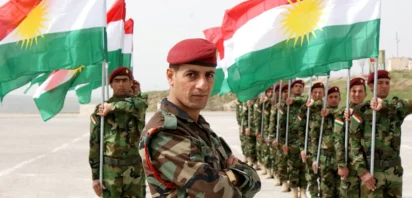
Unlike the Kurds of Syria and Türkiye, Iraqi Kurds were able to secure significant autonomy for themselves in the form of a centralized autonomous region within Iraq, the Kurdistan Regional Government (KRG), after the US invasion in 2003. The region has its own president, military, semi-democratic elections, and to a limited extent, foreign relations. And while major democracy indices like the Economist, V-Dem, or Freedom House don’t typically track Iraqi Kurdistan, there have been cases where the two major parties in the KRG, the Barzani-dominated KDP and the left-of-center PUK, have sometimes resorted to heavy-handed tactics against their rivals.
Nevertheless, there are seven parties that hold more than two seats in the KRG parliament. This includes the Liberal New Generation party and the Islamist Kurdistan Islamic Union, both groups that are not particularly ripe for the style of politics espoused by Ocalan.
Historically, the Iraqi Kurds fought for autonomy within the Kingdom of Iraq beginning in 1943 with a failed revolt by the Kurdish nationalist Mustafa Barzani. The mix of tribal allegiances and the nationalist tenure of Barzani’s revolt in Iraqi Kurdistan stands in sharp contrast to the democratic confederalist model espoused by many Turkish and Syrian Kurds.
Iranian Kurds
The situation regarding the Iranian Kurds largely mirrors that in Syria and Türkiye. The attempt of Tehran to “Persify” many of Iran’s ethnic minorities has not been lost on the Kurds living within its borders. Like their counterparts in Türkiye and Syria, groups like the PJAK and Komala share an affinity for Ocalan’s ideology.
The PJAK is by no means the only, or even dominant, Kurdish group fighting in Iran. Many Iranian Kurds have adopted the idea of a more autonomous Kurdish region, or the federalization of Iran. This largely has to do with their strategy of avoiding a larger backlash from the government or the ethnic Persian majority. It is also part of a wider strategy of building solidarity with other opposition groups active in Iran. By and large, despite the activities of nationalist groups, Iranian Kurds remain under tight political control in contrast to their neighbors in Syria, Iraq, and Türkiye.
Kurdish Statehood: A Perilous Path
The lack of contiguous territory in Kurdish-dominated regions poses a major challenge for prospective statehood. The KRG in Iraq, for example, does not govern the entirety of the country’s majority Kurdish regions. Pockets of Kurdish presence are scattered throughout eastern Türkiye. And many Kurds are no longer live in historically Kurdish areas, making their inclusion in a future Kurdish state challenging.
Furthermore, an independent Kurdistan would be landlocked, with its international trade needing to flow through its neighboring countries, which have historically been opposed to Kurdish independence and would likely lack goodwill toward the nascent state.
Maintaining a unified state across a diverse geography, from the mountains of Iran and Türkiye to the flatlands of Syria and the KRG, would be a challenge from a security standpoint. In combination with the divergent histories, political orientations, and tribal and regional differences, a “Greater Kurdistan” would likely face both demographic and geographic disunity.
This daunting outlook is compounded with a general lack of unified political will to create an independent state, indicating that a Kurdish state is highly unlikely to appear in the near future, at least outside of Iraqi Kurdistan. And even in the KRG, practical considerations and waning international support will prevent the creation of a limited Kurdish state, despite overwhelming support for independence in the 2017 referendum.
The views expressed in this article belong to the author(s) alone and do not necessarily reflect those of Geopoliticalmonitor.com.