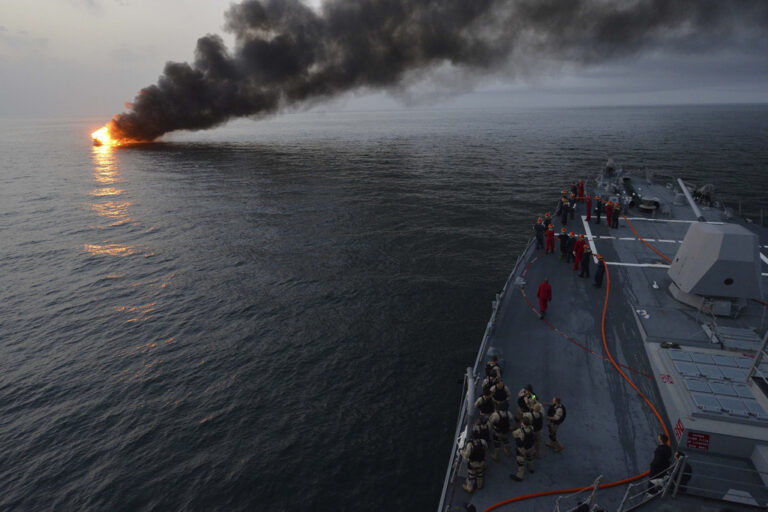

The extent of Iran’s asymmetric economic warfare could have significantly wider macroeconomic repercussions that will influence the outcomes of elections in countries directly involved in the conflict and beyond. The closure of the Strait of Hormuz only required some maritime mines and the use of a few cheap drones to scare both insurers and seafarers, bringing traffic to a halt. The result chokes about one-fifth of the world liquefied natural gas supplies and one-fourth of the world oil supplies. This is already leading to a global energy crunch that moves the war from the status of regional conflict to an international crisis. Brent crude oil reached $119 per barrel at one point in March. The conflict is also affecting world food prices because one-third of the world’s urea and other fertilizers transit through the Strait as well. With some energy and logistics infrastructure destroyed or damaged, going back to normal production and export levels will take a while even if the war were to end tomorrow.
It is easy to recognize that this will lead to a new surge in global inflation rates. The longer the war, the more entrenched that inflation will become. A Deloitte analysis was already projecting inflation to rise to 5.1% this year on the effects of the Trump tariff wars among other events in 2025. The compound effect with the blockade of Hormuz will clearly be more severe.
The macroeconomic turmoil of the war does not stop at higher prices. Curbing inflation requires that central banks increase interest rates in line with their mandates. However, higher interest rates stifle investments, reduce economic growth, and affect negatively the corporate and sovereign debt market. World fiscal deficits have cumulated to unprecedented levels, resulting in over $54 trillion of total sovereign debt worldwide in 2025 according to the OECD. While the interest on already issued debt might not get adjusted to the upcoming interest rate hikes, this would translate into higher debt refinancing costs. Nearly 40% of the outstanding debt of OECD countries alone are due to be refinanced in 2027.
Fallout at the Ballot Box
One needs to look only a little bit further down the road though to see that the economic effects of the war can also have serious political repercussions around the world and even swing elections. Economic turmoil is known to work in favor of the political extremes. A 2024 study by the Kiel Institute covering 365 elections found that both unexpectedly high inflation and weak economic growth significantly boost the electoral performance of extremist and populist parties.
The concept of economic voting also suggests that negative economic conditions weigh heavily against incumbent politicians because voters tend to hold them accountable for the country’s poor economic performance even in cases in which this might not be fully justified. The April 12 Hungary parliamentary elections could be a first case in point. While they might be taking place too soon for the full-fledged economic effects of the Iran war to be felt, the country has already had to impose a cap on pump prices. The polls were pointing towards the end of Victor Orban’s 15-year management of the country before the war started, with voters expressing a preference for Péter Magyar, president of Respect and Freedom (Tisza), based on early polling. This is in large part attributed to the sizeable economic decline of 2022 and 2023 and domestic inflation rates that are higher than the rest of Europe.
To sway things in their favor, incumbent governments frequently use budget deficits to engineer an election-timed economic boom, known as the political business cycle. So much so that the International Monetary Fund called explicitly for fiscal restraint in 2024 ahead the biggest-ever election year. In 2026-2027 incumbent governments will not have that fiscal leverage in their arsenal because of the expected higher borrowing costs and a fiscal space that will be constrained by the need to mitigate the reduced purchasing power of households amid high fuel and food prices.
Another ballot that will be obviously influenced by the US-Israel-Iran war is the upcoming October election for the Knesset. The composition of the next Israeli parliament and the faith of President Netanyahu clearly depend on the outcome of the Iran war. Many see the conflict not only as Netanyahu’s last chance of attacking Iran with the support of a US government and direct participation of the US military, but also as his only option to sway the domestic balance in his favor. Weighing against him are corruption scandals, the blame put on his government for ignoring the warning signals of the Hamas attack on October 7, 2023, and the controversy surrounding a conscription bill exempting the ultra-Orthodox.
However, it was the fiscal dimension that had threatened to put an end to his government even before the fall elections. Netanyahu entered his budget proposal in the Knesset more than two months after the legal deadline, amid fears it would not garner a coalition majority and only because he was ordered to comply by the Knesset’s legal counsel. His government and the Knesset itself would have dissolved automatically if the budget had not been adopted by end of March. The bill was approved at first reading at the end of January, and an updated war budget was approved only on March 20, with all other administrative hurdles and two additional readings cleared only 48 hours before the March 31 deadline. The government made numerous concessions in the name of ‘unity’ at a time of war to secure the vote.
The upcoming mid-term elections in the US would also be profoundly influenced by the outcome of Operation Epic Fury. So far, it has done nothing to salvage the President Trump’s plummeting public approval ratings. A protracted war would likely damage even further the Republican party’s chances to retain its parliamentary majority.
Even if Trump were to find a way to declare a swift US-Israeli victory in a convincing manner, the rising inflationary pressures from his tariff policy, now compounded by the energy crisis, will still significantly jeopardize his outlook for the November ballot. While relatively stable in February at around 2.4%, US inflation remains above the target of the Federal Reserve and precludes the central bank from reducing interest rates.
The president has been pressuring Federal Reserve Chair Jerome Powell to that effect with everything from orders on social media to an unprecedented federal criminal investigation. He needs interest rates to be lower to stimulate investments, which in turn could prevent the economic growth from declining significantly as result of his tariff wars. He also needs lower rates to decrease the government’s borrowing costs given that US debt has surpassed the $38 trillion. Cheaper borrowing could help avoid further government shutdown fiascos and more importantly – help refinance the $8–$10 trillion of marketable federal debt that comes due this year. Reducing the government borrowing costs is made nearly impossible by the economic effects of the war and this will jeopardize the US debt sustainability, but also Trump’s congressional support via the upcoming elections and, potentially, the entire legacy of his second presidency.
Beyond those directly involved in the war, over 40 other countries have elections scheduled for 2026 and many more are planned for 2027. There will be a new wave of politicians brought to power by economic voting in a high-inflation, low-growth, and high-interest environment, which will only worsen so long as the Strait of Hormuz remains blocked.
The views expressed in this article belong to the author(s) alone and do not necessarily reflect those of Geopoliticalmonitor.com.