Media headlines worldwide remain fixated on the Amazon rainforest.
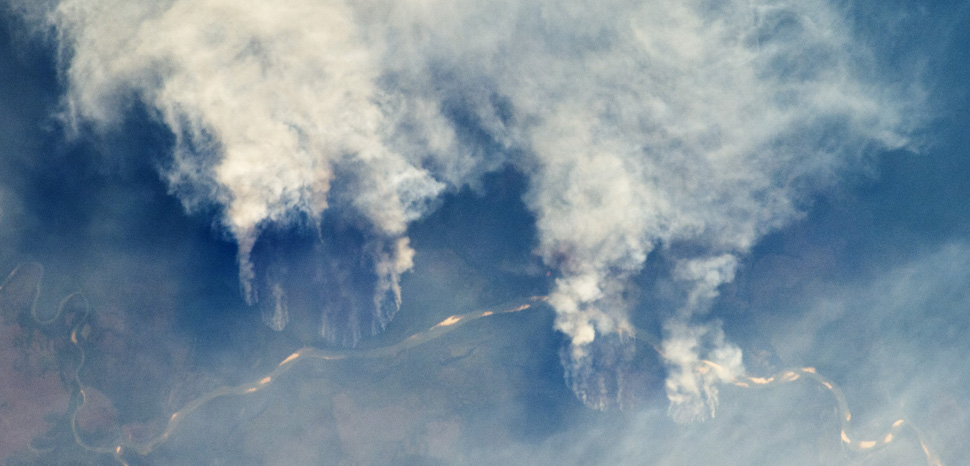
There’s the environmental and perhaps existential tragedy that’s currently unfolding, that of deforestation and wildfire ravaging one of the world’s most iconic biomes.
Then there’s the escalating war-of-words between two of the drama’s central players: France President Emmanuel Macron, who gave the Amazon forest fires and climate change central importance at the recent G-7 meeting at Biarritz, and Brazil President Jair Bolsonaro, who made ‘disrespectful’ comments about his French counterpart’s wife and ultimately rejected the G7’s offer of $20 million in Amazon aid, citing sovereignty concerns. With each tick of the news cycle, the feud escalates, with Bolsonaro now offering to reconsider the aid package if Macron apologizes for calling him a liar.
It’s a dust-up reminiscent of reality television; but far more consequential since these events will resonate in the global economy. In particular, Brazil’s woeful environmental policies are increasingly causing EU politicians and parties to rethink their recently agreed trade deal with Mercosur.
Analysis
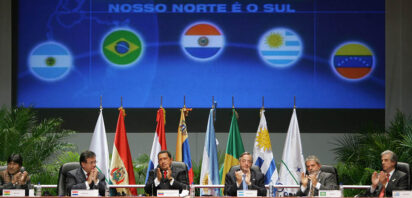
A landmark trade deal was reached earlier this year between the European Union and Mercosur, a Latin American regional grouping that includes Argentina, Brazil, Paraguay, Uruguay, Bolivia, and Venezuela (currently suspended). The agreement was a long time coming. It took 20 years of on-again off-again negotiations, and had to navigate protectionist minefields on both sides of the Atlantic en route to a final compromise. (Details on what the deal contains can be found in a situation report from earlier this year).
Yet no sooner was the deal announced than a backlash came from major EU unions, many of which complained of having to comply with onerous EU environmental regulations while competing against Mercosur producers operating under comparatively lax regimes. Deforestation in Brazil was also a key concern of environment-minded voting blocs.
The latest Amazon saga has put these issues into sharper relief, and in such a way that it seriously jeopardizes the chances for a successful passage of the Mercosur deal.