The United States and Canada have been intensifying their efforts to secure critical mineral supplies in an attempt to counterbalance Russia and China’s sweeping control over these crucial resources. The strategic push is aimed at bolstering US and Canadian defense, energy, and technology security amidst growing geopolitical tensions that threaten critical supply lines on multiple fronts.
The mining industry in both the United States and Canada has become increasingly active in lobbying efforts to secure favorable conditions for project development, particularly under recent critical minerals initiatives. In the United States, the passage of the Inflation Reduction Act has catalyzed a surge in lobbying activities by major and junior mining companies. The uptick in lobbying aims to accelerate both federal and state approvals for new mines, with a particular onus on bolstering production of minerals such as lithium, nickel, and cobalt. This effort however remains hamstrung to a certain degree by political tensions between environmental protection and expanded mining output, culminating in significant delays on domestic projects, which in some cases can wipe out as much as 1/3 of a mining project’s value, as per industry averages.
Last month, the U.S. established a Select Committee dedicated to critical minerals. Furthermore, Washington has leveraged the Mineral Security Partnership to encourage producers like Angola to diversify its exports beyond oil to include critical minerals and solar energy. On another front, Canada’s $3.8 billion CAD investment in its Critical Minerals Strategy directs more governmental support for research and development projects in the manufacturing, processing, and recycling of critical minerals. Other recent notable actions by the Canadian government include direct intervention in rare earth sales to China.
The 2024 Global Critical Minerals Outlook, published by the International Energy Agency, presents an insightful analysis of the rapidly evolving critical minerals market, crucial manufacturing inputs for the energy transition and dual-use technology. Amidst worsening relations between the West and China and Russia, the report highlights several key developments and trends that are shaping the future of critical minerals such as lithium, cobalt, and graphite, essential for renewable energy technologies and electric vehicles (EVs).
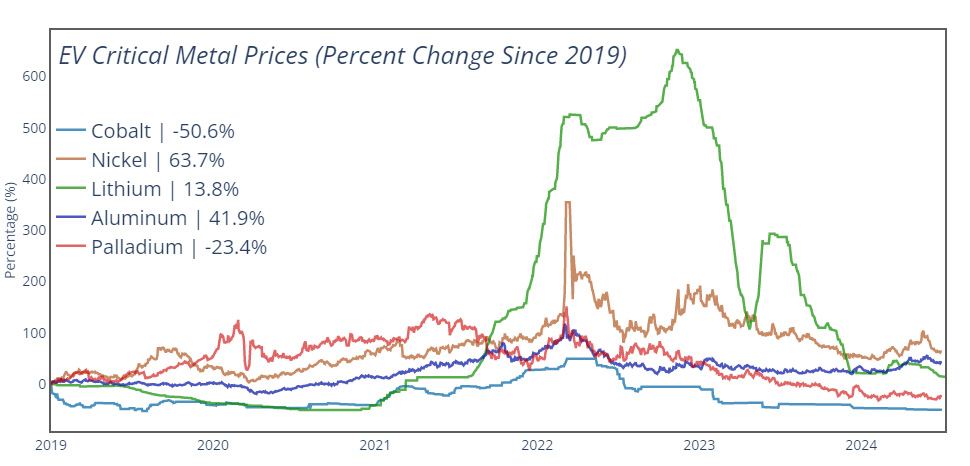
Significantly, the report notes a sharp decline in prices for critical minerals in 2023, reversing the steep increases seen in previous years. Lithium, for instance, saw a dramatic 75% drop in spot prices, while cobalt, nickel, and graphite experienced decreases between 30-45%. This price correction is largely attributed to a robust increase in supply, particularly from regions like Africa, Indonesia, and China, which has managed to outpace demand growth. Such adjustments are crucial for market stability and have profound implications for both producers and consumers globally.