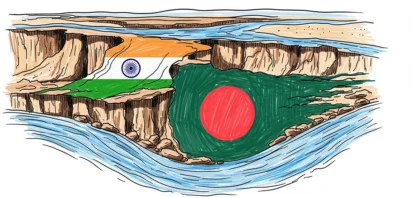
For over six decades, the Indus Waters Treaty (IWT) has stood as a rare beacon of cooperation between India and Pakistan, even as blood has spilled on battlefields. But today, pressure is mounting in New Delhi to break the dam of this 1960 agreement. A recent attack in Kashmir has resulted in the suspension of the IWT for the first time. The key question: Can India legally abrogate the IWT?
A Treaty with No Exit Clause
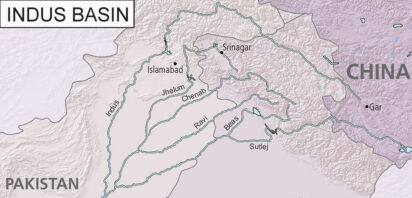
The Treaty, signed in 1960 under World Bank mediation, divides the Indus system’s waters between the two countries, granting Pakistan control over three western rivers. In return, India retained rights over the eastern rivers, albeit with significant restrictions. The IWT’s resilience stems in part from its deliberately rigid design. It was intended as a perpetual arrangement, with no built-in exit clause for either party. In fact, the treaty explicitly states it “shall continue in force until terminated by a duly ratified treaty concluded for that purpose” – meaning it can only end if India and Pakistan both sign a new pact to replace it.
Invoking International Law: How India Could Legally Justify Abrogation
Given the IWT’s lack of an explicit exit clause, any Indian move to abrogate or modify the treaty must rest on international law – chiefly, the Vienna Convention on the Law of Treaties (VCLT). India and Pakistan are not parties to the VCLT (which came into force in 1980), but many of its provisions are considered customary international law, providing guidance on treaty withdrawal. Article 56(1) of the VCLT addresses treaties that, like the IWT, have no termination or withdrawal clause. Article 56(2) mandates giving at least 12 months’ notice before withdrawal takes effect. Notably, in January 2023 India did formally notify Pakistan that it desired to “modify” the treaty – essentially a diplomatic notice, arguably in line with the spirit of Article 56 and 65’s requirements, that India was dissatisfied and intended to re-negotiate terms.
The two most relevant grounds here are “material breach” (Article 60) and “fundamental change of circumstances” (Article 62). Either could be invoked by India – albeit with significant caveats. A material breach means an outright repudiation of the treaty or violation of a provision essential to the treaty’s object and purpose. Pakistan’s broader hostile conduct – outside the water-sharing framework – has effectively undermined the spirit of cooperation that underpins the treaty.
Article 62 of the VCLT – the doctrine of rebus sic stantibus – allows a treaty to be terminated if there’s been an unforeseen fundamental change in circumstances that was an essential basis of the consent to be bound by the treaty, and that radically transforms the extent of obligations still to be performed. Here, India’s case is arguably stronger on substance if framed around environmental and practical changes rather than security issues. For instance, climate change has dramatically altered the hydrological reality of the Indus Basin in ways not imagined in 1960. The IWT was negotiated under assumptions of river flow patterns and water availability that six decades of population growth and climate shifts have upended. Under Article 62, India could claim that the “essential basis” of its consent in 1960 – stable river flows and a cooperative neighbour – no longer exists.
Lessons from Global Precedents: When Treaties Are Torn Up
History offers several precedents of treaties being scrapped – legally or otherwise – when they came to be seen as untenable or one-sided. The United States attempted withdrawal from the World Health Organization (WHO) in 2020. US lawyers pointed to Article 56 of the Vienna Convention on the Law of Treaties (VCLT)—the default rule for treaties that lack any exit clause. The 6 July 2020 notification set 6 July 2021 as the effective date—exactly the 12-month notice required by Article 56(2). Before the notice matured, President Biden (20 January 2021) formally rescinded the withdrawal. The example therefore shows the process in action even though the exit was ultimately reversed.
The Baghdad Pact (1955) – a Middle East defence treaty – had no explicit exit clause, yet Iraq successfully withdrew after a revolutionary regime change. Iraq’s exit was thus completed and recognized by the depositary and other parties, reflecting a fundamental change of circumstances (new republican regime hostile to the pact) – akin to invoking VCLT Article 62 (fundamental change of circumstances) to terminate a treaty that no longer aligned with the state’s core interests.
Egypt and the Soviet Union signed a Treaty of Friendship and Cooperation in 1971, a 15-year pact that lacked any early withdrawal clause. In March 1976, Sadat unilaterally abrogated the 1971 treaty – ten years early – citing Soviet breaches and the radically changed strategic context. Egypt’s action exemplified reliance on VCLT principles: it invoked material breach (VCLT Article 60) – accusing the USSR of not honoring its commitments – and a fundamental change of circumstances (Article 62) in Egypt’s orientation, to justify leaving a binding treaty with no exit clause.
Diplomatic and Strategic Fallout of Abrogation
Pakistan would almost certainly take India’s abrogation of the IWT to every international forum available: the United Nations, friendly capitals like Beijing and Turkye, perhaps even the International Court of Justice. While the effectiveness of such appeals is debatable (India could simply refuse to accept ICJ jurisdiction on this matter), the reputational costs for India could be significant.
From a strategic standpoint, abrogating the IWT opens up both opportunities and risks for India. On one hand, India would free itself to utilize the Indus waters as it sees fit. A desperate Pakistan might decide that a water cutoff is casus belli, prompting military confrontation.
International relations are governed not by sentiment but by the cold calculus of power, survival, and national interest. Under the Realist prism, treaties are instruments of convenience — binding only so long as they serve the vital needs of a nation. The treaty, once a symbol of resilience, increasingly resembles a strategic liability — constraining India’s ability to manage its own natural resources, defend its environmental security, and deter hostile provocations. India can lawfully and honorably move to abrogate the Indus Waters Treaty if needed. Such a decision would not be a betrayal of order, but a reassertion of the first principle of sovereignty: that agreements are tools of peace and prosperity, not chains of strategic helplessness.
The views expressed in this article belong to the authors alone and do not necessarily reflect those of Geopoliticalmonitor.com.