The Trump administration’s escalating confrontation with the International Criminal Court (ICC) represents a massive departure in normal state practice, although this should be seen as a shift in method rather than an entirely new position. Rather than accept this move by the Department of State as an act of Trumpian theatrics, it is more appropriate to understand both US grievances and the institutional consequences for international law, which could be grave.
First, previous American administrations have failed to ratify the Rome Statute, and governments under both parties have expressed discomfort at the notion of an international prosecutor reaching US nationals without consent. This has been a consistent position and has been contested under the argument that it strains the consent-based nature of international law. Bilateral immunity agreements and formal objections to jurisdiction over US personnel have been established well before the current administration’s objections to the ICC.
The recent move extends Trump’s grievances by showing that the United States is willing to take coercive action to prevent any intrusion of sovereignty. Beginning with a March 2020 decision by the ICC to investigate crimes alleged to have been committed in Afghanistan since May 2003 and actions against Israeli forces in Gaza, Trump moved to sanction ICC judges in February 2025 by Executive Order, including asset seizure and being barred from the US financial system. In an attempt to intimidate the ICC, judges faced abrupt credit cancellations and had bank accounts frozen.
A more defensible position for the administration would argue that the ICC invited this response by proceeding against officials of a close ally in an active, legally-contested conflict, where the Court should have recognize that its exercise of complementarity, a stipulation that it can only exercise jurisdiction when national legal systems fail or are unwilling to do so, was less than absolute. This was an argument that Israel was making, noting that it maintained an independent judiciary regardless of its foreign policy actions in Palestine.
But the US government’s new position makes any sympathetic course difficult as it was grossly self-serving. Trump pressured the ICC in December of last year to amend the Rome Statute so it could not investigate himself or senior US officials, as they may have broken international law in actions against Venezuelan drug boats. This action is tantamount to hypocrisy, as it moves away from the traditional legal argument that a non-party state cannot be bound by the Rome Statute and makes known rational fears that Trump, while still in office, is moving to protect himself from a jurisdiction his government legally did not believe existed.
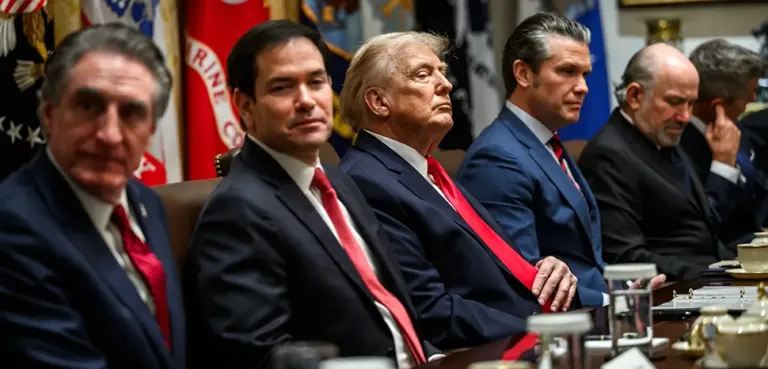
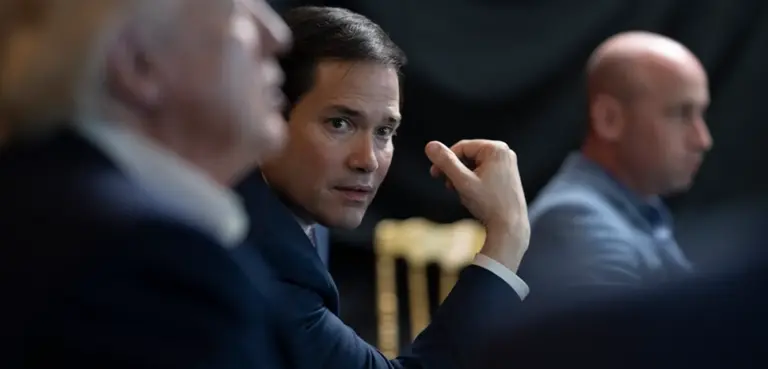
The new policy, announced by Secretary of State Marco Rubio, widens the war to a ”whole-of-government” effort to disable the ICC’s capacity, characterizing it as an “unaccountable global arbiter” or a supranational authority above that of any nation state. Rubio noted that the ICC’s conduct was a form of warfare waged through “so-called international law” and expanded the sanctions regime to include new ICC officials and UN experts in asset freezes and blacklist mechanisms. In short, this a radically different method, as it does not seek to condemn the ICC through rhetoric, but frames it as a grave threat and seeks its elimination “brick by brick.”
President Trump’s new war on the ICC also makes an appeal to states that are reliant on security cooperation with the US to undermine the Court’s authority, giving skeptical African countries rhetorical ammunition, although this only makes the claim against complementarity weaker as many ICC cases were self-referrals. More troubling for international law is the message that Trump sends to the international community, that powerful states can and will shield themselves from international law and when cornered, will use coercive means to defend themselves from accountability. This weakens US credibility on future topics of concern, such as in Myanmar, Ukraine, and Xinjiang, which remain largely beyond the ICC’s reach.
This new coercive campaign increases international tension and undermines the rules-based international order in ways not seen in living memory. It is a leap from principled non-participation to an explicit call for the real-world destruction of a contemporary pillar of international law. Trump is counting on bending international rules of conduct to his liking and counting on a lack of international resolve to defend the Court’s existence.
The views and opinions expressed in this article are those of the author alone and do not represent those of Geopoliticalmonitor.com