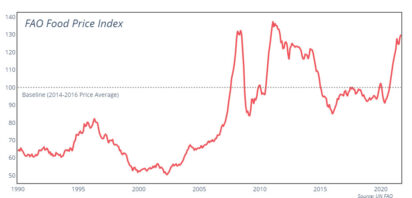
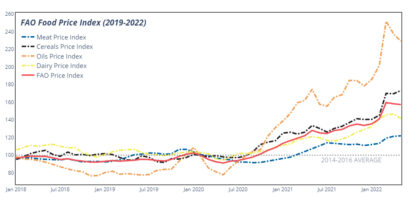
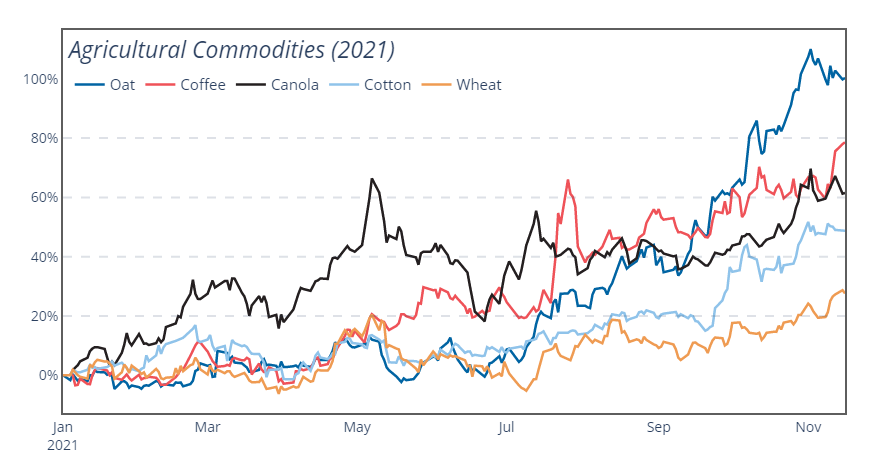
 The past year has seen price increases across a wide range of inputs as major economies unleash COVID-related fiscal stimulus and global supply chains reach their breaking point. Agricultural commodities are no exception. In fact, the UN Food and Agriculture Organization (FAO) price index hit a decade high earlier in the year, evoking fears of a two-pronged crisis of COVID and hunger in the developing world. Five outputs have led the way in price increases are oats, coffee, canola, cotton, and wheat.
Analysis
Oats have led the way in yearly price increases, touching triple-digit percentage increases in November. The global oats industry accounts for some $7.4 billion in global sales every year. It stands as a rare example of an export that actually expanded its global sales during the pandemic, as 2020 numbers reflected a small year-on-year increase in global exports. Canada is far and away the largest global producer of oats, accounting for some 54 percent of global exports.
It is this expanding demand, driven primarily by health-conscious consumers, that is setting oats apart vis-à-vis other agricultural commodities in terms of price gains over 2021. Supply-side issues have also blighted production throughout the year, stemming in large part from poor weather. Canada’s yield was down as high as 33 percent year-on-year, and a similar story played out in the United States as well. Prices are expected to remain elevated through 2022.
Wheat producers have encountered similar problems over the course of 2021, and though the resulting price increases pale in comparison to oats, this is a staple crop that is far more consequential in terms of generating hunger and potential geopolitical conflict. The wheat crop in Canada – the world’s fifth-largest producer – shrunk to a 14-year low on record-high temperatures. All told the harvest was down 35% year-on-year. Hot weather and below-normal precipitation in wheat-growing regions is also eroding forecasts of Russian wheat exports, which are projected to come in somewhere around five-year lows for 2021-2022.