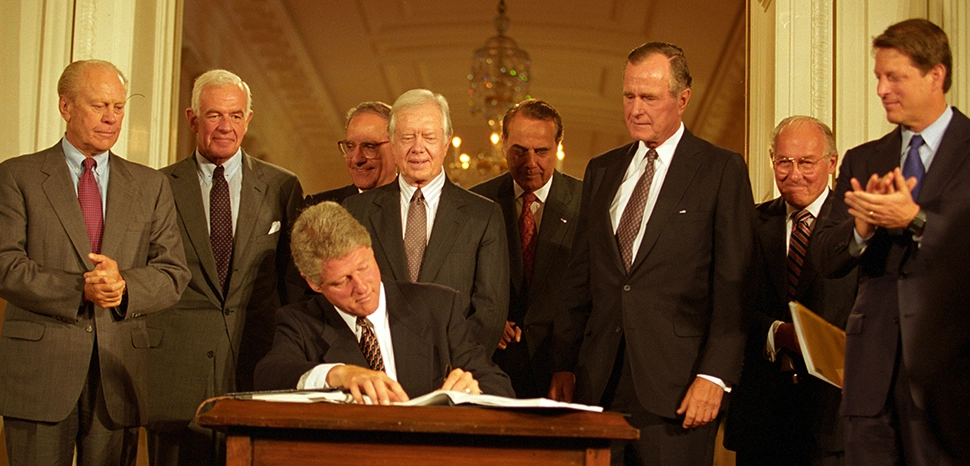
Unlike the Bretton Woods regime, which was heavily underpinned by Cold War politico-strategic and security rationales, the original North American Free Trade Agreement (NAFTA) was mostly a mercantile-centric frame. Masterminded by technocratic policymakers as a trilateral system of regional economic governance, NAFTA intended to encourage the proliferation of commercial exchanges on a win-win basis. Through free trade, shared prosperity would be nourished by the contribution of American, Canadian and Mexican comparative advantages. The bloc had a formidable pool of investments, high-tech, agricultural resources, industrial manufacturing capacity, energy and all sorts of natural resources. Joining forces was seen in Washington, Ottawa, and Mexico City as a wise trilateral strategy to compete, with advanced economies like Japan and reunified Germany, over the peaceful conquest of international markets.
Although NAFTA never purported to further European-style integration, the establishment of this trade bloc multiplied the volume of mutually beneficial economic exchanges. NAFTA facilitated the rise of dense logistic networks, cross-border supply chains and large-scale industrial clusters focused on the production of cars, spare parts, electronics, textiles, metallurgical outputs and even defense components. Thanks to a preferential access to the US consumer market, lower costs and the advantages conferred by geographic contiguity, Mexico became a magnetic investment hub that attracted US, Canadian, Spanish, Japanese and German FDI flows. Foreign companies built factories in Mexico so that their goods could be exported to the US. In parallel, as a byproduct of the removal of trade barriers and the growth of commerce, the circulation of illicit flows —drugs, firearms, cash, people— thrived on an unprecedented scale. Back then, this was seen as a negative externality that could be contained.
The spillovers were leveraged by Mexico to bolster productivity, efficiency and job creation. The Mexican political élite, inspired by the creed of the so-called “Davos men,” expected that the distribution of these benefits would help remake the country as a “first-world nation” with a full-fledged liberal democracy and a free market developed economy. NAFTA supporters —including government officials, business leaders, scholars and think tank experts— wanted to deepen and broaden the project’s threshold, even if that meant eroding sovereignty. The late Robert Pastor, former member of the US National Security Council, designed a far-reaching roadmap to build a North American Union. The spirit of these proposals was reflected in the ephemeral Security and Prosperity Partnership of North America (SPP) and the inclusion of both Mexico and Canada to the USNORTHCOM area of responsibility. The take-off of NAFTA triggered a major shift in Mexican grand strategy. As geopolitical thinker Parag Khanna notes, by entering the US gravitational orbit in exchange for commercial rewards, Mexico ultimately abdicated third world activism and previous diplomatic pretensions to lead a league of independent Latin American states.
The 2020 renewal of NAFTA, rebranded as USMCA, was not the ‘great leap forward’ that many expected. Nevertheless, in an environment in which free markets were being displaced by ‘trade wars’, protectionist tariffs, techno-industrial strategic competition, resurgent great power rivalries and economic nationalism, Mexico and Canada managed to preserve their privileged access to the US consumer market. Despite the staunch skepticism of the first Trump Administration and the intent of the MAGA movement to roll back this agreement, the US side got advantages in matters such as rules of origin, the exclusion of trade deals with “nonmarket economies”, labor policies, regional contents and a “sunset clause” that ensures cyclical readjustments in which junior partners can be easily overpowered. Mainstream American analysts described this unbalanced approach as “neo-imperial” because it sought to re-organize the economic structures of both Mexico and Canada to satisfy necessities of US economic statecraft. Contrary to the theories of neoclassical economics about trade as an apolitical source of wealth for everyone, these facts on the ground confirm that markets behave as an arena to pursue relative gains. The bitter truth is that ploughshares can be turned into swords.
The second Trump White House had embraced an even more hawkish neo-mercantilist approach. Amid the normalization of intermittent tariffs, Washington’s asymmetric weaponization of complex interdependence, and Trump’s threats to get rid of NAFTA/USMCA and tense trade negotiations, the twilight of NAFTA/USMCA is approaching. This trajectory has been met with disbelief. Economists, journalists and scholars argue that, from the perspective of the US national interest, the economic costs of dismantling economic exchanges would be superior to the benefits. Although their assessment is not numerically unwarranted, such an impression overlooks that integration is not irreversible and that, as Adam Smith himself taught, national security matters more than opulence. Furthermore, whereas the termination of the agreement would bring major challenges for Mexico and Canada, the US could get away with it in case Trump decides to pull the trigger. Exports represent 11.1% of the American GDP. The proportion is way higher in the cases of Canada (29.1%) and Mexico (36.7%). For MAGAnomics, it makes more sense to concentrate the high-value industrial activities of US firms on US soil than to share them with neighboring economies.
Trump’s attitude has been attributed to electoral calculations, rhetorical hyperbole, bluffing and ‘art of the deal’ psychological attrition tactics to exact transactional benefits. While these ‘benign’ working hypotheses are not entirely meritless (especially considering Trump’s penchant for kabuki theatrics), the White House may yet cross the Rubicon. NAFTA/USMCA is already on life support. Eurasia Group points out that NAFTA/USMCA is neither alive nor dead, remaining in a liminal zombie-like state. Conventional wisdom indicates that an abrupt unilateral “clean break” is deemed unlikely, as it would violate the contractual provisions of the agreement. Still, since power relations and not rules or money are the currency of today’s world order, disregarding USMCA’s provisions would suffice for its premature burial. As Schmittian political thinking teaches, sovereignty belongs to those with the de facto power to decide upon exceptions, not to those that invoke abstract legal rules that cannot be materially enforced. The US may not even need to pull the plug; involution or degradation would deliver a similar outcome, but with the courtesy of face-saving niceties.
A Shifting North American Political Economy
While the US can afford to burn commercial bridges and walk away, Mexico and Canada cannot. This asymmetry means that the US has the power to remake the North American trade bloc. For strategic, political and economic reasons, the Trump administration is staunchly committed to both the reversion of existing trade deficits and the industrial revitalization of the American heartland. However, both Mexico and Canada are assets that can strengthen the US position in techno-industrial strategic competition with China. US business chambers have a vested interest in the continuation of commercial ties. If negotiations move forward, the likeliest architecture would be a US-led geoeconomic Grossraum underpinned by the securitization of strategic-grade industrial supply chains, customs enforcement mechanisms, the proliferation of ‘nearshoring’ projects, discretional tariffs, compliance oversight, the suppression of Chinese investments, the adoption of external trade policies and unimpeded access to Canadian and Mexican minerals and fossil fuels. With the absorption of Mexico and Canada to the geoeconomic perimeter of US national security, this self-reliant North American fortress would be the mercantile equivalent of NORAD. The fate of NAFTA/USMCA is thus entwined with the US pursuit of regional hegemonic control over the American hemisphere.
Mexican policymakers and the country’s corporate elite welcome this prospect as the lesser of many evils. Under the umbrella of the so-called ‘Mexico Plan,’ the expectation is to harness this in-depth shift as a developmental lever of industrial policy to pursue a higher level of economic complexity. With this upgrade and the injection of US ‘nearshoring’ capital, the Mexican economy may transition towards a scalable platform for the manufacture of advanced industrial goods, the production of contents with an incremental added value, the establishment of data centers, and the generation of solar energy. As an aspiring appendix that would help the US ‘decouple’ from China and other Asian economies, Mexican economic statecraft intends to blend export-led growth and import-substitution. A great deal of political capital and money have been invested in an intensive lobbying campaign and the modernization of infrastructure to position Mexico as an attractive partner worth doing business with. Mexico would face a major challenge if NAFTA/USMCA —the engine of the country’s economic dynamism— remains “undead.” An emerging long-term diversification of economic exchanges with other partners (including Europe, China, India, Russia and Brazil) is theoretically possible, but their potential as consumers of Mexican exports is limited due to economic costs, political obstacles, and poor complementariness.
Canada, despite being a developed economy with prosperous primary and industrial sectors, is also in feeble position due to a geoeconomic profile shaped by challenging logistics, cold temperatures, vast distances and the lack of navigable rivers to export agricultural surpluses. Most Canadian provinces trade more with US partners than with each other. To compensate these vulnerabilities and maximize the margin of Ottawa’s bargaining power, the Canadian government has adopted a more defiant and assertive stance that contrasts with Mexico’s conciliatory acquiescence. Canada can afford to play this card because, unlike Mexico, the Americans cannot threaten Ottawa with the targeted disruption of food exports, remittances, and energy supplies. This attitude is reflected in the implementation of counter-tariffs and mercantile-centric overtures to China, the European Union and Mexico. Canada is interested in the extension of NAFTA/USMCA’ shelf life, but first it wants to secure a position of strength. Canada and Mexico have incentives to join forces at the negotiating table and engage together an aggressive neighbor. To prevent the emergence of this tactical alliance, the US may respond with the partition of the trilateral trade format into two watered-down bilateral rails.
Deepening Tensions with Mexico and Canada
The ongoing renegotiation of USMCA/NAFTA is tense due to unresolved commercial disputes. American tariffs and Mexican nationalist energy, agricultural and resource management policies are contrary to both the letter and the spirit of the agreement. In their own right, these controversies are cumbersome, but perhaps mutually acceptable solutions could be formulated through compartmentalized negotiations. The problem is that these talks are transversally influenced by plenty of diplomatic standoffs, related to migration, cross-border water resources, ideological discrepancies, hemispheric affairs, fuel contraband schemes, and even the screwworm crisis. Yet, the biggest dealbreaker is tied to diverging security policies and politico-strategic considerations in the context of the “North American Drug War.”
Despite the reactivation of military, law enforcement and intelligence collaboration between the ‘deep states’ of both countries, the US demands more punitive measures against large-scale criminal networks and their high-ranking political accomplices. After the re-classification of fentanyl as a weapon of mass destruction and the designation of Mexican cartels as “foreign terrorist organizations,” the spectre of an overt unilateral US intervention is haunting Mexico. Drone strikes, targeted assassinations or even boots on the ground would be the next operational frontier of an incremental trajectory now featuring covert operations and the escalation of ‘lawfare.’ Even the use of dilatory tactics, contradictory statements, strategic tariffs and the weaponization of unpredictability in bilateral trade talks could be interpreted as low-key economic warfare.
Under the Trumpian Damocles’ sword and besieged by the political blackmail of hardliners willing to sabotage an accommodation with the US, the Mexican government is scrambling to avert this possibility. For sure, the Mexican security crisis —involving Africa-like ‘warlordism’, irregular warfare waged by nonstate actors, the partial degradation of Westphalian territorial sovereignty, systemic corruption and rampant economic predation— worsens the unchecked proliferation of an anarchic witches’ brew. An American kinetic campaign in Mexico, based on the instructive lessons learned from Iraq and Afghanistan, may add fuel to the fire, introduce unforeseen variables in the equation or even backfire. For the US national interest, a hostile Mexico can be managed or defanged and even some disorder is exploitable to pursue relative gains, but a chaotic minefield across the border brings more risks than benefits. The geopolitical topology of Mexico’s hinterland discourages high-intensity expeditionary warfare, prolonged foreign occupations, and pacification.
Disregarding bellicose narratives on both sides of the Rio Grande, there are domestic political incentives that discourage détente. After a messy exit from the West Asian theatre of engagement, Trump and his “fellow travelers” have incentives to score a quick spectacular victory that can bolster the GOP’s popularity in mid-term elections. In turn, from the perspective of the Mexican government, accepting some US assistance to surgically checkmate troublesome internal rivals as a matter of political expediency is one thing, but it is in no position to accept unilateral military solutions that may irreversibly damage the stability and legitimacy of the Mexican political system. Although pragmatic, the Mexican leadership has not forgotten the consequences of preceding interventions, including the 1848 war in which the country lost half of its territory and the Mexican Revolution (in which competing American, British, French and German strategic mercantile interests contributed to a Syria-like civil war).
Despite Canadian membership in US-led partnerships such as NAFTA/USMCA, NATO and the Five Eyes, there is no shortage of bilateral contentious issues. Aside from ideological antagonism, the Trump administration has half-jokingly threatened Canada’s national sovereignty and territorial integrity with proposals of Anschluss and MAGA’s support for separatism in Alberta. As a response to these “red flags,” PM Mark Carney is exploring a grand strategy intended to position Canada as a middle power committed to a higher degree of self-reliance, diversified partnerships, strategic autonomy and multilateralism with like-minded states. Trump’s unfriendly attempts to downgrade Canada as “the 51st state” have reawakened Canadian nationalism.
Toward a Coalition Course?
Liberal thinkers like Immanuel Kant, Norman Angell and Francis Fukuyama have argued that free trade promotes peaceful intercourse. The attractiveness of profits, the argument goes, makes war irrational and inconvenient. Yet, such an assumption is not backed by historical experience or empirical reality. Vast economic exchanges between Great Britain, Germany, and France did not prevent WW1. As Kenneth Waltz points out, the dynamic interactional closeness that comes with complex interdependence increases the likelihood of disputes. Since it is more asymmetric than symmetric, in a zero-sum and power-based order, interconnectedness creates politico-strategic opportunities for weaponization, disruption, coercion, subordination and conquest. Commerce does not erase the “concept of the political,” understood as the collective existential distinction between friends and enemies. Carl Schmitt himself noted that, while trading with an enemy may be profitable for both sides, this does not overcome enmity. The fate of those that forget what the concept of the political is all about is to be crushed by those that have not. Despite the fact that Mexico is now the top US economic partner in both exports and imports, a Schmittian image is emerging in both major political forums and pop culture. While in France for the G7 Summit, Trump reinforced the narrative of Mexico as a cartel-run state. Former US Attorney General Pam Bondi portrayed Mexico as a “foreign adversary” just like Russia, China and Iran. Productions like Sicario and Lioness depict Mexico as a dangerous source of lawlessness, criminal gangs, illegal immigrants and drugs.
Both Mexican and US thinkers and policymakers have shown awareness about the possibility of a confrontation. When Mexico became independent as a short-lived monarchic state, the US was identified as a strategic menace for the imperial consolidation of “Mexican America.” In the 19th century, Lucas Alamán, a conservative Mexican statesman and diplomat often compared to the Austrian Prince Klemens Von Mettermich, foresaw that the quasi-imperial continental expansion of US geopolitical and economic power would threaten Mexican national security. As countermeasures to keep in check the “northern menace” and ensure independence, Alamán prescribed a partnership with Great Britain, industrialization, European investments, and an alliance with fellow Hispanic states. Alamán’s prescience was also based on the view of an Anglo-Protestant modern republic and an heir of the Spanish-Catholic monarchic tradition as inherently adversarial civilizational polities destined to fight.
Samuel Huntington, an intellectual prophet of the Trump era, pointed out a similar argument in the early 21st century. According to Huntington, the large-scale persistent arrival of Mexican immigrants to the US may lead to the bifurcation of the country for several reasons that set them apart from other emigre communities such as Italians, Jews, and Irishmen. Huntington explained that their full-fledged assimilation into the Anglo-Protestant mainstream is comparatively more difficult due to incompatible territorial claims, historical animosities, the rise of Hispanic enclaves in places like California and Texas and geographical closeness to their original hometowns. Huntington believed that these increasing tensions would hasten separatism and the dilution of a cohesive national identity.
There are also recent predictions about the prospect of war between Mexico and the US. In The Next War, Caspar Weinberger, former Secretary of Defense, discusses the possibility. The scenario Weinberger portrays involves a US ground invasion to overthrow a hardcore left-wing regime whose policies create a humanitarian disaster in close proximity to the US border. Weinberger anticipates that US troops would successfully contain the flood of refugees and achieve regime change. George Friedman’s strategic forecasts go further. Friedman argues that the progression of trends like a changing demographic balance in the borderland area, the mobilization of Hispanic insurgent militias in the US, and Mexico’s and economic hierarchical upgrade (fueled by both economic exchanges with the US and money laundering) will alter the bilateral correlation of forces. Despite the lack of conventional military parity, the revisionist challenge of Mexico as an emerging power and US strategic anxieties will collide. Friedman foresees a Thucydidean scenario in which the rise of Mexico and the fear that this will instill in Washington will make the war inevitable. In this conflict, likely to attract the involvement of extra-regional great powers, hegemonic control over North America will be at stake. Friedman situates this scenario in the late 21st century, but it looks like existing trends and the Zeitgeist of world history are propelling accelerationism. The US and Mexico may not want war, but war may be interested in them and perhaps the gloves may come off sooner than expected. The force of commerce cannot transcend the political.
The views and opinions expressed in this article are those of the author alone and do not represent those of Geopoliticalmonitor.com