In October 2025, Myanmar’s military staged a raid on KK Park, a compound on the Thai border where thousands of people from dozens of countries had been trafficked and forced to run crypto fraud, romance scams, and fake investment schemes under threat of violence. Then, soldiers posed for photographs while state media ran five pages of coverage. Operations on the ground, according to local sources, continued without significant disruption.
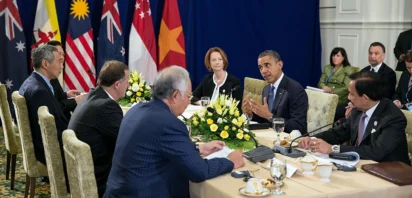
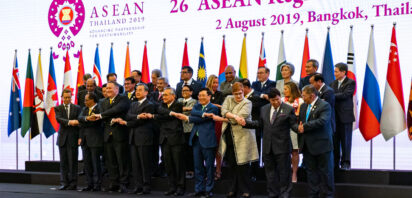
The timing coincided with an ASEAN summit.
A February 2026 report by the UN Office of the High Commissioner for Human Rights estimates global annual revenues from Southeast Asia’s scam compound networks at approximately $64 billion. The Mekong region alone accounts for $43.8 billion of that. 74% of documented compounds are concentrated there, with at least 300,000 people from 66 countries being forced to work inside them. Yet, these sites are not hidden and appear on satellite imagery. Their operators have been sanctioned by Western governments and locations are documented in UN reports. These networks persist not because governments are unaware, but because ASEAN’s institutional design limits collective action.
The Non-Interference Constraint
ASEAN’s non-interference principle holds that member states do not comment on, criticize, or intervene in each other’s domestic affairs. It was developed in a post-colonial era where the primary concern was external meddling – strong states pressuring weaker ones under cover of principle. As a tool for managing intra-bloc relations, it has served ASEAN’s cohesion for decades. Applied to transnational criminal networks, however, the principle has had the effect of limiting the collective accountability mechanisms that coordinated enforcement would require.
Take Myanmar as an example. KK Park and the Myawaddy compound cluster operate under the protection of the Karen Border Guard Force, whose leader received an honorary title from junta chief Min Aung Hlaing in January 2023. The October 2025 raid was reportedly coordinated with BGF leadership in advance. After the raid, scam operations continued. Without a mechanism to verify enforcement claims, performances of compliance function as workable substitutes for actual enforcement within ASEAN’s diplomatic framework, and the non-interference norm provides no tool to challenge them.
Laos is more instructive still. The Golden Triangle Special Economic Zone is run by Zhao Wei, sanctioned by the US Treasury since 2018 for drug trafficking, human trafficking, and money laundering. The Lao state holds a 20 percent equity stake in the zone and even local police reportedly require permission to enter. In 2024, when the zone remained under active US sanctions, the Lao government awarded Zhao a national development medal. Yet, no ASEAN member has formally raised these issues within ASEAN institutional channels.
In Cambodia, Amnesty International and UNODC have documented persistent failures to act against compound operators, alongside allegations of official protection. Yet, the response from other member states, again, is silence.
Geographic Arbitrage
What the non-interference framework produces, in practice, is a region where enforcement pressure in one jurisdiction simply pushes compound networks into the next. Call it geographic arbitrage – the systematic exploitation of jurisdictional gaps that non-interference, by design, prevents from being closed.
When Thailand cut power and internet to the Myawaddy area in early 2025, KK Park workers reconnected through Starlink. After the October 2025 raid, thousands of displaced workers moved to other compounds within days and Telegram channels filled immediately with recruitment posts. When Laos raided the GTSEZ in 2024, operators reportedly received three weeks’ advance notice. When Cambodia shuttered operations in January 2026, workers were released onto the streets of Phnom Penh with no documentation, no money, and no consular access.
There is an economic dimension here that tends to get overlooked. The OHCHR’s 2026 report documents that scam profits are systematically laundered through proxy bank accounts and cryptocurrency channels before re-entering formal banking systems. For Vietnam and Thailand in particular, the persistence of underground banking networks tied to these operations presents a real risk of Financial Action Task Force grey-listing, including higher cost of capital, constrained correspondent banking, and damaged investment credibility. ASEAN has no cross-border investigation mechanism, no shared intelligence framework, no mutual legal assistance treaty that is updated for the digital age.
China Steps In
In the absence of effective ASEAN-level coordination, enforcement capacity in parts of the Mekong has increasingly been shaped by Chinese-led ones.
China’s Lancang-Mekong Integrated Law Enforcement and Security Cooperation Center (LMLECC) has produced documented results through joint enforcement operations, including Operation SEAGULL. Beijing moved after high-profile trafficking cases involving Chinese nationals generated domestic political pressure. Its engagement has proceeded through extraterritorial operations on Thai soil that reportedly strained Sino-Thai relations and raised sovereignty concerns across the bloc. Criminal proceedings were led by Chinese authorities and Mekong countries had limited access to intelligence or judicial processes throughout.
The pattern that emerges from this is that China’s enforcement engagement, while operationally effective where Chinese nationals are the primary victims, also functions as an instrument of security influence projection in the subregion. ASEAN’s institutional constraints have left a vacuum, and a more operationally capable external actor has moved to fill it on its own terms. ASEAN Centrality – the principle that the bloc, not external powers, should serve as the primary architect of regional security – is being eroded in practice through the demonstrated effectiveness of an alternative.
What Change Requires
Addressing the governance gap would likely require ASEAN member states to accept political and institutional costs the current consensus does not support: acceding to the Budapest Convention on Cybercrime, updating the 2004 Mutual Legal Assistance Treaty for the digital age, and building a permanent cross-border enforcement mechanism. Each represents a meaningful departure from the ASEAN Way – an acknowledgement that in a digital threat environment, the assumption that sovereignty and regional security can be kept entirely separate no longer holds.
Malaysia’s 2025 chairmanship pushed in this direction, signaling greater pragmatism on Myanmar engagement and calling for stronger collective action on scam networks. The structural consensus for institutional reform did not follow. Absent that reform, the likely trajectory involves continued displacement of compound networks through bilateral and Chinese-led actions, deepening Chinese security influence in mainland Southeast Asia, and a slow erosion of the credibility ASEAN has built as a regional security actor — not through a single failure, but through an accumulation of problems it was structurally unable to address.