With the expected arrival of the aircraft carrier USS Abraham Lincoln and its carrier strike group to the US Central Command’s area of responsibility within a few days, combined with the reinforcement of US airpower in Jordan and intensified logistical activity at Diego Garcia, it is clear that a meaningful inflection point in Washington’s military posture toward the Middle East is taking place. The deployment moves toward operational readiness for a wide spectrum of contingencies, many of which imply escalation. It is more than just routine force rotation or simple deterrence signaling.
Over the past decade, the US military presence in the Middle East has been calibrated to manage risk, avoid entanglement, and leverage its presence for deterrence rather than sustained operations. What we are now observing is a recalibration where the US is positioning itself to preserve freedom of action under deteriorating regional conditions triggered by the unfolding events in Iran.
Carrier Strike Group: More than Just a Symbol
Carrier strike groups have long served as key instruments of US power projection, but in current circumstances, context matters. The redeployment of a full strike group from the Indo-Pacific, at a time when strategic competition with China remains a top US priority, signals that the US assesses the Middle East risk environment as sufficiently serious to justify opportunity costs elsewhere.
The operational value of an aircraft carrier in this scenario lies in its flexibility. Carrier-based aviation provides the US with an independent as well as a sovereign airbase capable of sustained strike operations without relying on host nations’ permissions or the political constraints associated with land bases in the GCC. This aspect matters in an environment where political timelines are compressed, and escalation pathways are uncertain. More importantly, the presence of a carrier strike group dramatically shortens the transition time from decision to execution. Should Washington choose to act, whether in response to an attack on US forces in the region, an escalation involving allies, or a perceived imminent threat, it can do so with minimal preparatory signaling.
The Quiet Center of Gravity: Jordan
The reinforcement of US airpower in Jordan, with 12 additional F-15 fighter jets, is possibly the most operationally revealing component of the current posture. Besides being one of the closest allies to the U.S. in the region, Jordan occupies a unique strategic position where it offers access to Syria, Iraq, and the broader Levant while remaining geographically insulated from maritime chokepoints and some missile threat vectors. The choice of the F-15 is also not incidental. This jet specifically is optimized for air superiority and long-range precision strikes, making it suitable for contested air environments rather than permissive counterterrorism operations. Its deployment suggests preparation for scenarios involving advanced air defenses and state-level adversaries.
Strategically, Jordan serves as a forward but politically stable launchpad, one that allows the U.S. to maintain operational reach while reducing dependency on GCC bases, which are increasingly vulnerable to missile and drone threats from Iran and its regional proxies, notably the Houthis in Yemen. That said, it is obvious that Washington is diversifying its angles of operations in anticipation of more complex engagements in the region.
Diego Garcia: Logistics of Serious Intent
Aircraft carrier deployments and fighter reinforcements are visible signals; however, Diego Garcia represents the hidden infrastructure of intent. Heavy cargo aircraft movements to the base are rarely associated with short-term or symbolic operations. Instead, they point to stockpiling, sustainment planning, and preparation for long-duration missions.
Historically, Diego Garcia has played a central role in the US operations requiring strategic bombers, long-range strike capabilities, and deep logistics support, from the Gulf War to Afghanistan. Its activation typically correlates with planning that extends beyond limited punitive strikes.
In the wake of the developing events in Iran, Diego Garcia provides the U.S. with a set of options that includes strategic bombing, long-range missile employment, and sustained operational tempo without immediate exposure to Iranian retaliation. Its use underscores that US planners are considering scenarios that require endurance, not just immediacy.
From Deterrence to Credible Escalation
This all suggests a shift from deterrence based on signaling to deterrence backed by credible escalation capability. The distinction matters: where symbolic deterrence relies on adversaries believing that the U.S. might act, credible deterrence relies on adversaries believing that it is ready to act.
This emerging posture directly challenges the core assumptions of Iran, which has operated for the past few decades under the belief that the U.S. is reluctant to escalate, risk regional war, or absorb political costs. In the Middle East’s environment, Iran has mainly thrived on regional proxy warfare, calibrated attacks, and incremental escalation. However, it is apparent that the current US posture aims to disrupt that calculus. In parallel, the new US posture creates pressure on regional state actors who may not be directly involved in day-to-day proxy actions but are ultimately responsible for enabling or tolerating them.
Reassurance, Alignments, and the Risk of Miscalculation
For US allies and partners, particularly Israel, Jordan, and the GCC states, the posture shift serves also as a reassurance factor where it signals that the US remains committed to regional security and is prepared to underwrite that commitment with assets, not just political statements. This reassurance has secondary effects where it also strengthens allied confidence in integrated air and missile defense architectures, improves the dynamics of intelligence-sharing, and reduces incentives for unilateral or preemptive actions by regional partners who might otherwise feel compelled to politically act alone. In this sense, US readiness acts as a stabilizer for allies, even as it raises anxiety for Iran.
However, military readiness has reciprocal effects. Enhanced US posture increases deterrence, but it also raises the risk of misinterpretation. Iran may view these deployments as preparatory steps for a preemptive strike rather than defensive positioning. That perception could drive the accelerated readiness of the IRGC and the dispersal of missile assets.
Looking Ahead
In the short term, several trajectories are possible. The U.S. may maintain this position as a form of coercive deterrence and use its military readiness to shape the Iranian regime’s behavior without crossing the threshold into kinetic action. Alternatively, a significant attack on US forces or allies could trigger limited but high-impact strikes designed to restore US deterrence through punishment.
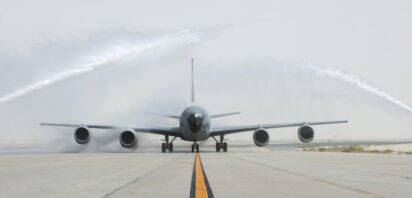
Another possible scenario involves gradual normalization of an elevated posture, effectively resetting the baseline level of US military presence in the region if instability persists. Such a shift would have long-term implications for force allocation, alliance management, and, more importantly, strategic competition with other global powers, including Russia and China, who have supported the Iranian regime over the past decades. For defense and security analysts, the key indicators to watch are not rhetoric but logistics and enablers: the forward deployment of aerial refueling assets, increased ISR activity, changes in rules of engagement, and force protection measures for US personnel. These signals often precede actions more reliably than public statements.
Washington is not simply repositioning; it is preparing. Current military movements reflect a recognition that the Middle East is entering a phase of heightened unpredictability where deterrence must be backed by armed capability and readiness. Whether this posture succeeds in preventing escalation with Iran or inadvertently accelerates it will depend not only on US decisions but also on how Iran and its regional proxies interpret and respond to a U.S. that appears, once again, willing to keep military action firmly on the table.
The views expressed in this article belong to the author(s) alone and do not necessarily reflect those of Geopoliticalmonitor.com.