On December 5, the White House released the new US National Security Strategy, which marked a serious shift in Washington’s foreign policy priorities and principles. One of the key principles declared in the document is the concept of “flexible realism.” According to this approach, the United States intends to pursue a more pragmatic policy, abandoning the previous practice of forcibly imposing democracy and ideological projects.
The strategy explicitly states the intention to support constructive relations with various countries “without imposing on them democratic or other social change that differs widely from their traditions and histories.” Basically, Washington acknowledges the civilizational diversity of the modern world and signals its willingness to accept countries as they are, even if their political system or values differ from Western standards. This shift signifies a rejection of the neoconservative approach of past decades, when the spread of democracy was regarded as a justification for intervention. Now the strategy places US national interests and stability at the forefront, proclaiming a “predisposition to non-intervention” in the internal affairs of other countries.
This is a clear signal to the countries of the Middle East: Washington is in fact abandoning the policy of “regime change” and the export of democracy, which for many years caused tension in the region. Instead of human rights rhetoric and threats of military intervention, the new doctrine emphasizes pragmatism – cooperation in the fields of trade, security, and energy – where it is beneficial to both sides.
Within the framework of the review of Middle Eastern policy, a special place in the strategy is devoted to the new course toward Syria. The document is remarkable in that, instead of the previous rhetoric about the “axis of evil” and the isolation of Damascus, it now expresses the opposite stance: “Syria remains a potential problem, but with American, Arab, Israeli, and Turkish support may stabilize and reassume its rightful place as an integral, positive player in the region.” In other words, Washington openly announces plans to help in the strengthening and rehabilitation of Syria, a country that for more than ten years was considered an outcast on the international arena.
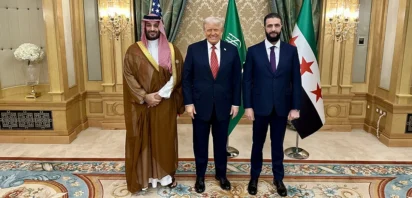
This turnaround is caused by significant changes within Syria itself. In 2024, a sudden change of power happened in Damascus: the regime of Bashar al-Assad fell, and on the political stage a new authority under the leadership of Ahmed al-Sharaa emerged. His government was quickly recognized by the United States, which marked the actual end of Syrian isolation. It is characteristic that already in November 2025, Donald Trump personally met with Ahmed al-Sharaa at the White House. This visit became a symbolic confirmation of the “thaw” between Washington and Damascus.
The reason for such a sharp change in course is the Iranian factor. Regional experts have long noted that previous American actions unintentionally strengthened Iran’s position in the Middle East. Thus, influential political scientists John Mearsheimer and Stephen Walt pointed out that after the overthrow of Saddam Hussein in 2003, the balance of power in the Persian Gulf sharply tilted in favor of Tehran. Before the US invasion of Iraq, a peculiar balance existed: Iraq, weakened by sanctions but still sufficiently strong, restrained Iran. The elimination of the Iraqi army led to a power vacuum, which was filled by Iran. Tehran rapidly expanded its influence, relying on allies, supporting Shiite groups in Lebanon (through Hezbollah) and Palestine, and advancing its interests throughout the region. Washington attempted to counter the rise of Iran by placing its bet on Israel as a key ally. However, such a one-sided strategy had a side effect: the hard-line pro-Israel policy served to alienate large segments of the Muslim world, including many Sunnis, and contributed to Iran being perceived as the “shield” of the entire Islamic world in the face of Israeli-American pressure. Iranian leaders positioned themselves as the main defenders of the Palestinians and as opponents of the Israeli occupation. Moreover, in 2025 Tehran demonstrated ambitions as a mediator beyond the region. Suring the sudden armed crisis between Pakistan and India in May 2025, Iran offered its mediation and maintained contacts with Islamabad, advocating for a peaceful settlement of the conflict. All of this reinforced Iran’s image as an influential player and as an “advocate” of Muslim interests on the global stage.
Judging by the new strategy, Washington is fully aware of these changes and draws lessons from previous miscalculations. In order to counter Iran, it is not enough to rely solely on Israel, a necessary ally among Arab countries is required, capable of balancing Tehran on the regional chessboard. America now sees such an ally in a renewed Syria. Washington is ready to invest generously in strengthening the new Syria, both politically and economically. The U.S. has already lifted a number of sanctions on Damascus: in June 2025, Donald Trump, by special decree, suspended the most stringent restrictions (Caesar Act), stating his intention “to give Syrians a chance at greatness.” It is possible to expect both financial aid and technological support from the United States in order to stabilize and restore Syria after a long-standing war. The rapid growth of the Syrian economy and military power is capable, in the long run, of turning Syria into a new regional leader, comparable in influence with the Iraq of the past. For Washington, such a configuration is beneficial, since it will create a counterbalance to Iran in the Middle East: Tehran will have to divert resources to compete with the revived Syria.