Relations between NATO and the Indo-Pacific Four (IP4) have come under scrutiny as most leaders from the collective, consisting of South Korea, Japan, Australia, and New Zealand, chose to skip the 2025 NATO summit in The Hague. While progress was made in areas such as defense industry cooperation and support for Ukraine, the absence of these leaders speaks volumes, suggesting that the impetus to maintain the relationship is no longer reciprocated from the IP4. This distancing from cross-regionalism signals a broader trend among IP4 nations as they adapt to evolving geopolitical realities and prioritize regional challenges, particularly their engagement with China and each other.
NATO’s Cross-Regional Push
In the months leading up to the summit, NATO pushed for cross-regional cooperation and dialogue with the IP4. Senior officials made inaugural trips to the Indo-Pacific, including the NATO Aviation Committee visiting to New Zealand and Secretary General Mark Rutte’s trip to Japan, where he and Japanese Prime Minister Shigeru Ishiba affirmed the “shared recognition that the security of Euro-Atlantic and Indo-Pacific is inseparable” and security cooperation is paramount. NATO officials attended the 2025 Shangri-La Dialogue, where they engaged with regional military and political leaders. Rutte, along with members of the NATO Parliamentary Assembly, have emphasized that cross-regional cooperation with the IP4 is essential to counter growing threats from Russia, China, North Korea, and Iran (and possibly Laos). However, Beijing rejected Rutte’s claims about China’s military expansion and support for Russia in the Ukraine war as “misinformation.”
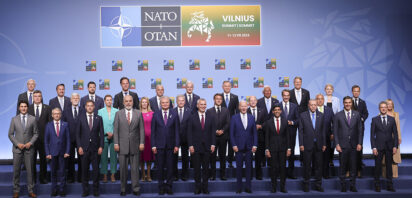
The NATO Hague Summit
The IP4 leaders who did not attend the summit cited different reasons for skipping it. Some prioritized national interests, while others sought a meeting with US President Donald Trump after his early departure from the G7 meeting. Concerns over US involvement in the ongoing escalation in the Middle East also played a role.
Australian Prime Minister Anthony Albanese opted not to attend for the second consecutive year, instead sending his deputy and defense minister, Richard Marles, to represent him.
South Korean President Lee Jae-myung was hesitant ahead of the event, stating he would skip it unless the deliberations addressed pressing issues. Days before the summit, it was announced that he would not be attending. Prime Minister Ishiba initially committed to attending but later changed his mind following Lee’s decision.
New Zealand Prime Minister Christopher Luxon was the only head of state from the IP4 to attend the summit. The absence underscores the symbolic significance of how this exclusive group of non-NATO members now approaches the cross-regional relationships. Although the heads of state sent delegates to represent their respective countries, the scope of discussions may have been limited. Nevertheless, there were still some announcements regarding defense industry cooperation.
NATO officials did meet with the representatives from the IP4 and subsequently released a statement summarizing their discussions. The language largely rephrased the wording from the Washington Summit Declaration, re-emphasizing the NATO-IP4 relationship, contributions to defense industry cooperation, and support for Ukraine. Tokyo provided additional discussion points that were covered in the meeting including the participants’ policies on North Korea. However, both statements did not address other Indo-Pacific countries, notably China.
Shift to Indo-Pacific Priorities
The ambiguity of the statement and absence of most the IP4 leaders reflects that they are shifting focus away from a cross-regional relationship in order to focus on regional relationships, in particular China. As relations with the United States have become more complex, IP4 countries are balancing their engagement with the United States and the emphasis to increase defense spending while also managing economic and diplomatic relations with China, the regional power they cannot afford to ignore.
Lee, who was just elected to office in June, has asserted that his foreign policy will be “flexible and pragmatic”; during his presidential campaign, he reiterated that he wants to “stabilize and manage” South Korea-China relations because he considers Beijing an “important trade partner.” Lee’s strategy has already shown results: Chinese President Xi Jinping invited him to visit for the upcoming Victory Day parade. Additionally, Lee has spoken with Rutte about deepening the South Korea-NATO partnership. NATO will likely be monitoring Lee’s decision on Xi’s invitation.
New Zealand is increasing its engagement with China. Just days before the NATO summit, Luxon visited China to meet with Xi, where they discussed trade and regional security. Luxon’s remarks leading up to and following the summit convey an intention for Wellington to engage with Beijing strategically, while also addressing NATO concerns. Following his trip, he dismissed NATO’s claims regarding China’s role in supporting Russia’s invasion of Ukraine. At the summit, he stated that he would encourage China to leverage its influence over Russia and North Korea.
Both Canberra and Beijing have emphasized the importance of maintaining their bilateral relationship. China is a vital trading partner for Australia, and has expressed concerns regarding Australia’s consideration to increase defense spending. At the same time, Australia has raised concerns of China’s growing presence in the region. Albanese is scheduled to meet Xi for the fourth time in two years in the coming days to ensure that diplomatic relations remains stable.
Japan’s outreach to China remains complex. Since entering office, Ishiba has sought to improve relations with Beijing, but endeavors of diplomacy have been mixed with deterrence. However, there has been efforts on economic cooperation and reassurance from Tokyo that the longstanding enmity must be resolved in order to handle larger geopolitical matters.
The IP4 nations are also working to improve relations among themselves. Notably, Ishiba changed his mind about skipping the summit after Lee made his announcement, which reflects both leaders’ optimism to enhance bilateral cooperation and the opportunities it presents. Additionally, South Korea and Australia are strengthening their bilateral relationship. At the G7 Summit, Lee and Albanese publicly acknowledged that their countries will engage in deeper cooperation. Lee has also appointed special envoys to Australia, a decision described as “unusual,” but one that could help ease relations with China.
The IP4 continues to navigate the balance between NATO alignment and relations with China. China will likely monitor the actions of each member country when engaging with Europe. Nevertheless, Rutte has emphasized that the Indo-Pacific and European regions are becoming increasingly interconnected due to emerging threats from Russia, China, and their allies. While the IP4 may be distancing itself from NATO, there is still strong mutual support for Ukraine, with each member continuing to provide assistance in some form. For instance, Japan and Ukraine maintain a 10-year security arrangement that was signed in November 2024. Tokyo is also implementing new programs to support humanitarian and economic assistance for Kyiv. Before the summit, New Zealand committed an additional $9 million in military and humanitarian aid to Ukraine. During the summit, Marles announced that Australia will be deploying Royal Australian Air Force aircraft and military personnel to Europe to facilitate humanitarian and military assistance to Ukraine. It is likely that Lee will shift South Korea’s support towards post-conflict reconstruction efforts.
However, once the Russia-Ukraine conflict concludes, there may be changes in the NATO-IP4 relationship, especially if the IP4 continues to prioritize regional matters. A potential Taiwan conflict would draw attention from the IP4, but they will likely consider their options regarding how far to engage, similar to their new approach with NATO.
The views expressed in this article belong to the author(s) alone and do not necessarily reflect those of Geopoliticalmonitor.com.