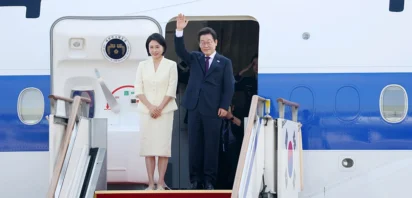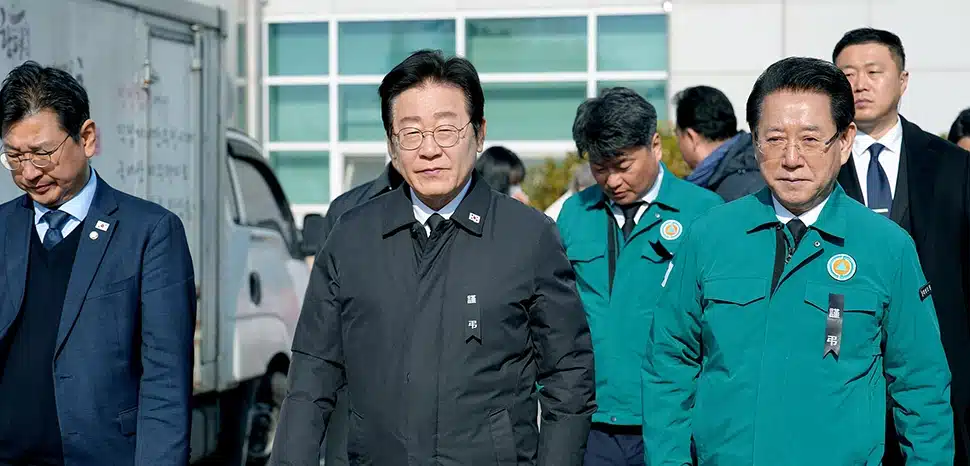
Lee Jae-myung has been elected as the next president of South Korea (ROK). His campaign focused on improving domestic affairs, specifically the economy and repairing the country from the political polarization that spiked in the wake of the December 2024 martial law incident. His predecessor, Yoon Suk Yeol, placed greater emphasis on the ROK’s role in international affairs, most notably the Ukraine war, through the Global Pivotal State (GPS) strategy, but his management on domestic affairs was not as acclaimed.
Lee, a one-time critic of Ukrainian President Volodymyr Zelenskyy, has now inherited Yoon’s foreign policy portfolio. The ROK’s support for Ukraine under Yoon elevated Seoul’s global profile, but that is now likely to change under Lee, whose comments suggest a recalibration of ROK’s global stance that reshapes not only involvement in the Ukraine war but the ROK’s broader foreign relations as well.
Northeast Asia’s Role in the Conflict
All of the ROK’s neighbors have directly or indirectly played a role in the Ukraine war; Russia launched the expanded invasion of Ukraine in February 2022; North Korea (DPRK) has played a critical role in fulfilling the “strategic partnership” it shares with Russia by providing military troops and munitions; Japan and Ukraine signed a 10-year security arrangement in November 2024; Ukraine and other European nations have reported finding Chinese drone components launched by Russia. Ukraine has also claimed that Chinese nationals are fighting for Russia. Both claims have been denied by Beijing. Mongolia provided aid to Ukraine in the beginning of the war but has since maintained a neutral position.
Compared to its neighbors, the ROK under the Yoon Administration played an important role supporting Ukraine via GPS. GPS represented Yoon’s approach to enhancing ROK’s influence and leadership in the international arena. The strategy emphasized the promotion of peace, security, and prosperity through active participation in international affairs, the defense of democratic values, and collaboration with other nations to tackle global challenges. Unlike his predecessor, Moon Jae-in, President Yoon sought to broaden ROK foreign policy by “embracing greater roles and responsibilities for addressing regional and global challenges in the Indo-Pacific region and beyond.” Essentially, Yoon aspired for the ROK to have a proactive voice alongside other key decision-makers on issues of global security.
While ROK foreign policy had historically aligned closely with that of the United States, Yoon’s GPS strategy aimed to allow the country to step out from the shadows and establish a distinct presence on the world stage. The ROK experienced more cross-regional cooperation with Western nations and intergovernmental alliances when it came to addressing the conflict. It was the first country in the Indo-Pacific region to implement sanctions against Russia and to supply arms to Ukraine through third countries. The ROK became part of the IP-4 (or AP4), the collective of Indo-Pacific allies of NATO; diplomatic engagement with Ukraine; financial, humanitarian, and non-lethal military aid to Ukraine. Engagement with the Trilateral alliance also included addressing the conflict, specifically the DPRK’s supporting role for Russia. Additionally, Ukrainian officials and their South Korean counterparts collaborated on discussing repatriation of DPRK prisoners of war and intelligence exchanging.
But there were critics, such as then-Democratic Party leader Lee, who expressed concerns of the Yoon administration’s contributions to supporting Ukraine and other endeavors such as deploying ROK personnel to monitor DPRK troops in Ukraine. To Lee, assistance to Ukraine was amplifying tensions with Pyongyang and Moscow. By late 2024, the Democratic Party and the public expressed their disapproval of the country continuing to supply Ukraine.
Shift to Pragmatic Diplomacy
With Yoon no longer in office, GPS will dissipate and likely be replaced. A central feature of Lee’s 2025 campaign was his pivot toward the political center, also known as “right-clicking.” He has recast himself from a populist figure on the left into a centrist focused on economic recovery and national interest before any strategic alignment. Lee’s campaign demonstrated how foreign policy and domestic issues have changed since the previous election, stressing the need for the president to reflect these changes and address the growing disconnect from the progressive party’s foundational ideals. He has underscored that his foreign policy will be “flexible and pragmatic,” marking a shift from Yoon’s policies that strained relations with neighboring countries. Lee wants reciprocal diplomacy; to restore dialogue with Pyongyang, and to “stabilize and manage” ROK-China relations, as he considers Beijing an “important trade partner.”
Lee stated on the campaign trail that ROK-Russia relations will be approached with a focus on national interest, while “contributing to Ukraine’s reconstruction and ensuring pragmatic diplomacy for the security of the Korean Peninsula and Korean businesses.” If implemented, this would represent a departure from GPS. Lee aims to avoid further damaging relations with China and Russia, while continuing to support Ukraine, but only to the extent that it does not prolong the conflict. At the same time, he intends to continue arms sales to European countries. This supports his economic priorities and reflects continuity with one of GPS’s goals of expanding ROK’s defense exports. That being said, the statement also shows that if Yoon and Lee ever broadly agreed on anything in their political careers, it was that Seoul should play a role in the reconstruction of Ukraine. Lee reiterated this in his call with Czech Prime Minister Petr Fiala, the first European leader he contacted. This could mean improving trade relations/policy with Ukraine or helping Korean businesses navigate the opportunities in the country for mutual benefits. This aligns with Lee’s pledge to push Korean businesses to “freely start, grow, and compete globally.” In fact, the effort has already begun. In May 2025, the Ukrainian Ministry of Economy and the Korean Business Council signed a memorandum to strengthen economic and bilateral relations.
Lee’s adjusted stance on the conflict could also help establish his relationship with US President Donald Trump. The United States under the Trump administration has significantly changed its position in the conflict. Lee’s pragmatic diplomacy could impress Trump, who is known to prefer bilateral relationships, and lead to US-ROK cooperation on other matters.
Balancing Alliances and Future Engagement
Lee has commented on the ROK’s future participation in some intergovernmental alliances. He has emphasized that he will strengthen cooperation among the trilateral alliance. According to experts, Lee has specified that he would not pursue quashing previous accomplishments. Recent statements published by the trilateral alliance before the election have softened; a statement released in 3 April, 2025 stated that the alliance encourages efforts for dialogue with Russia and for a ceasefire, compared to one released on 15 November 2024 that condemned Russia’s war of aggression while also being a permanent member of the United Nations Security Council. The rhetoric of the April statement reflects Lee’s aspirations to improve relations without increasing hostiles.
However, there may be a change in the ROK’s relationship with NATO. During his term, Yoon improved ROK-NATO relations in order “to strengthen solidarity with nations sharing universal values and establish a global network for comprehensive security cooperation.” By standing with NATO/IP-4, the ROK supported its stance against Russia’s and DPRK’s roles in the war, and regarding China as a security challenge. In contrast, Lee has expressed uncertainty about attending the upcoming NATO summit, emphasizing that unless the meeting directly addresses pressing current issues, his focus remains on domestic challenges like economic recovery for ordinary citizens, with foreign policy beyond the US-ROK alliance being a secondary priority. This could also mean engagement with NATO might be limited if pragmatic diplomacy is to improve relations with Russia, China, and DPRK.
Lee’s pledges to shift ROK foreign policy will shape its role in the Ukraine war. While dialogue between Ukraine and Russia has begun, fighting continues and serious obstacles remain that prevent meaningful negotiation or ceasefire. Lee’s pragmatic approach to improve relations with the DPRK and Russia may be easier said than done, given how strained how relations have become, and it could put pressure on other regional and cross-regional relations. Over time, there may be mutual benefits for ROK and Ukraine, timing will depend on how the conflict ends. In his congratulatory message to Lee, President Zelenskyy expressed interest for closer cooperation between the countries, but how the new administration chooses to integrate that opportunity into its broader foreign policy will be a key test of its direction.
The views expressed in this article belong to the author(s) alone and do not necessarily reflect those of Geopoliticalmonitor.com.