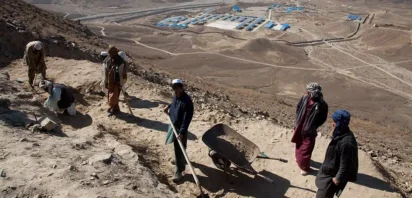
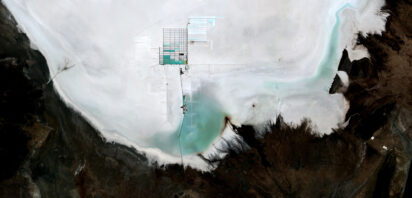
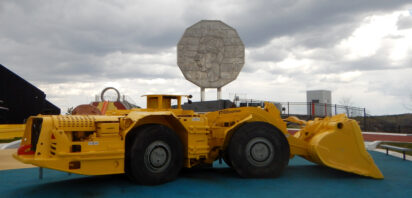
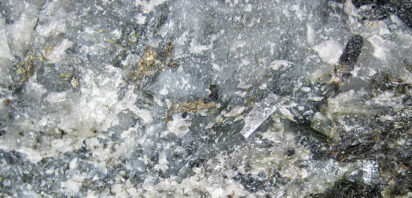
The gunboats of the US trade diplomacy have gone home, and only cargo ships wait in the water – stalled by ongoing tariff uncertainty. One thing that the administration would very much like these cargo ships to be bringing back is reserves of rare earth metals and critical minerals. Unfortunately for the United States, these ships will have to go via China first for the foreseeable future.
Critical minerals – like aluminium, copper, and lithium – are crucial materials in powering the green industries of tomorrow, like electric vehicles and renewable energy. A subset of these minerals are rare earth metals, whose unique catalytic and magnetic properties make them suitable for advanced defense technologies and the vast data centers that underpin artificial intelligence
Until now, the United States has been happy to benefit from access to these minerals. The US predominance in world-leading technology companies depends on them, and the strategy has been to offshore low-value-added manufacturing to markets with cheaper labor. Only in exceptional circumstances does the United States manufacture domestically, such as Tesla’s highly publicized gigafactory assembly lines.
But the tech tycoons have a problem. Their arch-competitor – China and its rapidly evolving tech sector – has the good fortune to sit on top of the vast majority of the world’s reserves of the rare earth metals they depend on. Nearly 70% of US rare earth imports come from China, which also has considerable domestic access to critical minerals like bauxite and copper.
To date, the Trump solution has been to bargain hard with your enemies and even harder with your allies to secure access to mineral and metal deposits.
Metals and minerals have played a key part in Trump’s public posturing towards Greenland (‘we have to have it’) and the now infamous critical minerals deal as part of the Russia-Ukraine peace process. Under the radar, the government in Kinshasa is looking to offer up the Democratic Republic of the Congo’s (DRC) reserves of cobalt to the United States in a minerals for military muscle deal.
But there are three problems with this approach.
The first is simple. Yes, countries like Greenland and Ukraine have vast supplies of untapped critical minerals. But they still represent a tiny fraction when compared to China, especially when it comes to rare earth metals. Take Greenland – where rare earth reserves amount to 3% of that of China. Or Ukraine – which is estimated to hold 5% of global reserves of critical raw materials compared to China’s two-thirds.
The United States would have to build a vast coalition of willing trading countries – including Brazil, Chile, Argentina, India, Vietnam, and Australia – to begin to get close to China’s access to these minerals. Even then, this coalition would only cover access to critical minerals, not necessarily the rare earth metals they also need.
At the moment, the Trump administration does not seem focused on building such alliances – especially in its drive to access these resources.
But there is a second deeper problem. Access to critical minerals is pointless without the capacity to refine and process them: to recover the pure metals from the rock and transform them into industry-grade materials.
Once again, China has the advantage here – with over 92% of global rare earth metal processing – and it’s one the United States will be hard pressed to overcome.
Mineral refining and processing are incredibly costly, and the profit margins are tiny. Another reason why these facilities are so hard to build in the United States (and other Western countries) is the environmental costs.
Take the example of Australia’s Lynas Rare Earths – the largest rare earths producer outside of China – whose investment in a production site in Texas (that would supply over 15% of the world’s neodymium outside of China) has stalled due to overflowing costs of wastewater management.
Lynas’ profits are suffering from a double pinch. On the supply side, environmental costs have scuppered its development. On the demand side, the introduction of trade barriers generates huge uncertainties for buyers. Lynas is now seeking federal investment to refloat the project.
But could the United States look to develop its critical mineral producing capacity elsewhere in the world? In the last decade, the Chinese Government has subsidized over USD 57 billion globally in mineral refining and processing infrastructure as part of its Belt and Road Initiative.
A US government, in the act of tightening its own belt, would be hard pressed to spend that many taxpayers’ dollars abroad. Instead, it might be more tempted to invest in such infrastructure at home – for example, by building up domestic industrial capacities or providing leases for foreign mining companies to expand operations in red states.
In any case, the price may be too high for the U.S. to justify, as global interest rates rise and government borrowing becomes more expensive. Revenue from tariffs could help pay for this, but then again, the same tariffs would make the import of these refined minerals more expensive anyway. This might not be a limiting factor for an administration with a strong political mandate for a domestic manufacturing renaissance. But the result would be a massive transfer of taxpayer money into private sector hands, as profits are eaten up by major industries.
But there is one inescapable problem: the United States is out of time. It can take many years (decades!) to explore, extract, and develop refining and processing infrastructure, and the results could only come to fruition well beyond the incumbency period of any democratically elected government.
The result: the United States is stuck when it comes to rocks (critical minerals) and hard places (Greenland, Ukraine, and the DRC).
And for now, the United States is squirming its way towards a critical minerals policy that is incoherent. That is, unless, the bravado about minerals is part of a wider mercantilist strategy to carve out a new role for Washington in its own backyard, Europe, and Africa – to prioritize any deal tipped in its favor, which can be sold as a win domestically, despite the wider strategic implications.
The Trump administration may well be in it for the long run to protect domestic jobs and production, but its other foreign policy endeavors, including increasing market chaos and torpedoing relationships with allies, run counter to this.
From this incoherent strategy will emerge an unfortunate truth: Neither the United States nor China can fully disentangle the Gordian knot of their relationship. The United States needs China’s industrial power. China needs the US markets.
And so, come hell and high tariffs – and despite tit-for-tat bans on bargaining chip minerals like antimony, gallium, and germanium – cargo ships carrying precious metals will continue to sail between these two powers.
It will be hard to turn these ships around when faced with the fact that in the decade between 2013 and 2023, they bore the brunt of a tripling in the trade of rare earth metals. After all, the trade in rare earth metals between the two superpowers reached its apogee during Trump’s first term.
Henry is a researcher at FAIRR Initiative, where he manages projects investigating the impact of global and regional water scarcity on food security, and a Rising Expert for Climate, Energy, and Environment at Young Professionals in Foreign Policy (YPFP).
The views expressed in this article belong to the authors alone and do not necessarily reflect those of Geopoliticalmonitor.com.