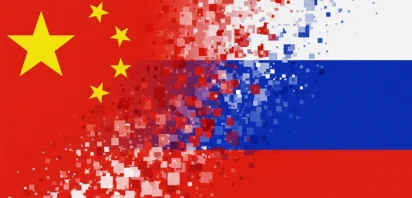
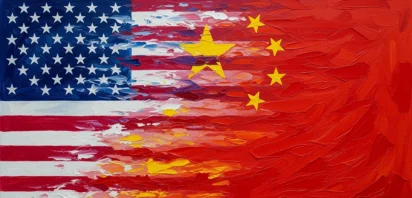
President Donald Trump has repeatedly asserted that his foreign policy aims to counterbalance the growing threat from China. Central to this vision is a bold strategic gamble: to decouple Russia from Beijing and drive a wedge between the two authoritarian powers, what some analysts refer to as “reverse Nixon.” In practice, however, Trump’s approach has achieved the opposite. His appeasement of the Kremlin and economic belligerence toward US allies have not only failed to fracture the Russia-China axis—they’ve strengthened it.
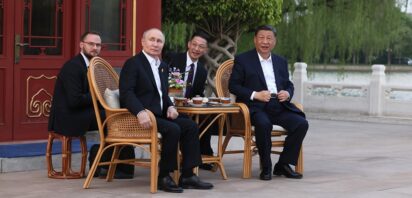
Nowhere is this failure more visible than in Moscow this May. This past week, for only the second time in history, Chinese troops marched alongside Russians in the May 9 Victory Day parade—a dramatic display of military solidarity meant to project the durability of their deepening partnership. Chinese President Xi Jinping’s decision to attend the event in person only underscored the symbolism. This wasn’t just a celebration of the Soviet Union’s defeat of Nazi Germany. It was a not-so-subtle rebuke to Washington, particularly to Trump: a declaration that the Sino-Russian relationship is thriving—and united in opposition to American power.
Trump’s repeated overtures to Russian President Vladimir Putin not only failed to deter the Kremlin, they have sent a dangerous signal: that the U.S. is unwilling to impose meaningful costs on Moscow for its aggression. From his public deference to Putin at the 2018 Helsinki summit to his ongoing calls to “end the war” in Ukraine by discontinuing military aid and forcing Kyiv into a frozen conflict, Trump has consistently chosen carrots for the Kremlin and sticks for its victims. Pursuing “a deal” that halts the war without demanding a Russian withdrawal only reinforces the perception that aggression pays.
This tactic has deeply unsettled America’s NATO allies, especially in Eastern Europe, where Trump’s rhetoric is considered not only morally suspect but strategically reckless. It signals a weakening of US security guarantees at a time when Europe is facing its most serious military threat since the Cold War.
By undermining faith in US leadership and decoupling strategy simultaneously, Trump is inadvertently encouraging exactly the behavior he seeks to prevent. The Kremlin now believes it can extract concessions without consequences, while Beijing sees an opening to fill the vacuum left by America’s retreat from its traditional role.
What Trump fails to grasp is that Russia and China are not just aligned by convenience but by a shared ambition to revise the international order in a way that boosts their power at the direct expense of the United States. Both regimes seek a world less constrained by American leadership, liberal institutions, and democratic norms. And critically, the only way the U.S. could genuinely tempt either regime into realignment would be by surrendering its global influence—a process Trump appears to be enabling, however inadvertently, through neglect, appeasement, and self-inflicted division with allies.
While Trump coddles Russia, he has turned his economic guns on America’s closest allies. His revival of aggressive tariffs on European and Asian goods—including those from NATO members—has frayed transatlantic economic ties. These punitive measures have strained alliances and pushed many European nations to diversify their economic partnerships—often in Beijing’s direction.
This has undercut Washington’s effort to form a unified economic front against China. European governments, already wary of Trump’s transactional and confrontational diplomacy, have grown more willing to engage with China on trade, technology, and infrastructure. As a result, China is increasingly able to position itself as the new champion of globalization and the “rules-based order” despite its authoritarian practices and strategic ambitions.
In a geopolitical paradox, Trump’s protectionist measures—aimed initially at countering China—are giving Beijing new economic inroads in Europe and the Global South. Far from isolating China, these moves make building the broad, values-based coalition needed to check its rise harder.
Trump’s notion that Russia can be pulled away from China rests on outdated assumptions. The two countries share more than just convenience: they are united by a common interest in reshaping the global order away from Western liberalism and toward authoritarian dominance. Their military, energy, and diplomatic ties are deeper than at any point since the 1950s. Efforts to decouple them through unilateral appeasement are naïve at best and dangerous at worst.
If Trump intends to succeed in his second term’s goals of containing China, he must recalibrate. That means abandoning fantasies of a strategic partnership with Putin and ending the mixed signals undermining American credibility. Instead of freezing the conflict in Ukraine, he must recommit to deterring Russian aggression. Instead of alienating allies through tariffs, he must rebuild economic and diplomatic bridges across the Atlantic and Indo-Pacific.
Only a united front—militarily, economically, and ideologically—can blunt the ambitions of Beijing and Moscow. Until Trump grasps that, his policies will continue to do the opposite of what he intends: empower America’s adversaries, fracture its alliances, and accelerate the global decline of US influence.
The views expressed in this article belong to the authors alone and do not necessarily reflect those of Geopoliticalmonitor.com.