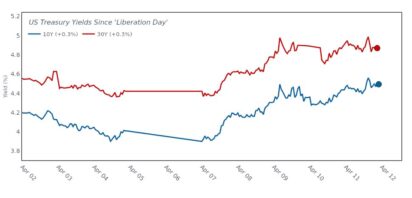
When Donald Trump announced sweeping new tariffs on April 2—slapping a 10% blanket duty on all imports and imposing up to 54% on goods from countries like China, Japan, and even European allies—it confirmed a troubling truth: Trump’s foreign policy instincts remain rooted in isolationism and economic warfare, even as the global balance of power tilts toward Beijing.
This approach undermines the US “Asia Pivot,” a strategy of reorienting toward the Indo-Pacific sought over the past decade. If the United States hopes to preserve its influence in a region increasingly dominated by China, it cannot afford to alienate the very partners it needs to succeed. Yet Trump’s trade policies and antagonism toward traditional alliances do precisely that—undermining trust, fracturing supply chains, and leaving China with a golden opportunity to consolidate leadership in the region and beyond.
The latest Trump tariffs are not limited to adversaries. Key allies like Japan (24%), South Korea (30%), and the European Union (20%) were hit as well. These countries are essential partners in any comprehensive Indo-Pacific strategy. Imposing aggressive tariffs on them while simultaneously expecting a political alignment in containing China sends a contradictory message. Unsurprisingly,China responded swiftly, enacting 34% retaliatory tariffs and leveraging the moment to deepen ties with countries increasingly wary of erratic US leadership. This is not just a trade issue; it’s a geopolitical self-sabotage.
Trump argues that these tariffs are necessary to restore fairness to US trade relationships. However, many of the countries targeted by the tariffs are the same ones the US relies on to help constrain China’s regional ambitions. Penalizing these allies economically weakens their willingness to support broader US strategic goals, especially when alternatives—such as deepening ties with China or prioritizing regional trade blocs like the Regional Comprehensive Economic Partnership (RCEP)—appear more stable and beneficial.
The Trump tariffs don’t just provoke retaliation—they accelerate America’s exclusion from key global supply chains. Southeast Asian nations, already wary of being caught in a great power rivalry, are turning inward. Trade among Asian countries is booming under RCEP, a mega-regional agreement that pointedly excludes the United States.
In the wake of US protectionism, key world economies will pursue new supply networks that depend less on American inputs and markets. US companies are also responding to this uncertainty: some are relocating manufacturing to friendlier countries, while others are losing ground to competitors operating in tariff-free zones.
As these nations trade more with each other and with China, the US risks being bypassed in the development of next-generation sectors like green energy, AI, electric vehicles, and semiconductors. Global firms are adjusting accordingly, favoring stable, integrated, and predictable ecosystems. In this context, Trump’s tariffs are not just economically costly—they are strategically suicidal.
In parallel to his economic policies, Trump’s well-documented disdain for NATO—calling it “obsolete,” threatening to withdraw troops from Europe, and suggesting that the United States might not uphold collective defense obligations—has deepened transatlantic mistrust. While this may seem like a European problem, it reverberates far beyond the Atlantic, making Asian partners less eager to align with Washington in containing China. US credibility suffers when alliances are treated as transactional. Nations across Asia are watching. If Trump is willing to abandon NATO, will he also walk away from security commitments in the Indo-Pacific? That question casts a shadow over American reliability in a region already on edge.
A successful Asia strategy requires more than military deployments—it demands coordinated pressure from a coalition of democracies. European engagement—whether through sanctions, tech controls, or joint naval exercises in the South China Sea—enhances the credibility and legitimacy of any US-led effort to counterbalance China. Weakening those transatlantic ties strips Washington of one of its most powerful assets: a network of allies who share values and interests.
As the U.S. steps back, China steps in—with trade deals, infrastructure investments, and an image of political stability. While US tariffs fracture global markets, Beijing offers regional neighbors something Washington increasingly struggles to provide: predictability. Over the past decade, China has steadily expanded its footprint through the Belt and Road Initiative, infrastructure finance, tech exports, and vaccine diplomacy. It has embedded itself in global institutions, advocated for multilateralism (on its own terms), and offered countries an alternative development model that eschews human rights conditionality and encourages state-led economic planning.
And China’s ambitions are not confined to Asia. In Africa, Latin America, and parts of Europe, China presents itself as a more consistent and pragmatic partner. Its investments may come with strings attached, but they do not come with volatility or isolationist threats. That contrast is becoming starker as the US oscillates between global engagement and inward-looking nationalism.
Some supporters argue that the Trump tariffs are about protecting US workers. But the historical record offers reason for skepticism. After the 2018 washing machine tariffs, US consumers paid significantly higher prices, and studies estimated the cost per job saved was over $800,000.
Beyond consumer costs, the long-term risk is strategic irrelevance. Economic decoupling may sound appealing on the campaign trail, but it is a recipe for declining influence. As countries reconfigure supply chains in ways that exclude the United States, US firms will lose access to innovation hubs, emerging markets, and vital raw materials. The Asia Pivot wasn’t just a military strategy—it was also about embedding the United States in the economic architecture of the world’s most dynamic region. That opportunity is now slipping away.
Without diplomacy, consistency, and deep alliances, the success of America’s Asia pivot can’t be taken for granted. Trump’s tariff policies, his alienation of traditional partners, and his disregard for multilateralism risk killing the pivot outright. The result could be a world where the United States is no longer the indispensable power, but a peripheral one—viewed with caution, tolerated for its market size, but no longer trusted to lead. As China builds new coalitions and deepens its global reach, America’s retreat from strategic leadership will have consequences that last far beyond a single administration. If the United States wants to remain relevant in the Indo-Pacific, it must stop treating allies like adversaries and start reinforcing the partnerships that have underpinned global order for decades. Protectionist bluster may win applause at rallies, but it is ceding the future to China—one tariff at a time.
The views expressed in this article belong to the author(s) alone and do not necessarily reflect those of Geopoliticalmonitor.com.