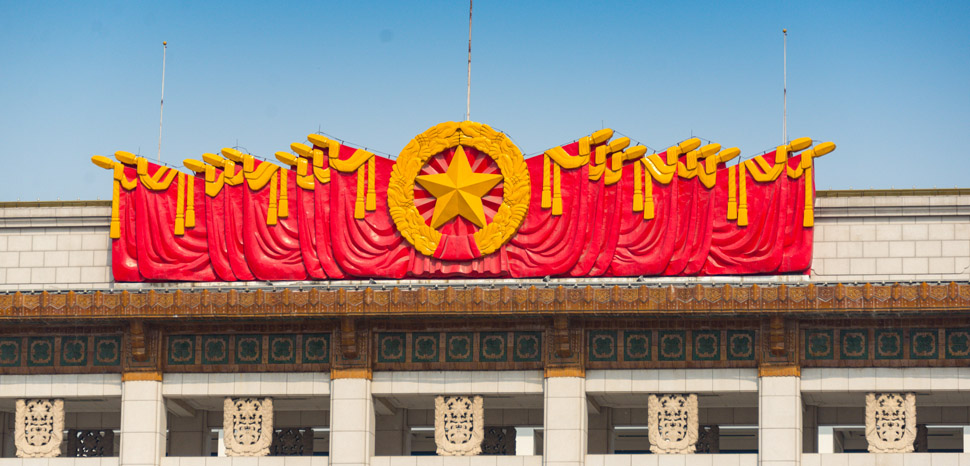
The Chinese authorities will hold the ‘two sessions’ later this week. First is the Chinese People’s Political Consultative Conference (CPPCC), which begins on March 4, and then the National People’s Congress, which follows on March 5. Both are expected to be in-session for seven days, which is about half as long as the pre-COVID precedent.
Though the bodies themselves are largely symbolic, this week’s disclosures will effectively pull back the curtain on a slew of policy aims. Broadly, these include setting out the economic imperatives of the post-COVID era and transitioning economic growth to a domestic-consumption model.
Analysis
Both the CPPCC and the NPC are the frontend facades of the sprawling Party bureaucracies that sustain them; in other words, they lack significant political power in and of themselves.
The CPPCC sits atop the Party’s United Front Working Department (UFWD), and can broadly be described as a grouping of various luminary friends of the Party, along with united front representatives, divided into various representative associations: political (China’s pantomime parties, such as the China Democratic League), business, cultural, science, ethnic, and territorial (Hong Kong, Taiwan, Macau).
The stated function of the CPPCC is consultation. In theory the meeting – and the united front bureaucracy underneath it – consult with representatives of these diverse fields so as to better inform Party policymaking. On paper the forum provides a modicum of plurality for a Party bureaucracy in desperate need of it. But the intercourse is only skin-deep; in practice, the Party utilizes CPPCC representatives as conduits for smoothing over the delivery of predetermined policies to contemporaries in their respective fields. The CPPCC members are in turn rewarded for the trouble, if not directly then via the political connections they make at high-level events like the two sessions.
Thus, the CPPCC is ultimately an exercise in persuasion – a way to ingratiate Party governance in the eyes of domestic and international populations. Of particular note this year is how CPPCC delegates and reports treat the issue of Hong Kong. With high-level CCP officials declaring that only “patriots” should be able to rule the territory, and the NPC believed to be considering a sweeping overhaul of its election laws, the Hong Kong CPPCC delegation will be tasked with some major PR heavy-lifting to try and sell the changes back home.
Most eyes however will fall on the work of the National People’s Congress. This body is ostensibly the legislative branch of the PRC’s political system, but far from deliberating and passing new laws, its function is merely symbolic. But there’s still information to be gleaned here as the NPC leg of the two sessions is where a host of new Party policies are first revealed to the public.
Various disclosures from the NPC will be watched closely by foreign audiences. They include: