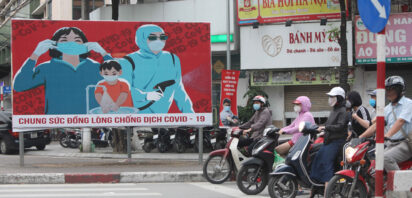
Vietnam’s effective response to COVID-19 has attracted widespread global acclaim. Eight months into the pandemic – after an early lockdown, border closures and an aggressive contact tracing strategy – Vietnam has recorded just 1,215 cases and 35 deaths. Vietnam’s economy is expected to be one of very few in Asia to expand despite the tumultuous events of 2020, with the government projecting annual GDP growth of 2–2.5%. This target was revised down from the 5% predicted before a second wave of COVID-19 emerged in the central city of Da Nang in July, compounding damage to the virus-hit tourism and hospitality sectors.
Although borders remain closed to most visitors, Vietnam has regained control of COVID-19 since the Da Nang scare, with no community transmission reported in 70 days. While pledging that containment of the virus remains its main priority, the ruling Vietnamese Communist Party is cautiously looking to the future. Last month, it announced a new five-year economic plan, aiming for average growth of 6.5–7% between 2021–2025. Yet to meet this target, a strong domestic revival must be aided by a boost in FDI and exports, which is likely if existing trade tensions between the US and China persist under President-elect Joe Biden.
COVID-19 slows decades of rapid growth
Prior to the onset of COVID-19, Vietnam’s GDP had increased at an annual rate of 6% over the past decade, making it one of the fastest-growing economies in the region. After initially struggling to recover from the Indochina conflict, which ended with communist victory over the US-backed regime in Saigon in 1975, the government in Hanoi ditched its centrally-controlled approach to state finances in the mid-1980s in favour of a ‘socialist oriented market economy,’ facilitated through a 1986 reform package known as Doi Moi, or renewal. Vietnam de-regulated its market and opened-up to foreign investment, setting the stage for the export of agricultural commodities such as rice and coffee, textiles, and more recently electrical products.
More than 40 million Vietnamese have since risen out of poverty. GDP per capita reached $2,750 last year as the country has moved comfortably into middle-income status, helped by a free trade deal signed with the US in 2000. Vietnam joined the World Trade Organization in 2007, while a free trade agreement with the EU in 2019 injected further impetus. Major economies have contracted amid COVID-19, but Vietnam has avoided the worst. Inevitably, aviation and the tourism industry have been badly hit. Vietnam Airlines estimated it will lose $647 million this year, while arrivals for January–September are down 67% on 2019.