In its latest update on government defense spending, the Stockholm International Peace Research Institute (SIPRI) forecasts that 2019 may represent an apex in what has been a historic run over the last decade. With response and recovery plans associated with COVID-19 absorbing a significant amount of government resources, defense spending is likely to see a decline, even as governments shift and deploy military resources as part of their pandemic response efforts.
Underlying SIPRI’s annual report and its compiled figures are a series of findings that offer insight on the geopolitical ambitions and concerns of the world’s powers and its periphery. In particular, three findings are salient in understanding shifts in the security realm: the anticipated return of “great power conflict,” the Asian arms race, as well as a Central and Eastern European-led effort to hedge against Russia’s regional aspirations.
A Return to “Great Power Conflict”
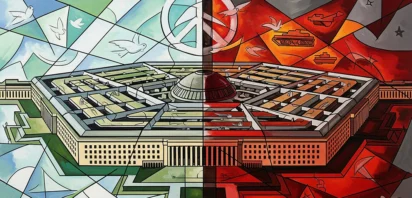
Few predictions are more frequently invoked among policy circles than a resurgence in “great power conflict.” Any notion of American unipolarity has withered in the face of China’s precipitous rise as the next global superpower, and a brand of Russian foreign policy described as revanchism.
Such conditions are best exemplified by trends that first emerged during the Obama administration’s “Pivot to Asia” and have persisted under the Trump administration. A broad interpretation of these trends indicates a reorientation of America’s defense strategy, with shifts from the Middle East and South Asia toward new theatres, such as the South China Sea and the Eastern Front borders shared between EU member-states and Russia.
In preparation for such a conflict, the United States continues to far outpace both China and Russia in defense spending, with $732 billion USD spent last year. Even combined, the expenditures of Russia and China are under 45% of that figure. Efforts to bolster capacity in both traditional domains (air, ground, sea) and emerging ones (cyber, space) are likely to play an outsized role in America’s maintenance of its military might, even as Russia and China seek to narrow the innovation gap.
Wargames that envision great power conflict often point out the asymmetric advantages enjoyed by Russia and China in areas such as disinformation and cyber-warfare. Furthermore, addressing logistical constraints and infrastructure deficits is a taxing exercise for America, particularly in scenarios where Russia and China would enjoy a “home field advantage” in mobilizing a greater number of its military resources in proximity to potential hotspots, such as the Baltic States for Russia, or Taiwan for China.