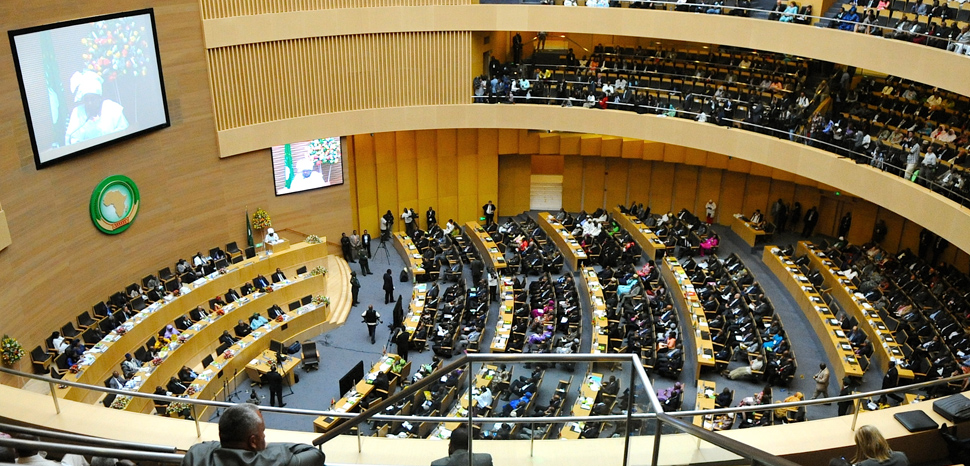
Quixotic, sluggish, and toothless are just some of the terms used to critique the legitimacy of the African Union (AU) and its policies. Now in the 18th year since its founding, the AU faces what could be its most exigent set of challenges to date. In North Africa, spillage from Libya’s Civil War has complicated ongoing counter- terrorism and insurgency efforts of neighboring Algeria, Egypt, and Chad.
In spite of foreign military support, the continent’s western half, which includes much of the Sahel, has been ravaged by a blend of terrorism and ethnic conflict that spans Nigeria, Niger, Burkina Faso, and Mali. Having endured daunting civilian and military casualty figures, the efforts of these countries to wrestle control from armed groups operating in largely lawless territories has seldom yielded promising results. Such conditions are a far cry from the lofty proclamation the AU made just seven years ago, in which the organization declared it would “silence the guns” and bring about a conclusion to the continent’s violent conflicts by the year 2020.
Meanwhile, in Central and East Africa, which feature some of the continent’s longest-ruling autocrats, electoral disputes and violence continue as recurring themes. To round out the continent’s struggles, weak commodity prices have led to subdued economic growth across Southern Africa, with the region’s attempt to industrialize and diversify hobbled by poor infrastructure and chronic unemployment.
While Africa’s silver linings remain outnumbered by its laments, positive prospects do exist in the form of demographics. Expansion of the continent’s middle-class, a youthful workforce, and the intrigue of foreign investors have buoyed optimism, with some observers maintaining a decades-old declaration that the 21st century will be “Africa’s Century.” Bolstering these hopes is the recent ratification of the African Continental Free Trade Agreement (AfCFTA), which promises to move the continent toward its goal of economic integration, in a bid to make it a formidable rival to other common-market unions, such as ASEAN, Mercosur, and the EU.
In keeping with its theme of “silencing the guns”, the AU’s most recently held summit featured an agenda prioritizing the continent’s need to contain conflict, a vital prerequisite to the success of continental initiatives like AfCFTA. By heralding momentous events such as pro-democratic reform in Sudan, or brokered peace between Ethiopia-Eritrea, Africa’s most bullish optimists hope to replicate comparable outcomes in the continent’s hotspots, namely the Sahel, Libya, and South Sudan.