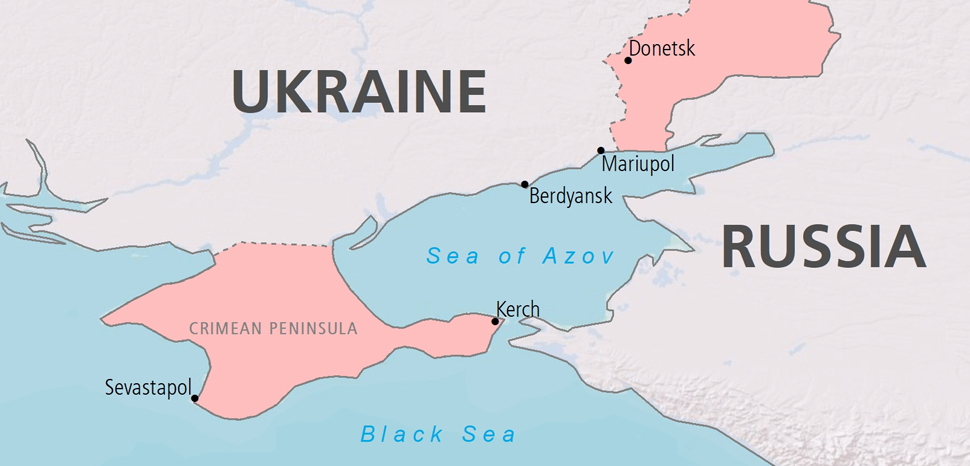
Sunday brought an incendiary new flashpoint in the Russia-Ukraine conflict. The incident occurred around the Kerch Strait, a narrow body of water separating Russia from the Crimean Peninsula. It involved three Ukrainian Navy vessels – two gunboats and a tug – which were fired on and disabled by a Russian FSB patrol boat, injuring at least six sailors on board. The Ukrainian boats and crews have since been taken into custody by the Russian authorities.
The naval clash is already reverberating politically (a pending vote on martial law and looming 2019 general elections in Ukraine), economically (the potential for Ukraine’s Sea of Azov ports to be blocked off), and militarily (the yet unresolved civil war in the east and potential for new altercations in the confined waters of the Kerch Strait).
Impact
The blame game unfolds as expected. Both sides are blaming the other, but it’s clear that the initial optics are unfavorable to Russia, which commands a much stronger naval force than Ukraine and predictably came out on top in the Kerch Strait exchange. Ukraine lost the bulk of its naval forces in 2014, when Russia confiscated Ukrainian military equipment in Crimea following its annexation of the peninsula.
Russian boats under direction of the FSB (the agency broadly responsible for domestic security and counter-terrorism) rammed the Ukrainian tug, and impeded its passage through the strait using an oil tanker. Blocking Ukraine’s access to the Azov Sea contravenes a 2003 agreement classifying the sea as the domestic waters of both countries. It’s also worth mentioning that this kind of blocking action wasn’t possible before the completion in May of a $3.6 billion bridge connecting mainland Russia with the Crimean Peninsula. With the advent of the low-lying concrete bridge, Russia began conducting inspections of Ukrainian vessels moving through the strait, drawing criticism from Kiev and Western governments.