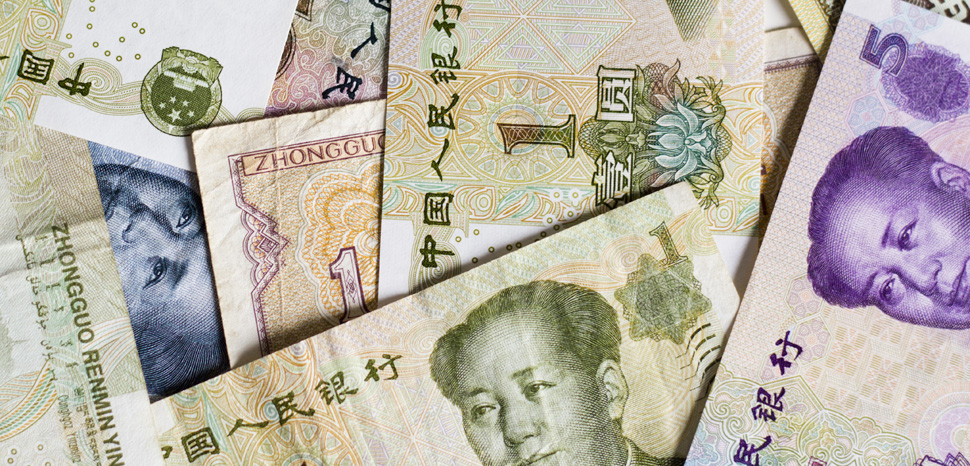
China’s renminbi hit its lowest level against the US dollar in nearly a decade on Friday, with onshore renminbi falling 0.22% to hit 6.96. The currency has now broken through its 3-year low set in December 2016, reaching levels not seen since the financial crisis.
If trends continue, the RMB will drop through the 7.00 floor that Chinese authorities have viewed as a key psychological level, one they’re willing to defend with aggressive money market interventions.
The People’s Bank of China (PBoC) maintains a hybrid monetary policy sometimes referred to as a ‘dirty float.’ The approach involves allowing the yuan to be reactive to market forces, but still stepping in to adjust its value via market interventions when the need arises. In practice, the renminbi is allowed to trade within a band determined by the PBoC, which sets a daily midpoint and allows a 2% fluctuation in either direction.
The ‘dirty float’ requires ample foreign exchange reserves to shore up the value of the local currency. The last time the RMB was under similar downward pressure in late 2016, Beijing was burning through upward of $70 billion a month in reserves to maintain its price target.
There had been a general consensus over the previous decade that we were going to see a liberalization drive in China that would allow the yuan to float freely, be easily convertible, and thus be elevated to a global status in the same vein as the US dollar. These reforms have not come about, and there’s no reason to believe we’ll see them anytime soon given the stability-over-all mantra of the Xi Jinping administration. Since the yuan joined the IMF’s Special Drawing Right (SDR) basket of currencies in 2015, financial system reforms have tended to go in the opposite direction, increasing government control over the currency.