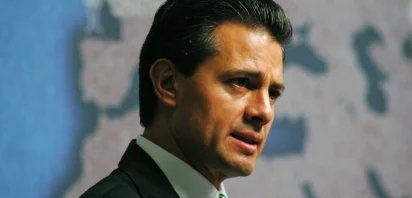
When Mexicans head to the polls on July 1, they’ll be bringing their brooms. The country appears to be the next stop of the populist wave sweeping establishment parties out of power throughout the democratic world. The current frontrunner is Andres Manuel López Obrador, often known by his initials AMLO, who leads the National Regeneration Movement (MORENA). According to recent polls, Obrador enjoys the support of 37.7% of likely voters. He is trailed by Ricardo Anaya of the National Action Party (PAN) with 20%. José Antonio Meade of the Institutional Revolutionary Party (PRI) is currently in third place with just 17%, setting the stage for a savage defeat for incumbent president Enrique Peña Nieto’s party.
The story of Mexico’s election is one that’s becoming increasingly familiar, that of an outsider (though this is AMLO’s third presidential run) benefiting from voter exhaustion amid a corrupt and ineffective political establishment.
But will AMLO be able to cure what ails Mexico?
Background
Getting to know AMLO
Andres Manuel López Obrador is a leftist firebrand who was flying the populist flag long before it came back into style. But don’t let that fool you; he is still a dyed-in-the-wool member of Mexico’s political class. AMLO is only an outsider insofar as actually obtaining national power is concerned. He began his political career as a member of the PRI party back in 1976, but when the Party of Democratic Revolution (PRD) split from PRI in 1988 amid allegations of election rigging, AMLO went with it and became the new party’s national leader. He went on to be elected the mayor of Mexico City in 2000, but resigned in 2006 to stand as PRD’s presidential candidate in a broad election coalition. He narrowly lost the vote, falling just 0.5% short of PAN’s Felipe Calderón, and subsequently refused to concede, prompting months of protest in Mexico City. Then in 2012 he stood once again as the PRD candidate, finishing second with 31.6% of the vote. In 2014, he founded a new party called the National Regeneration Movement, and will run under its banner on July 1.
Unlike the Donald Trumps and Sebastian Kurzs of the world, AMLO is a left-wing populist in the same vein as Bernie Sanders or, to a lesser degree, Jeremy Corbyn – who happens to be a close friend of his. AMLO’s message has always been one of “taking Mexico back,” back from the corrupt institutional parties like PRI, back from the oil barons, back from the cartels, etc. The message was the same in 2006 and 2012, but it has found a new resonance in 2018 due to the political ennui that descended over Mexico in the twilight of the Nieto era. Voters are tired of corrupt and incompetent leaders who have no solution to the problems of stagnant wages and spiraling drug violence (23,100 murders were investigated in 2017). They are motivated less by AMLO’s specific policy prescriptions and more by the fact that AMLO doesn’t belong to either PRI or PAN.