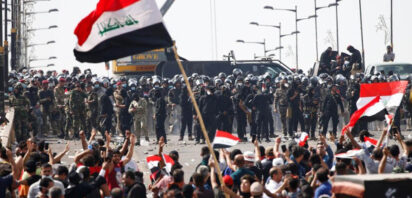
With 91% of the votes counted, Muqtada al-Sadr’s Sairoon Alliance of Shia is leading in Iraq’s elections. It’s trailed by the Iran-backed Fatah Coalition in second and Prime Minister al-Abadi’s Nasr Coalition in third.
al-Sadr’s strong showing comes as a surprise to many who were expecting the incumbent Prime Minister Haider al-Abadi to capitalize on his victory over Islamic State and win another term in office. It would appear that a split vote between Shia parties and widespread dissatisfaction over the country’s economic dire straits were too much for the Nasr Coalition to overcome.
Now the spotlight falls on Muqtada al-Sadr, the controversial Shiite cleric who made a name fighting against US occupation and then the Islamic State. Al-Sadr himself won’t become prime minister since he did not personally run for office, but he will be instrumental in forming the next government. His choices have the potential to recalibrate the delicate Iraq-US-Iran triangular relationship that has prevailed since 2003, with consequences for Iraq, the Iran-Saudi Arabia rivalry, and the region at large.
Impact
- Al-Sadr is no friend of the United States… or Iran. If victory for the Fatah Coalition, which includes the Popular Mobilization Unit militias, would steer Baghdad toward Iranian influence, and victory for al-Abadi’s Nasr Coalition would steer it toward Washington, then al-Sadr’s Sairoon Alliance is a vote for proceeding straight ahead and keeping both powers at arm’s length. Indeed, al-Sadr’s nationalist electoral slogan of “no USA, no Iran” mirrors the surprisingly diverse make-up of his coalition, which includes communist party and secular candidates. Though his movement has received support from Iran in the past, al-Sadr has set himself up as an alternative to the Shia religious establishment that leads straight to Tehran via Iraq cleric Ali al-Sistani (who declined to endorse a candidate in the election). He has even extended an olive branch to Saudi Arabia, traveling there in July 2017 to meet Crown Prince Mohammed bin Salman. One interesting note about this Saudi meeting is that it was soon followed with a call on the government from al-Sadr to disband the Popular Mobilization Forces, the Iran-backed militias that were deployed in the war against Islamic State. Looking ahead, this will be an interesting political fault line over the short-term, one that potentially pits Tehran squarely against the next prime minister, whoever they may be.