US debt is projected to surge over the short-term thanks to recent tax cuts and other longstanding government outlays. What this all might mean for US Treasury yields, and the US economy as a whole, is drawing a great deal of attention from market watchers. In the short term, the pump-priming from tax cuts has boosted markets, but companies like Goldman Sachs are warning that President Trump’s ambitious infrastructure plans and an unbalanced budget mean that the US is expanding its debt load at a potentially destabilizing pace. Goldman economists predict that the US deficit could reach 5.2 percent of gross domestic product by next year. This means market watchers are looking closely at how foreign buyers of US debt (especially China and Japan, who hold over $2 trillion in bonds between them) react to the latest planned borrowing spree by the US federal government. The appetite of foreign buyers for future US debt purchases will be a key test of whether US lawmakers can continue to borrow their way out of partisan gridlock on deficit spending.
Impact
The U.S. has never owed so much money before, and foreigners have never before owned so much that debt. Currently, foreign investors collectively hold about $6.35 trillion in US government debt, more than twice as much as in 2008, and that number is set to rise if President Trump’s infrastructure plans have any hope of securing financing. Battles over government spending and the rising tide of US debt date back to the George W. Bush administration. The Clinton administration was the last US presidency to project a budget surplus, not a deficit, all the way back in 2001, and the issue of how to tackle deficit spending without cutting cherished government programs in areas like defense or social security outlays has never been satisfactorily resolved in Washington’s hyper-partisan political culture.
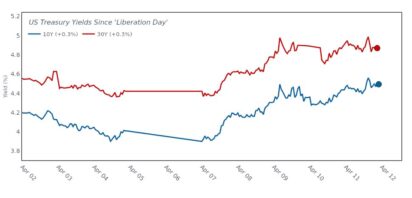
- Will foreigners buy more US debt? Markets are already jittery about gloomy long-term forecasts from the likes of the Goldman Sachs economists; the Japanese yen, considered a haven asset, climbed against the US dollar in its strongest showing in 12 months at the start of this week. At a time when Treasury issuance is set to grow sharply as the US budget shortfall increases, a fall in demand for US debt would force the Treasury to increase yields to lure in more investors. Investors also know there will soon be a flood of Treasury auctions, which could speed up the recent climb for bond rates. Higher borrowing costs in turn means greater pressure on the US budget in future, just as welfare payments to support an aging population are projected to ramp up sharply. In general, today’s younger taxpayers are also in a worse off fiscal position than earlier generations, suggesting that Washington may struggle to pay its mounting bills in the years to come.