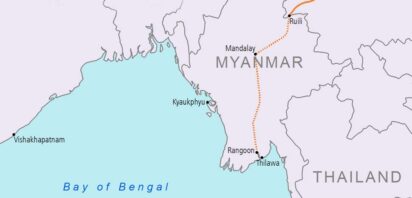
Building modern infrastructure to link China’s Yunnan province with South Asia via Bangladesh is an idea that long predates the Belt and Road Initiative. First imagined as the “Kunming Initiative” in the early 1990s, this regional development scheme contributed greatly to China’s earliest plans to revive the Silk Road of antiquity. In 1999, the Kunming Initiative evolved into the BCIM Corridor (Bangladesh, China, India, Myanmar). And over a decade later, it was incorporated into President Xi Jinping’s landmark Belt and Road Initiative.
Yet unfortunately, years of these rebrandings, and the vague pledges that inevitably follow, have done nothing to alter the ground-level geopolitical and developmental hurdles that continue to thwart greater connectivity in the region. Foremost among them is the fact that both India and China view swathes of the BCIM corridor as falling in their own exclusive backyards, and thus tend to view economic inroads made by their rival through a zero-sum lens. This dynamic has contributed heavily in making the BCIM corridor the most intangible of all overland BRI corridors. In fact, there was a moment in 2019 when it appeared as though the corridor had been dropped entirely from the BRI project.
Overview
BCIM corridor: style over substance?
There is an enduring economic rationale for creating a modern infrastructure network to link the economies of China, Myanmar, Bangladesh, and India. The region occupies prime geopolitical real estate as a potential nexus between East Asia, Southeast Asia, and South Asia, and it has long been a laggard in terms of poverty alleviation. However, there are also geopolitical reasons for Beijing and New Delhi to view each other as competitors (explained in detail below). This baked-in confrontation has stunted cooperation over the years, relegating the BCIM corridor to the realm of the hypothetical.
To get a sense of the pace: The concept of inter-governmental, coordinated sub-regional development was first announced in 1999, but the Kunming Initiative didn’t even feature any established mechanism for promoting state-to-state cooperation until 2013, when it was incorporated into the Belt and Road Initiative. Unfortunately, this latest rebranding also didn’t turn things around. Since BCIM came under the banner of BRI, the yearly Joint Study Group has produced no tangible results. In the April 2017 meeting, delegates proposed cooperation in 11 different sectors without specifying any actual projects (a stark contrast to more tangible BRI corridors such as CPEC).