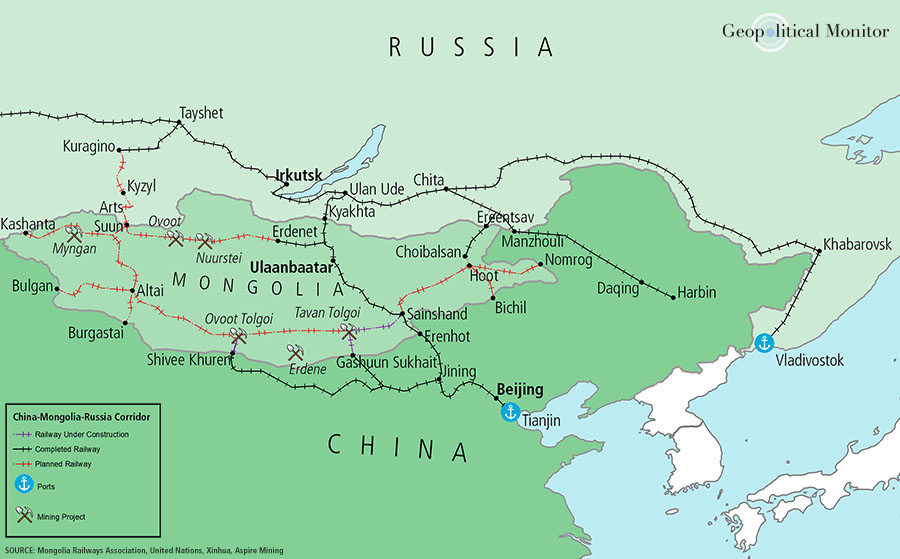
The China-Mongolia-Russia Economic Corridor (CMREC) is one of the six major corridors envisioned by China’s Belt and Road Initiative (BRI). The project seeks to improve infrastructure links between the three countries, reduce freight times, and create new sea and land-based export routes for Mongolian natural resources. It also aims to reduce bureaucratic barriers at the border and provide a shorter route for Russian freight to Pacific ports via Mongolia.
Stakeholders
Mongolia
CMREC represents the prospect of large-scale investment inflows overhauling Mongolia’s aging infrastructure network; it would also situate landlocked Mongolia as a key link in new trade networks linking East and West, potentially representing new economic opportunities as a transit and logistical hub. In more immediate terms, CMREC will connect Mongolia’s southern coal deposits with China’s energy-hungry northeast. New rail links to connect Ovoot Tolgoi and Tavan Tolgoi with China’s national rail network are in the works; both use China’s 1,435 gauge standard. According to the Mongolian government, the Tavan Tolgoi-China link will be completed by 2021. Once it’s done, it will deliver up to 30 million tonnes of coal a year to the Chinese market.
Overall, some 90% of Mongolia’s exports are in the mining sector, and as such, the country is extremely susceptible to price swings in global commodity markets. Mongolia is believed to be sitting on anywhere between $1-$3 trillion in mineral wealth; specifically, the it is rich in copper, coal, crude oil, and various other nonferrous metals. However, the windfall tied to these resources is beholden to global supply and demand, local regulations, and environmental concerns. Nowhere is this truer than with the country’s southern coal industry, which booms or busts on Chinese demand. Some analysts believe that this demand has already peaked; others point to the possibility that it will do so in the near future due to the necessity of reorienting away from fossil fuels. Either way, a question mark looms over the long-term economic viability of projects like the Tolgoi mines.
In terms of the country’s involvement in BRI, Mongolia’s overriding priority is to secure new export markets for its commodity exports. Mongolia’s status as a landlocked country restricts its export options, which in turn depresses purchase prices and impacts overall economic development (by some estimates, this can result in as much as 40% of a price premium).
Mongolia has long sought to develop its national rail and road infrastructure, most recently with the government’s “Land Road” plan of 2013. Yet these initiatives have often floundered amid a dearth of outside investment. Enter China’s Belt and Road plan, which, supplemented by assistance from the China-led Asian Infrastructure Investment Bank (AIIB), is in the position to extend financing and kick start long-stalled infrastructure projects. That’s at least how it is supposed to work in theory. In practice, the political establishment in Mongolia is deeply concerned about becoming too economically beholden to its powerful neighbor to the south. These worries are underpinned by the deep and asymmetric links between the two countries – Mongolia sends some 84% of its exports to China – and such concerns have served to dampen Chinese investment levels, leaving them well below those seen elsewhere in BRI, namely the China-Pakistan Economic Corridor (CPEC).