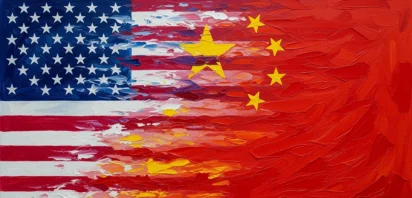
Relations between Russia and the U.S. have reached their lowest point since the end of the Cold War. In Europe, a new round of anti-Russian sanctions recently signed by US president Donald Trump is reinvigorating US allies in Russia’s neighborhood in Eastern Europe and the South Caucasus. US Vice President Mike Pence’s recent tour of Estonia, Georgia, and Montenegro further solidified the feeling that there is little space for Moscow and Washington to compromise in former Soviet territories.
Yet this does not preclude the U.S. and Russia cooperating in some areas around the world. For instance, in Syria, Moscow and Washington share the common vision of defeating Islamic State (ISIS). In Afghanistan, Moscow, like Washington, aims to limit instability and prevent it from spilling over into Central Asia. Tensions on the Korean peninsula could also serve as another area of cooperation, where both Moscow and Washington oppose Pyongyang’s nuclear program.
That said, any cooperation in Asia-Pacific and the Middle East is very unlikely to spread to the former Soviet space, which will remain a primary theater of interaction between Russia and the U.S. Cooperation in Afghanistan, N. Korea, or Syria would not diminish geopolitical disagreements over the NATO buildup in and around Eastern Europe, Ukraine, and Georgia, making it unlikely that relations between the two powers will improve in the near future.
Impact
Russia finds itself in a difficult position. The recent spike in tensions between Russia and the U.S. could well send both countries to the bilateral point-of-no-return. On July 30, Russia introduced countersanctions against the U.S. by ordering 755 American diplomats to leave the country. Moscow’s move comes after the U.S. toughened its own sanction regime against Moscow. Although these Russian moves were presented as countermeasures against the Trump administration, they were in fact directed against restrictions imposed by former US president Barrack Obama in late 2016, when 35 Russian diplomats were ordered to leave the country.
Politicians in Russia currently understand they cannot afford imposing serious counter sanctions against Washington as they would harm the much-troubled Russian economy more than the U.S. one. One good examples is Russia-manufactured power engines for NASA. As the U.S. depends largely on these engines, stopping their export could cause significant difficulties in the US aerospace industry. However it would cost the Russian economy as much as $1 billion in lost revenues over the next couple years, and Russian leaders are hesitant to inflict such self-harm.
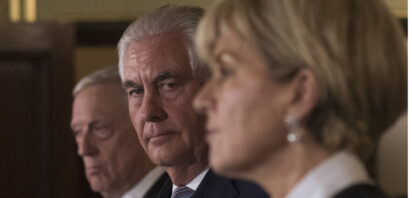
The very fact that Washington imposed sanctions on Russia together with North Korea and Iran makes it clear how the White House currently views Russian actions across Eurasia. Yet relations still haven’t reached the bottom, at least according to US Secretary of State Rex Tillerson, who said on August 1: “The [US-Russia] relationship is at a historic low since the end of the Cold War, and it could get worse.” On August 3, Russia Prime Minister Dmitry Medvedev made his own bleak statement on the state of bilateral relations, saying that any hope for an improvement in relations is now essentially lost with the new US sanctions.
Moscow sees that the pressure from the US significantly increased over the past several months. Indeed Moscow should be worried with the existing international situation. Official statements from American politicians on how supportive the US will be in case of conflict situation with Russia are clear signs of the US resolve. For instance, the US Vice President Mike Pence’s recent visit to Estonia and Georgia was a good reflection of this sentiment.
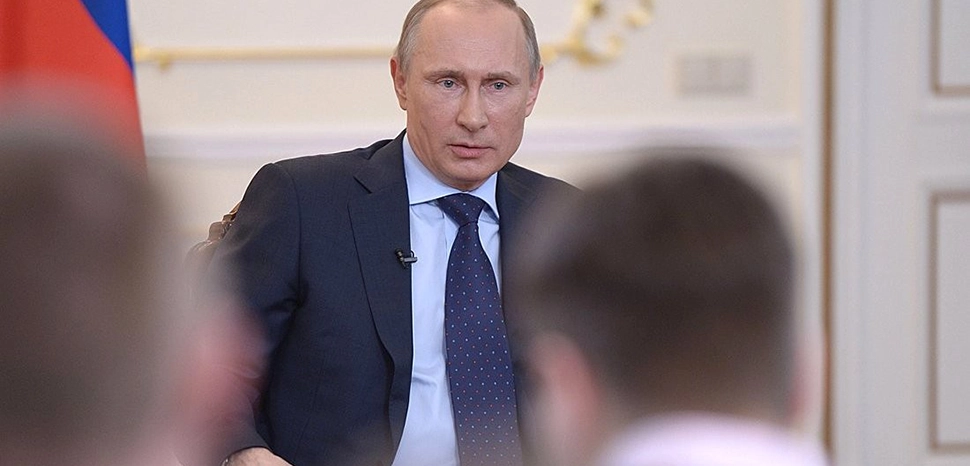
Moreover, beyond official statements, the US/NATO military and security build-up in Eastern Europe continues unabated. Several days ago the largest military exercises were kicked off on Georgian soil with the participation of US troops and its other allies. As a further sign of complicated situation the Kremlin is finding itself now is Putin’s recent decision to visit Abkhazia on August 8 which serves as the anniversary of a short Russo-Georgian war back in 2008. Moscow even made it clear that Putin’s visit specifically comes as a response to Pence’s visit in Tbilisi.
Thus the relations between the two powers are indeed strained. The US has made it repeatedly clear that any improvement of relations is contingent upon Russia making concessions in her current support for pro-Russia separatists in east Ukraine, Georgia’s breakaway territories of Abkhazia and South Ossetia, and elsewhere. Russia‘s complicated position naturally makes Putin to seek an exit strategy in other conflict areas across the globe where Russia holds political leverage.
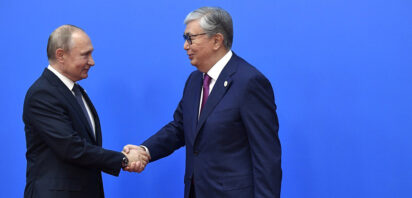
Last hopes for a thaw. Despite the two states reaching their lowest point in relations since the end of the Cold War, the two powers may still find some common ground for cooperation. Syria is a primary example for this. Indeed Russia and the U.S. share a vision of defeating the Islamic State. Both countries even managed to lay a foundation for future cooperation by announcing a ceasefire in the southwestern part of Syria. The agreement was reached in early July during the meeting of the two presidents in Hamburg, Germany.
Afghanistan could be another theater of cooperation as Russia fears the spillover of militancy across the Afghan border into the Central Asia. Moscow, at least in theory, is not entirely against the U.S. in Afghanistan since, despite Moscow’s military presence in Tajikistan and Kyrgyzstan, it is still unclear how effective those forces would be against potential cross-border attacks from the Taliban and Islamic State fighters.
The third geographic area of potential cooperation is the Korean Peninsula, where both countries oppose North Korea’s nuclear program and fear that the Kim regime could deal a final blow to international non-proliferation policy, which is already under a considerable stress from both Moscow and Washington.
Yet even these potential points of cooperation have their limits. In Syria, for instance, Putin’s grand gamble of tying up the Syrian civil war with the Ukraine crisis in order to gain leverage in negotiations with the West has notably failed. Western countries successfully decoupled Syria from the Ukraine problem. In Afghanistan, the U.S. has been criticizing Moscow for its alleged military support of the Taliban and its interference into Afghanistan’s internal affairs. In North Korea too, despite their shared vision, Secretary Tillerson recently criticized Russia along with China for not doing enough to stop Pyongyang’s nuclear program.
Forecast
Russia feels considerable pressure from the U.S. across the former Soviet space. Relations have reached the lowest point since the end of the Cold War. Although there are several theaters across the globe where Russia and the U.S. could cooperate, there are still substantial obstacles to doing so. This, in turn, leaves little chance for any rapprochement between the two powers across the former Soviet space. Different geopolitical readings on Ukraine, Georgia, and the wider eastern European security makes it highly unlikely to expect any breakthrough in Russia-US relations in the coming months.