Two national elections will be held in Indonesia this year. The first one, the national legislative election, will be held in April, setting the stage for a presidential election in the summer. The parliamentary election is critical not just in its determining of which political parties earn the privilege of nominating a presidential candidate, but also because it will provide an early insight into the shifting political mood in Indonesia.
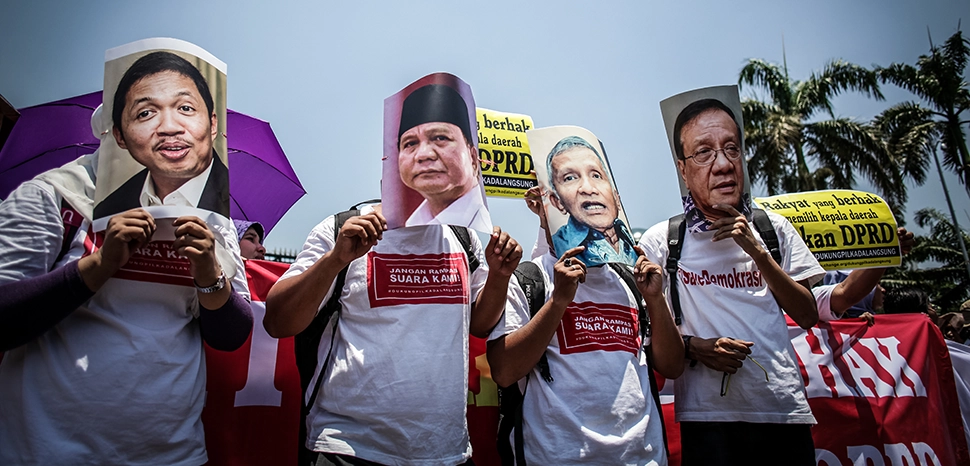
The political establishment in Indonesia has never seemed less popular. Stalled democratization initiatives and rampant corruption in the halls of political and military power have not gone unnoticed by the Indonesian public. Party loyalty has hit rock bottom, and an increasingly cynical electorate is eager to find alternatives to the status quo. Parties that can convincingly adopt the mantle of reform and field new faces will enjoy great electoral success, while parties that promise business as usual while fronting traditional figures are at risk of falling behind.
Those hoping for a new breed of politics are focused on Joko Widodo, better known as Jokowi, the meteoric governor of Jakarta and unofficial presidential hopeful. Though he has thus far abstained from national politics, his rising star would no doubt be singularly influential should he throw his lot in with a particular party and confirm a bid for the presidency.
The absence of a fresh political brand has led to many disengaged voters in Indonesia, who view the major parties as largely interchangeable. But with the buzz surrounding Jokowi, and a clear incentive for parties to enlist young, reform-minded leaders, the 2014 elections may see voters taking a renewed interest as they try to cast out the old for the new.
Parties and Politicians
Indonesia’s party landscape is diverse and shifting, and coalition governments have historically been the norm. No democratically-elected party has ever managed to secure enough of the People’s Representative Council (DPR) to operate without needing to assemble a ruling bloc.
Much of this shifting nature has to do with the relationship between parties and presidential nominees. Unfulfilled promises of democratization and little activity in parliament have left many Indonesian voters disillusioned. Rather than adhere to party ideologies, which often overlap (all the leading parties are secular and nationalist), Indonesian voters tend to throw their support behind strong or charismatic individuals, whenever such figures arise. As a result, leaders may be popular but not their parties, or vice versa, and parties within the coalition-dense system tend to rely heavily on partnerships and running-mates to gather support.