China often has a turbulent and tense relationship with western countries; it has huge economic power but a shaky human rights record and a tendency towards oppressive and heavy-handed policy-making. However, in at least one sector, China is pulling ahead of the global pack in its commitment to clean energy.
China may become the unlikely champion for green energy, as the economic powerhouse is in the midst of a growing pollution crisis. In response to rapidly decreasing air quality in major cities and the resulting widespread health issues, China’s government has declared a “War on Smog.’
Although a complete transition from coal to cleaner forms of energy would be ideal, in reality China still relies heavily on coal, and therefore fossil fuels, to keep the lights on. Any transition to cleaner, greener technology will take time, and it is unlikely that current technologies could totally replace coal in the near future. Due to the fact that China relies on coal for three-quarters of its power generation, efforts have been made to clean up coal production in addition to shifting towards cleaner wind and solar power. However, in an effort to ‘greenify’ its current coal usage, China has been spearheading innovation in the field of Carbon Capture and Storage, known colloquially as CCS. CCS is the process of removing fossil fuels from the coal-burning process and storing the carbons underground, where they can remain for thousands of years. Currently, CCS is too expensive for widespread application, but the technology does exist and is the best method of cleaning up coal that is available.
China’s Hexi corridor, a 600-mile stretch of land running along the southern edge of the Gobi desert, is dotted with coal plants and oil refineries. The region was once thriving due to large oil reserves, but has been abandoned in recent years as the oil and gas has been exploited to its capacity. In an ironic twist, the Chinese government has chosen this former poster child of dirty energy to develop its solar wind power capacity.
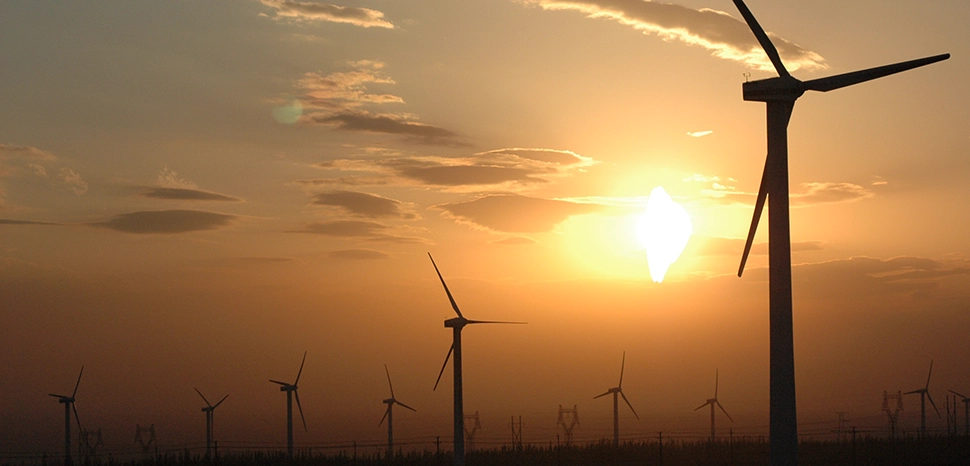
The Hexi corridor is characterized by consistent, high-speed wind gusts, which make it the perfect testing ground for the development of wind power. Solar panels have already been installed on many rooftops in the city of Yumen, and a 20-gigawatt wind power plant is currently under construction, which when finished will be one of the largest in the world.