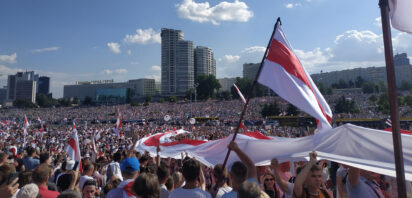
The population of Iran continues to take to the streets, demanding liberty, a better life, and dignity. Similarly, the Iranian government continues to resort to repressive and violent counter-measures to crack down on protesters. At the time of writing, the number of deaths number is estimated in the thousands. It is still unclear whether the Iranian government will remain in power – Tehran has survived other major uprisings in recent years – or if a transition will occur.
It is important to keep in mind that Iran has a very diverse population. Persians comprise the majority, but there are many minorities and ethnic groups. Tehran’s repressive activities make no distinction among protesters. This analysis will discuss the ongoing Iran crisis by focusing on the Azerbaijani population of Iran, a critical factor in the ongoing protests.
A Decade of Protest
Since the Iranian Revolution of 1979, the Iranian government has been known for its repressive behavior towards its own population. Within the past decade, more and more Iranians have taken to the streets to protest economic hardships, lack of employment, water shortages, or general government repression. Protests took place between 2017 and 2018, in 2019, and in 2021. The more recent 2022-2023 protests commenced after the 22-year-old Kurdish-Iranian woman Mahsa Amini died in a hospital in Tehran, after she was beaten up by the country’s infamous religious police. Her crime? Choosing not to wear a hijab.
The more recent round of protests commenced in late December 2025, due to high inflation and food prices. The protests then expanded into broader anger towards the government and have spread across the country, though the uprisings are more prevalent in some areas than others.
Thousands of people have died in the recent wave of protests, for the unforgivable crime of wanting a better life. Azerbaijani blood has also been spilled. During an anti-government protest in South Azerbaijan province, the Azerbaijani footballer Mojtaba Tarshsiz and his wife were killed by gunfire.
Iran: A Multi-Ethnic Nation
Multi-ethnicity is a factor to keep in mind, as Iran is highly diverse. The Persians constitute the majority of the population, but there are many other ethnic groups, including Azerbaijanis, Kurds, Balochi, and Turkmen. Unfortunately, the Iranian government (both during the Shah era and post-1979 Revolution) has treated the non-Persian populations as second-class citizens. A historical concern for Tehran is that non-Persian populations may seek to separate from Iran or attempt to greater autonomy within the country. Rather than engagement and developing a common national identity, the Iranian government chooses fear, intimidation, and violence.
The Azerbaijanis constitute Iran’s largest non-Persian population: an estimated 30 million live in Iran, making them the second-largest ethnic group, after the Persians. They primarily live in the northern provinces: East Azerbaijan (particularly in the provincial capital, Tabriz), West Azerbaijan, Ardabil, and Zanjan.
As I have previously discussed, Tehran has engaged in systematic cultural repression against the Azerbaijanis in Iran. For example, young Azerbaijanis are not allowed to learn their native tongue or Azerbaijani history in schools. Article 15 of the Iranian Constitution calls for the education of Iran’s minorities in their respective mother tongues, but this does not occur in practice. What Tehran is carrying out is the eradication of the identity and culture of Azerbaijanis in Iran. Moreover, job opportunities are scarce in the northern provinces, and poverty is rampant. The environmental situation is also problematic. Lake Urmia, the region’s largest body of water, has dried up in recent decades, with Tehran seemingly uninterested in stopping it. This situation hurts access to water for Iranians living in the north, particularly Azerbaijanis. (The Iranian government, in general, has a history of not caring about environmental protection, a fact demonstrated by the dangerous levels of air pollution in Tehran itself.)
When peaceful protests occur, individuals are quickly arrested and sent to prisons where they are also abused. Many Azerbaijani activists and citizens are arbitrarily detained and sentenced to unjust prison sentences, including being transferred to the infamous Evin prison in Tehran.
President Masoud Pezeshkian was elected in 2024 (after President Ebrahim Raisi died in a helicopter crash), and there were hopes that he would be a reformist. Unfortunately, Pezeshkian’s first year in office was summarized by the Middle East Institute, a research center in Washington, DC, as fractured by “familiar political structural constraints, external crises, and a moderate-reformist base forever frustrated with his cautious pragmatism and unfulfilled promises,” adding that the leader “has not made any fundamental difference in how the Islamic Republic is run.”
Azerbaijanis and the Recent Protests
As for the current wave of protests, they have spread across the country. Dr. Shukriya Bradost, Professor of International Security and Foreign Policy at Virginia Tech University, points out that “the role of Iran’s ethnic minority groups in the current protests has evolved” from initial skepticism to more active involvement.
Kurdish involvement in the protests began in the small city of Malekshahi in Ilam province on January 3, according to Bradost. The Baloch people in Iran’s Southeast have also joined the protests. As for the Azerbaijanis, Bradost notes, they “joined later and more cautiously” as the delayed, small protest reflects Azerbaijanis’ “current favorable position within Iran’s political, military, and economic institutions.”
History is a critical factor that is influencing the level of engagement as well. A commentary by Rachel Avraham in the Jerusalem Post focused on the level of engagement so far of non-Persian groups across Iran in the protests. The author notes that one concern is that the protests “were initiated in Tehran with chants in support of Reza Pahlavi,” the son of Iran’s last Shah. Analyst and commentator Reza Parchizadeh, quoted in Avraham’s report, noted, “this is deeply problematic for many ethnic minorities, whose ancestors were suppressed in different ways under the rule of his father and grandfather.” The analysts adds, “much of Pahlavi’s current support base is itself hostile to ethnic minority claims and demands, which further alienates these communities.” In other words, while large parts of Iran are protesting against the Iranian regime, there are also strong divisions and distrust due to how non-Persian communities have been historically treated by Tehran, even prior to the revolution.
Regime Change: Two Sides of the Same Coin?
Dr. Ali Askerov, Professor of Peace and Conflict Studies at the University of North Carolina – Greensboro, believes the same. In a recent analysis of the ongoing protests, he noted that calls for the return of the Pahlavi era by some Iranians within Iran “reinforces a long-standing fear: that any post–Islamic Republic order would simply reproduce a Persian-centered hierarchy under a new political label.” The academic goes on to explain that the monarchy and the Islamic Republic actually share some common traits: both systems relied on strong centralization, cultural homogenization, and the suppression of non-Persian identities, Askerov said.
Similar opinions were shared by Negar Mortazavi, an award-winning journalist and commentator, editor and host of the Iran Podcast, and a Senior Fellow at the Center for International Policy (CIP), a think tank in Washington, DC, and Dr. Daniel Brumberg, the Co-Founder and former Director of Democracy and Governance MA Program at Georgetown University and a Senior Non-Resident Fellow at the Arab Center during a recent event at Georgetown University titled “Protests in Iran: Is this the End of the Islamic Republic?” organized by the Alwaleed Center for Muslim-Christian Understanding.
In response to a question by the author of this essay about the role of the non-Persian population in the ongoing protests, Mortazavi noted that, Azerbaijanis “didn’t join the protests early on. It only happened later.” She added that the more “remote provinces,” like the Azerbaijani provinces or the Kurdish provinces, “are more impoverished,” which is linked to “a fear of the central government of the threat of border communities.”
Meanwhile, Brumberg noted that ever since the establishment of the Islamic Republic, and even during the era of the monarchy there has been drive by the central government of the country “to impose its will on these communities and to extract resources from them,” while at the same time “contain any sort of political threat that they may pose to the regime.” Should the protests continue and the regime collapse, this scenario “creates a real possibility of the fragmentation that the government fears is a consequence of its own policy,” the scholar explained.
Overall, all scholars and analysts mentioned in this section agree that Tehran, both during the Islamic Republic and the monarchy, has historically treated non-Persians, like Azerbaijanis, with repression. History matters, hence calls for the return of Reza Pahlavi have not resonated positively among the non-Persian population.
Looking Ahead
It is too early to predict the future of Iran, and whether the protests will succeed in regime change or at least some change in the manner the Iranian government treats its population – Persians and non-Persians alike. At the time of writing, the prospects for positive change remain slim, particularly as the Iranian government will not go down without a proverbial fight. Iranian officials have reportedly commenced punishment for rioters. Judiciary chief Gholam-Hossein Mohseni-Ejei has stated on social media that “our main work at the judiciary about the recent developments has just started,” and “if, without justification, we grant leniency to someone who is not deserving of leniency, then we have acted contrary to justice.” In other words, violent repression continues to be the Iranian government’s primary strategy.
Many analysts and officials from different governments are predicting the collapse of the Iranian government. However, the dictatorship has survived other massive nationwide uprisings in recent history, so it is debatable whether the current protests will have any short- or long-lasting effect. Ultimately, life in Iran must change for the entire population. A better quality of life, job opportunities, a healthy, natural environment, and a transparent government that focuses on good governance, freedom, and rejects repression are all rational expectations that any Iranian should have. As for minorities like the Azerbaijanis of Iran, it is time that they are treated with the respect that they deserve as equal human beings.
The views expressed in this article belong to the author(s) alone and do not necessarily reflect those of Geopoliticalmonitor.com.