
On March 26, 2026, Iranian Foreign Minister Abbas Araghchi announced that vessels from five nations — China, Russia, India, Iraq, and Pakistan — would be permitted to transit the Strait of Hormuz. Malaysia and Thailand were added shortly after, following separate bilateral negotiations with Tehran. The Philippines followed. The criterion for passage was neither tonnage, nor flag registration, nor international mandate. It was the nature of each country’s relationship with Iran.
Naval analysts reached for their charts. Legal scholars reached for UNCLOS. Maritime insurers reached for their exclusion clauses. Yet the most precise framework for interpreting what Iran had just done was written not in Geneva or The Hague, but in ninth-century Baghdad — by a jurist named Muhammad ibn al-Hasan al-Shaybani. This is not a historical curiosity. It is an analytical problem. And that problem is becoming strategically consequential.
The Framework That Rules — and Where It Ends
Mahan’s central insight was that maritime power determines global power. Whoever controls the narrow passages between oceans controls trade, and whoever controls trade controls strategic outcomes. The Strait of Hormuz — through which roughly 20 percent of globally traded oil and 20 percent of global LNG transited daily before February 2026 — is the paradigmatic Mahanian chokepoint.
The framework is correct as far as it goes. Military power does determine who can physically enforce passage. When Iran threatened closure in 1988, Operation Praying Mantis provided the kinetic answer. But Mahan asks: who has sufficient naval power to control the strait? He does not ask: who holds the legitimate right to determine who passes? These are different questions. The first is answered by force. The second is answered by rules — and rules require a framework for legitimacy, not just a fleet.
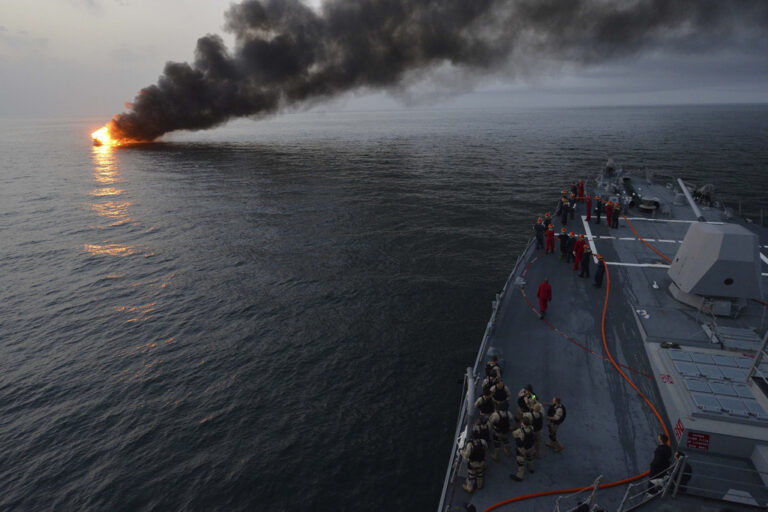
When Iran published its passage list in March 2026, no amount of naval tonnage explained the logic. Countries were permitted or denied passage based on their bilateral standing with Tehran. The United States Navy, positioned nearby, could not compel inclusion on the list without escalating to a level of force that would destabilize the very energy system it sought to protect. Mahan’s equation produced no answer.
The Jurist Who Asked the Right Question
Muhammad ibn al-Hasan al-Shaybani (749–805 CE) was the leading jurist of the Hanafi school in Abbasid Baghdad. His Kitab al-Siyar al-Kabir — the “Great Book of the Law of Nations” — is the most systematic treatment of inter-entity relations in the classical Islamic legal tradition. Written six centuries before Hugo Grotius and a full millennium before Mahan, it addresses a question that has returned to the center of global affairs: Who governs the spaces between sovereign entities?
Shaybani’s framework rests on a distinction that Mahan never drew: the difference between military control of a passage and the right of transit through it. For Shaybani, the key variable is not power but the nature of the relationship between the entities involved. A merchant traveling under aman — a safe-conduct — holds rights that a hostile state’s vessel does not, regardless of the relative military strength of the parties. The space between entities has legal character derived from the relationship, not from geography or force alone.
His framework for the aman is particularly precise. Once granted, the merchant’s contracts are enforceable, his goods are protected from seizure, and he has standing to seek redress if wronged. The underlying logic: the passage of goods and commerce can be separated from the state of war between political entities, provided the relationship governing the passage is clearly defined and mutually reliable.
This is exactly what Iran applied to the Strait of Hormuz. The passage list was not arbitrary. It reflected a categorization of relationships: states with functioning bilateral ties, trade agreements, and mutual interest received passage; states operating under US-Israeli alignment — where no such relationship existed — did not. Iran’s Foreign Minister made this explicit: “There is no reason to allow the enemy to pass through the strait.” The criterion was relational legitimacy, not raw power. Shaybani would have recognized the architecture immediately.
Who Writes the Rules of the Passage?
The Hormuz passage list raises a question that extends well beyond the current conflict: who holds the authority to determine the legal character of a strategic strait? The 1982 UN Convention on the Law of the Sea establishes the right of transit passage through international straits, explicitly limiting coastal-state jurisdiction. Iran’s ceasefire position — which asserts exclusive sovereignty over the strait — directly challenges this architecture. But legal challenge alone does not shift the framework. What shifts it is the demonstrated capacity to enforce an alternative.
When Iran effectively sorted passage requests by bilateral relationship — and when ships from China, Russia, India, Pakistan, Malaysia, Thailand, and the Philippines transited while others waited — a de facto alternative framework operated in real time. UNCLOS did not disappear, but its practical authority over the strait’s daily operation was temporarily displaced. The governing logic was Shaybani’s, not Grotius’.
The disruption to the strait has laid bare two structural shifts that predate the war itself. The dollar’s share of global foreign exchange reserves fell to 56.3 percent in mid-2025 — its lowest point in three decades, according to IMF COFER data. Simultaneously, the Gulf’s share of global oil exports has declined from 55 percent in 1980 to under 35 percent in 2024, while semiconductor trade now rivals petrodollar flows in scale. The Iran war did not create these pressures. It revealed them. The petrodollar system’s governing logic — oil priced in dollars in exchange for US security guarantees — is being stress-tested precisely because the underlying relationships have already shifted.
Whoever writes the rules governing the next settlement architecture — for straits, digital trade corridors, or reserve currencies — will exercise constitutive authority of the kind Shaybani described at the level of inter-entity law. These rules are not the same as military power. Mahan’s answer is temporary. A framework embedded in the practice of parties who accept it can outlast the power that first established it. The Abbasid Caliphate that hosted Shaybani is long gone; the legal principles he articulated shaped inter-entity commerce for centuries after it fell.
The Question That Remains
The Strait of Hormuz crisis is generating a vast literature on energy economics, military deterrence, and alliance management. Most of it asks Mahan’s question: Who has sufficient power to reopen the strait? This is an important question. It is not the only one.
The more durable question is Shaybani’s: who will write the rules that govern passage when the military crisis subsides? That answer will not be found in force alone. It will be found in the legal architecture embedded in post-conflict arrangements — the passage protocols, the insurance frameworks, the corridor agreements, the settlement currencies. Iran’s passage list lasted weeks. The rules written into the frameworks that follow it may last decades.
This is the lesson that Mahan cannot teach. And it is the lesson that a ninth-century Abbasid jurist — writing about merchants crossing between entities in a state of war — understood with a clarity that contemporary strategic analysis is only beginning to recover.
The views expressed in this article belong to the author(s) alone and do not necessarily reflect those of Geopoliticalmonitor.com.