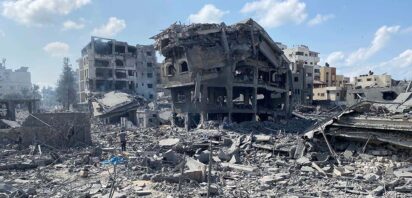
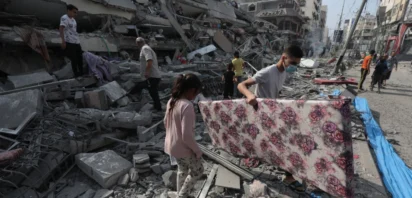
The conflict in Gaza has generated more moral commentary than analytical clarity. It is described, depending on the observer, as a just war against terrorism, a humanitarian catastrophe, a failure of international law, or a symptom of American imperial decline. These readings are not simply incompatible, they just proceed from entirely different frameworks of analysis. And it is precisely that divergence, more than any single event on the ground, that explains why the international system has been so comprehensivelyparalyzed in response.
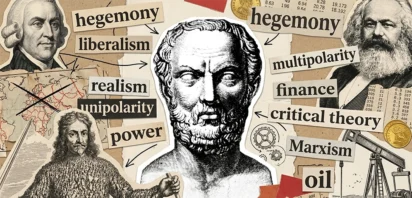
The tools of international relations theory — realism, liberal institutionalism, constructivism — do not adjudicate who is right. They do something more useful by explaining why the same conflict produces radically different imperatives depending on how one reads the international system. Gaza has become, in this sense, a stress test not only of international humanitarian law (IHL) but of the analytical frameworks through which states decide what they owe each other — and what they owe the rules. Trump’s foreign policy has not created this tension, but has made it impossible to ignore.
The Realist Is Not Surprised
From a realist standpoint, the situation in Gaza is more a confirmation than a paradox. Israel is a state fighting for its survival against an organization whose foundational objective is its destruction. The October 7, 2023 attack killed approximately 1,200 people and took 250 hostages. Hamas has since refused disarmament and has operated from within civilian infrastructure — hospitals, schools, residential areas — in a deliberate strategy that exploits the asymmetry between a state bound by international law and a non-state actor that ignores it. For the realist, a state in these conditions does not accept normative constraints that its adversary treats as a tactical resource.
Realism also predicts the US posture. Trump’s decision to suspend humanitarian conditionality — exempting military aid to Israel from a global freeze on US assistance — is not irrational within this framework. It is the logical expression of a transactional reading of alliances: Washington supports an ally it deems strategically valuable, without subordinating that support to normative constraints it considers secondary to the balance of power. What realism cannot easily explain is the long-term cost: an ally whose conduct systematically undermines the credibility of the order the United States itself built.
The Liberal Institutionalist Sees a Systemic Failure
The liberal institutionalist framework produces a different reading entirely. The architecture of international humanitarian law was designed precisely for conflicts like this one — not for symmetrical warfare between state armies, but for the asymmetric, civilian-entangled conditions that define most modern conflicts. IHL applies regardless of the justness of the cause and regardless of the adversary’s violations. That is its point. The question, for the liberal institutionalist, is not whether Israel has the right to defend itself — it does — but whether the institutions designed to operationalize those constraints can function when their principal guarantor withdraws from the enforcement role.
The evidence from Gaza suggests they cannot. The ICC issued arrest warrants for Netanyahu and former Defense Minister Gallant in November 2024, obligating all 125 member states to enforce them. The ICJ ordered Israel to ensure unhindered humanitarian access. Neither order produced meaningful compliance. States guaranteed Netanyahu safe passage; Belgium’s prime minister cited “realpolitik” to explain why arrest was unlikely. The institutions functioned — they deliberated, they ruled, they documented. What they could not do was convert those rulings into strategic costs without US backing.
This is the core liberal institutionalist diagnosis: the enforcement of IHL has always been structurally dependent on a power willing to impose costs on violators, including its own allies. When Trump suspended that conditionality, he did not abolish the rules, he removed the mechanism that gave them operational weight. The European response of summer 2025 illustrated the limits of what remains: Germany imposed an arms embargo, the EU moved toward suspending trade agreements, and both reversed course within weeks of Trump’s October peace plan. Without US leverage, multilateral normative pressure cannot sustain itself.
The Constructivist Identifies the Contagion
The constructivist framework shifts the question from enforcement to expectation. Norms do not function only through formal mechanisms, they function through shared beliefs about what behavior is permissible and what costs follow from transgression. When those beliefs erode, the norm weakens not only in the specific case but across the system, as other actors recalibrate what the order will tolerate.
This is where Gaza connects to a broader systemic dynamic. The argument is not that other states will imitate Israel’s specific conduct, the US patronage making Israel’s position possible is not replicable. The argument is that the selective suspension of IHL enforcement transmits a signal: the constraint is, from now on, contingent, not universal. Rules apply to those without powerful patrons. For those with one, they are negotiable. Every government that observes this updates its calculation of what future violations might cost and what pressure it can resist. The threshold of transgression, as in the South China Sea, has fallen.
Three Readings, One Verdict
What is striking about Gaza, viewed through these three frameworks, is not their divergence but their convergence on a single uncomfortable finding. The realist notes that power, not law, determines outcomes — and that an ally fighting for its survival will not be constrained by institutions its patron has chosen to bypass. The liberal institutionalist observes that the enforcement architecture of IHL has been functionally disabled by the withdrawal of American conditionality — leaving institutions that document but cannot compel. The constructivist warns that the signal being sent — that norms are selectively applicable — will reshape expectations across the system long after the conflict ends.
Trump did not create the asymmetries that produced this paralysis. He made them visible by removing the normative language that had partially concealed them. The result is a world in which international humanitarian law remains formally intact — its texts unchanged, its institutions still convening — but functionally conditional. That is not an anomaly specific to Gaza. It is, increasingly, the operating logic of the international order itself.