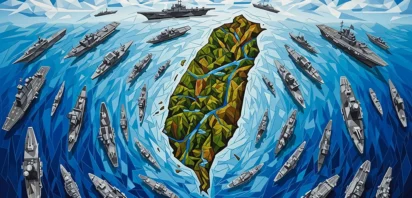
Taiwan’s international status hinges on three documents that dominate every legal brief, policy paper, and diplomatic exchange: the Cairo Declaration of 1943, the San Francisco Peace Treaty of 1951, and UN General Assembly Resolution 2758 of 1971. These texts rule the debate not because they offer clear answers, but because they form the only shared textual baseline that all major actors can selectively cite, reinterpret, or weaponize to advance competing claims.
Their authority exceeds their clarity. Cairo is non-binding, the San Francisco Treaty fails to mention any recipient of sovereignty, and Resolution 2758 addresses representation rather than territory. Together they answer the question of Taiwan’s ownership with deliberate silence, producing a calibrated ambiguity that every stakeholder exploits.
Beijing reads them as an unbroken chain proving “return.” Washington uses the same texts to justify strategic ambiguity, deterrence, and arms sales without recognizing statehood. Taipei invokes them to defend de facto independence while avoiding moves that would trigger conflict.
These documents function less as sources of law than as instruments of policy. They are flexible enough to sustain contradictory readings and rigid enough to forestall settlement. Their engineered gaps allow the PRC to assert claims without immediate escalation, the United States to deter aggression without treaty obligations, and Taiwan to govern itself without total isolation.
Eight decades on, this deliberate incompleteness remains both the stabilizing and destabilizing core of the cross-Strait status quo. This article examines how that incompleteness was constructed, why it persists, and who continues to benefit from a legal limbo that has outlasted the Cold War.
What the Three Documents Actually Say
Understanding Taiwan’s sovereignty debate requires acknowledging the uneven historical record. PRC archives remain largely closed, ROC materials are partial, and US documents reflect strategic framing during the early Cold War. These asymmetries shape how each actor constructs its preferred narrative. The Cairo Declaration, the San Francisco Peace Treaty (SFPT), and UN Resolution 2758 vary sharply in authority, yet they remain the only shared texts that all sides can cite, reinterpret, or use to justify competing claims.
The three documents set the boundaries of credible claims while leaving crucial gaps:
- Cairo Declaration (1943). Issued by Roosevelt, Churchill, and Chiang Kai-shek, Cairo was a political statement, not a treaty. It declared that territories seized by Japan, including Taiwan, “shall be restored to the Republic of China.” It relied on intent rather than law. The declaration projected Allied unity but offered no mechanism to implement transfer, leaving later actors free to question whether it alone could determine Taiwan’s sovereignty.
- San Francisco Peace Treaty (1951). Signed by 48 states, the SFPT carried binding authority over Japan’s postwar settlements. Japan renounced Taiwan, but the treaty named no successor government. In resolving Japan’s claims while leaving Taiwan’s status undefined, it created a legal vacuum that remains a central source of dispute today.
- UN Resolution 2758 (1971). This resolution recognized the PRC as China’s representative at the United Nations and removed Chiang Kai-shek’s representatives. It addressed representation, not territory, leaving wide interpretive space for competing claims.
Official readings differ sharply. Beijing argues that Cairo returned Taiwan to China, SFPT completed the transfer, and Resolution 2758 confirms PRC sovereignty. Taipei maintains that Cairo was non-binding, SFPT left status unresolved, and Resolution 2758 concerns representation only. Washington treats Cairo as aspirational, sees SFPT as leaving sovereignty undefined, and considers 2758 neutral on Taiwan’s status and PRC sovereignty.
The three texts do not reconcile with each other. Cairo promises but cannot enforce. SFPT renounces Japanese claims without naming a successor. Resolution 2758 decides who speaks for China at the UN while remaining silent on territory. The deliberate omissions of enforcement, beneficiary, and territorial scope, built into the documents in 1943, 1951, and 1971, remain the only uncontested facts in the debate. These gaps allow each actor to pursue its interests while sustaining a shared reference framework for legal and diplomatic arguments.
Background: How the Trio Emerged and Why Gaps Persist
The ambiguities surrounding Taiwan’s status were deliberate outcomes of shifting geopolitical imperatives between 1943 and 1971. Each document in the trio met immediate strategic needs while deferring final resolution, allowing uncertainties to accumulate.
The process began with the Cairo Declaration of 1943, a non-binding communiqué by the United States, United Kingdom, and Republic of China. Intended to sustain Allied unity and weaken Japan, it pledged that Taiwan and the Pescadores “shall be restored to the Republic of China.” Political symbolism outweighed legal precision, producing aspirational language with no enforcement mechanism and ignoring China’s looming civil war. This created the first enduring gap.
Japan’s 1945 surrender briefly operationalized Cairo’s terms, placing Taiwan under provisional ROC administration. No treaty confirmed permanent transfer, deliberately preserving flexibility as Cold War tensions and the Chinese Civil War intensified.
The San Francisco Peace Treaty of 1951 added the decisive legal layer. Signed by 48 states but excluding both Chinese governments, it required Japan to renounce Taiwan yet named no successor sovereign. The omission reflected US strategy amid civil war and the Korean War, choosing ambiguity over clarity to retain options in an unpredictable Asia. The treaty ended Japan’s claims while institutionalizing a sovereignty vacuum.
The final layer came with UNGA Resolution 2758 in 1971. During decolonization and early US–China rapprochement, it recognized the PRC as China’s sole representative and expelled ROC delegates. Narrowly framed, the text addressed only UN membership, leaving territorial questions unresolved and amplifying prior gaps.
This sequence of wartime pledge, provisional occupation, calculated legal silence, and representational reframing shows a consistent pattern: each instrument prioritized short-term imperatives over definitive settlement.
The resulting ambiguities were intentional, preserving maximum maneuvering room for major powers and leaving Taiwan’s status undetermined into the present.
Structural Tensions: Points of Alignment and Contradiction
The trio of documents do not form a coherent legal framework for Taiwan’s status. Instead, they create a deliberately fractured system, in which alignments and contradictions coexist to prevent definitive resolution while preserving strategic flexibility for major powers.
Examining these alignments and fault lines reveals how the trio functions less as a legal foundation and more as a repertoire of deployable fragments, which actors interpret selectively to suit their strategic aims.
Convergences
The texts share a narrow but undeniable common ground. All three assert two principles that no major actor publicly rejects:
- Japanese colonial rule over Taiwan must end. The declaration announced the political intent, the peace treaty turned it into binding law (Article 2b), and the resolution completed the anti-imperial arc by seating the PRC as China’s representative.
- “China” – whichever government embodies it – possesses the superior historical claim after 1895. Cairo named the Republic of China as the intended recipient; the SFPT deliberately omitted any beneficiary; 2758 implied the PRC as the bearer of that claim.
Beyond these two points, consensus collapses. The trio converges only in rejecting Japanese imperialism and in nominally restoring Taiwan to an undefined “China.” That is the ceiling and not the foundation of agreement.
Contradictions
Three structural fractures dominate and are demonstrably intentional:
- Intent versus Silence: The Cairo Declaration articulated a clear political goal (“shall be restored”) but lacked legal force. The San Francisco Peace Treaty, legally binding, refused to name a successor sovereign – an omission US negotiators fought to preserve amid the Chinese Civil War and the Korean War. Political promise collided with calculated legal neutrality.
- Representation versus Sovereignty: Resolution 2758 decided who speaks for “China” at the United Nations yet was deliberately drafted to exclude any reference to Taiwan’s territory. Sponsors (including Algeria, Albania, and others) accepted this limitation to secure passage. Beijing later grafted sweeping territorial implications onto a purely procedural text.
- Succession versus Self-Determination: The trio assumes Taiwan’s future lies with “China,” yet the SFPT’s silence on succession creates the very legal void that self-determination arguments exploit. The same documents are simultaneously invoked to assert Chinese sovereignty and to deny its completion.
These contradictions are not defects; they are design features. They allow every actor to cherry-pick compatible fragments while discarding inconvenient ones. Beijing stresses Cairo’s intent and Resolution 2758’s representation; Taipei and Washington highlight the SFPT’s silence and Resolution 2758’s non-territorial scope. No reading can be definitively refuted because no reading is definitively authorized.
The result is a canon that functions less as law than as a shared repertoire of rhetorical weapons. Its internal tensions do not invite resolution; they prohibit it. Eight decades after Cairo, the deliberate incompleteness of these three instruments remains the single most powerful stabilizing, and yet potentially destabilizing, element of the cross-Strait order.
Peripheral Texts in the Taiwan Sovereignty Debate
While the trio dominate Taiwan’s sovereignty debate, a number of secondary texts also shape legal and diplomatic discussions. These documents matter in specific contexts, but their influence is largely overshadowed by the central trio. International law and geopolitical considerations have consistently marginalized their authority.
These secondary instruments include:
- Potsdam Declaration and Japanese Instrument of Surrender (1945): Reaffirmed Cairo’s intent, with Japan formally accepting Taiwan’s return to “China.” These texts were subordinate to the non-binding Cairo Declaration and were effectively overridden by the SFPT’s silence on sovereignty.
- Treaty of Taipei (1952): Japan renounced Taiwan to the ROC, and mutual recognition lasted until 1972. The PRC was never a party, and the treaty was dismissed as inconsistent with the SFPT framework.
- US–ROC Mutual Defense Treaty (1954–1979): Explicitly included Taiwan and the Pescadores in US defense commitments. Abrogated in 1979 and replaced by the Taiwan Relations Act, it no longer governs international obligations.
- Three US–PRC Joint Communiqués (1972, 1979, 1982): US statements “acknowledge” Beijing’s claim over Taiwan but do not recognize sovereignty. They are political declarations, deliberately ambiguous and non-binding.
- Taiwan Relations Act (1979): US domestic law mandating arms sales and treating Taiwan as a de facto state. It lacks international legal personality.
- PRC Anti-Secession Law (2005): Authorizes force if Taiwan declares independence, but it carries no weight outside China.
- Treaty of Shimonoseki (1895): Original cession of Taiwan from Qing China to Japan. Invoking it today is politically sensitive.
- US–Japan Security Treaty (1960 revision): Implicitly covers areas under Japanese administration, but deliberately avoids mentioning Taiwan to maintain consistency with the SFPT.
These secondary texts could, in theory, clarify or challenge the canonical trio. In practice, they are largely treated as derivative, unilateral, outdated, or politically inconvenient. This ensures that the Cairo Declaration, SFPT, and Resolution 2758 retain their central, nearly mythic authority in shaping Taiwan’s legal and diplomatic position.
The Practical Effects of Taiwan’s Ambiguous Status
In 2025, Taiwan functions as a fully sovereign state in all practical respects except formal recognition. It has an elected president, a multi-party legislature, an independent judiciary, its own currency, passport, and armed forces. Citizens enjoy universal healthcare, same-sex marriage, and press freedom among the highest in Asia. No external actor exercises effective control over its territory, airspace, or governance, reflecting de facto sovereignty in its fullest form.
Yet the canonical trio leaves Taiwan legally isolated. Beijing uses Resolution 2758 to block its participation in the UN, WHO, ICAO, and Interpol. Only a few states plus the Holy See maintain formal diplomatic ties, all under pressure. The SFPT’s silence on a successor sovereign and the non-binding Cairo Declaration are cited to deny Taiwan separate statehood.
This creates a persistent asymmetry. Taiwan can defend itself with a modern, well-funded military and advanced asymmetric capabilities but cannot secure formal mutual defense agreements. It dominates semiconductor production yet faces barriers to major trade agreements, and it ranks among the world’s twenty largest trading entities while being excluded from Comprehensive and Progressive Agreement for Trans-Pacific Partnership (CPTPP) and Regional Comprehensive Economic Partnership (RCEP) due to recognition issues.
The ambiguity that began as wartime expediency has become a structural constraint. It protects Taiwan by raising the cost of forceful unification while limiting its legal and diplomatic options. Policymakers must balance domestic expectations with external pressures to maintain autonomy without provoking escalation. Taiwan’s sovereignty is real and experienced by its people, yet international law treats it as provisional. Historical documents written decades ago continue to shape the island’s freedom and vulnerabilities today.
Taiwan’s Ambiguous Status in Geopolitical Context
Taiwan’s unresolved status, sustained by the deliberate silences of the canonical trio, remains a central organizing principle of the Indo-Pacific order as of 2025. These documents do not settle the question of sovereignty; they preserve the space in which competing narratives operate.
Beijing uses the trio to legitimize its claims while maintaining escalation dominance. Resolution 2758 is repeatedly invoked to exclude Taiwan from UN agencies, and coercive pressure continues at a calibrated pace. PLA aircraft and naval vessels conducted over 3,000 incursions into Taiwan’s air defense identification zone in the first ten months of 2025, a tempo designed to intimidate without crossing into open conflict.
Washington maintains strategic ambiguity as deliberate policy. Arms sales under the TRA have reached approximately $35 billion since 2019, yet successive administrations still avoid committing to military defense. Congressional actions, including H.Res.148 and provisions in the FY2025 NDAA, explicitly counter Beijing’s interpretation of Resolution 2758 by affirming that it confers no PRC sovereignty and does not block Taiwan’s international participation.
Indo-Pacific alliances mirror this calibrated restraint. AUKUS and the Quad expand joint exercises, technology cooperation, and contingency planning without naming Taiwan as a trigger for collective action. Japan and South Korea deepen trilateral coordination with Washington while continuing to observe their one-China policies. Deterrence strengthens, but each actor preserves plausible deniability.
Taiwan’s dominance in advanced-node semiconductors, which account for 92 percent of global output below 10 nanometres in 2024 to 2025, converts legal ambiguity into systemic economic risk. Any blockade or invasion would likely cause global GDP losses of 5 to 10 percent, a scale far greater than the economic shock of the Ukraine war.
The canonical trio are not inert relics. Their engineered incompleteness provides legal cover for competitive behavior while embedding fragility into alliances, supply chains, and crisis management. This equilibrium has endured for eight decades, but in 2025 it shows growing signs of strain.
Why Legal Limbo Persists and Who Benefits
Taiwan’s legal ambiguity is not an oversight; it is an engineered outcome of the canonical trio. None of the three was ever designed to settle sovereignty; each preserved a vacuum that major actors now treat as a strategic asset.
Beijing gains most diplomatically, invoking the trio to assert ownership while using Resolution 2758 to exclude Taiwan from nearly every UN organ. The same silence on territory shields these exclusions from formal legal challenge.
Washington also exploits the gap, supplying arms, conducting transits, and coordinating allies without ever endorsing or rejecting PRC claims, thus preserving deterrence without treaty obligations since 1979.
Taipei leverages the absence of a definitive transfer from Japan to argue that its status remains unresolved, sustaining domestic legitimacy as a distinct democracy while steering clear of Beijing’s red lines.
Allies and trading partners, from Tokyo to Brussels, benefit from Taiwan’s 60% share of global semiconductors without granting statehood, maintaining economic stability and political deniability.
Recent US–EU rejections of Beijing’s expansive Resolution 2758 claims confirm the vacuum’s continued utility. Clarity would risk war, diplomatic rupture, or supply chain collapse. Ambiguity therefore persists, not because the documents failed, but because they succeeded in preventing settlement.
Conclusion
Taiwan’s status remains one of the most persistent ambiguities in international relations, sustained by a small set of historical documents whose authority outweighs their clarity. The Cairo Declaration, the San Francisco Peace Treaty, and UN Resolution 2758 each emerged from different contexts and carried different legal weight, yet together they created gaps that continue to shape diplomacy, strategy, and perceptions of sovereignty.
The influence of these texts extends beyond the Strait. Strategic ambiguity influences alliances, deterrence, and economic interdependence across the Indo-Pacific, especially in sectors such as semiconductors. It enables states to pursue competing interests with legal cover, but it also raises the risk of miscalculation when norms and intentions are unclear.
Taiwan’s legal and political limbo illustrates how historical documents can outlive their authors and embed ambiguity into the international system. Formal recognition is only one dimension of sovereignty. Understanding the origins, limits, and functions of these canonical texts is essential because ambiguity remains both a tool and a constraint in how power is exercised.
The trio continues to shape the island’s sovereignty, the conduct of great powers, and the stability of the regional order. Recognizing how these texts interact with contemporary realities is vital for navigating cross-Strait tensions and the wider international system going forward.