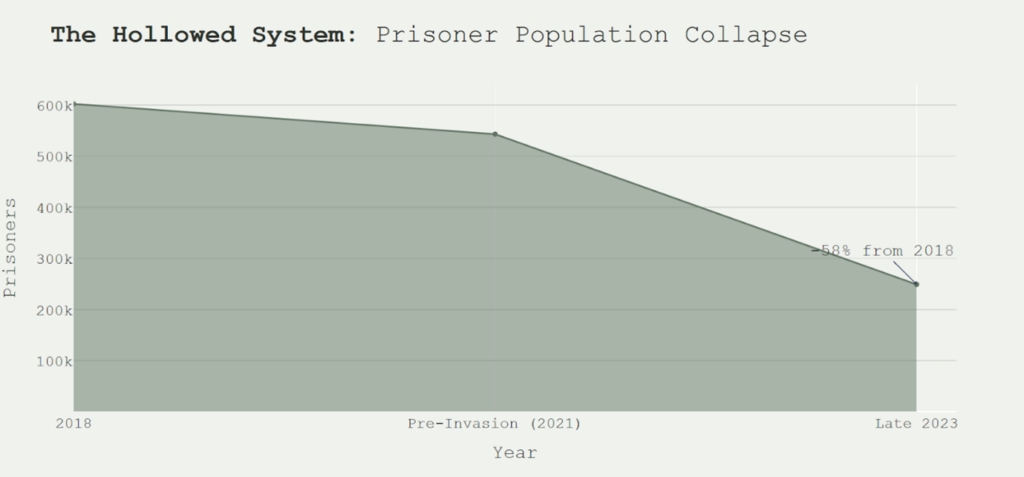
According to World Prison Brief data, Russia held approximately 602,000 prisoners in 2018. By late 2023, this number plummeted to historic lows of roughly 249,000, as reported by SWP. While differences in reporting methodology account for some variance, the trend is undeniable: the system has been hollowed out. Ukrainian Intelligence attributes at least 180,000 people to inmate recruitment practices. The same intelligence source indicates payment withholding practices and a casualty rate of nearly 70-80%—with tens of thousands killed in action. Which, compounded, underlines an economic reality: Russia’s Federal Penitentiary Service (FSIN) saved more than half a billion USD in 2022-2023, and the Russian Armed Forces gained soldiers who require minimal training and no veteran benefits, healthcare, or pension—a package that represents nearly $12 billion in avoided personnel expenditure. Since then, Ukraine has also implemented similar recruitment practices, with its Shkval Battalion.
Cleansing of Sins
“I can say with confidence: we’ve lowered crime in Russia tenfold, and we’ve trained former prisoners better than they trained Pioneers and Little Octobrists during Soviet times,” affirmed Prigozhin in 2023. His approach involved high-casualty, often suicidal, “human wave” tactics, which ensures that a significant portion of the most violent criminals are permanently removed from society. “It’s either them [the prisoners] or your children, decide for yourself,” he would say.
Wagner’s boss underlined a vision, a message. He implicitly positioned the prisoners as a disposable demographic layer whose sacrifice saves the general population from mobilization and further criminal activity.
He would also frame prisoners’ military involvement as a way for them to “redeem [their] debt to the Motherland” and “cleanse [their] sins by blood.” Such a philosophy and spiritual language rationalized the high-risk deployment as a form of societal and personal redemption. The notion of spilled blood is not new either, and can be found still nowadays, for example, in the French Foreign Legion doctrine, which allows every foreigner who served the French Republic to directly access French citizenship (see Français par le sang versé).
Either French citizenship or one’s own life and freedom, the idea of trading with individuals who have nothing to lose is at the core. From it, at least three branches of thought spread out: philosophical, societal, and economical. Given the world we are living in, and the priorities that it pushes, focusing on the economy seems appropriate.
The Cost of Meat
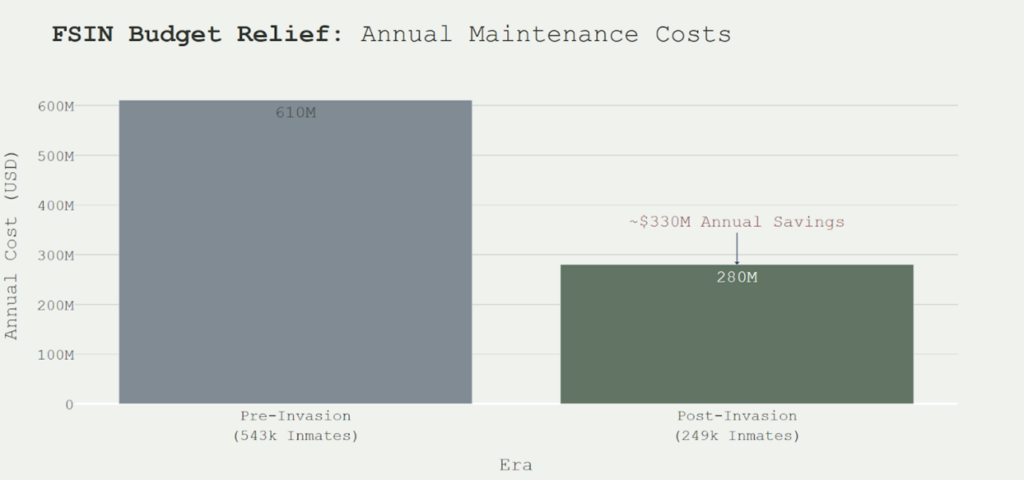
Russia’s Federal Penitentiary Service traditionally operates on a massive budget; in 2017, it stood at 257.6 billion rubles, or around $4.4 billion USD (at the 2017 mean exchange rates of 58.5 rubles per dollar). The per-prisoner variable spending—for food, clothing, medical and other supplies—is estimated at roughly $3.10/day ($1,125/year) based on 2021 figures. As mentioned in the introduction, Russia hosted 543,000 prisoners pre-invasion, and 249,000 post-invasion. So, pre-invasion annual variable spending on prisoners would be around $611 million, and post-invasion around $280 million.
A 54.14% decrease of $330.75 million, or around $661.5 million saved/reallocated cumulatively in 2022 and 2023.
The Multi-Billion Dollar Discount
Once incorporated, at least 180,000 prisoners became soldiers between February 2022 and December 2023. If around 35% of them survived, then 117,000 were killed in action, captured, or maimed to the point of invalidity. Which stays the same: these men were removed from the FSIN’s long-term financial liability columns.
So, if we leave aside the fact that the Russian Armed Forces gained a significant amount of precious units via penitentiary recruitment, its economic reality appears financially positive for the military as well.
The promised signing bonus amounted to 195,000-400,000 rubles (around $2,166-$4,444 at the 2022-2023 mean exchange rates of 90 rubles per dollar), the promised monthly salary to 100,000-200,000 rubles/month ($1,111-$2,222), and the promised death benefits to 5,000,000 rubles (around $55,555), according to BBC.
The reality turned out much different—the signing bonus got cut by 60%, the rest is clawed back through bureaucratic status changes or simply withheld; the monthly wages went down to around $348.69 for the first 30-40 days, then routinely withheld for the subsequent months, especially for HIV-positive prisoners or otherwise marked as expendable, as reported by the Russia Behind Bars NGO; as for the death benefits, bureaucracy helps yet again: to obtain them, the families must produce a death certificate stamped killed in action, yet, field evidence shows, prisoners are listed as missing or deserter instead, voiding the payout.
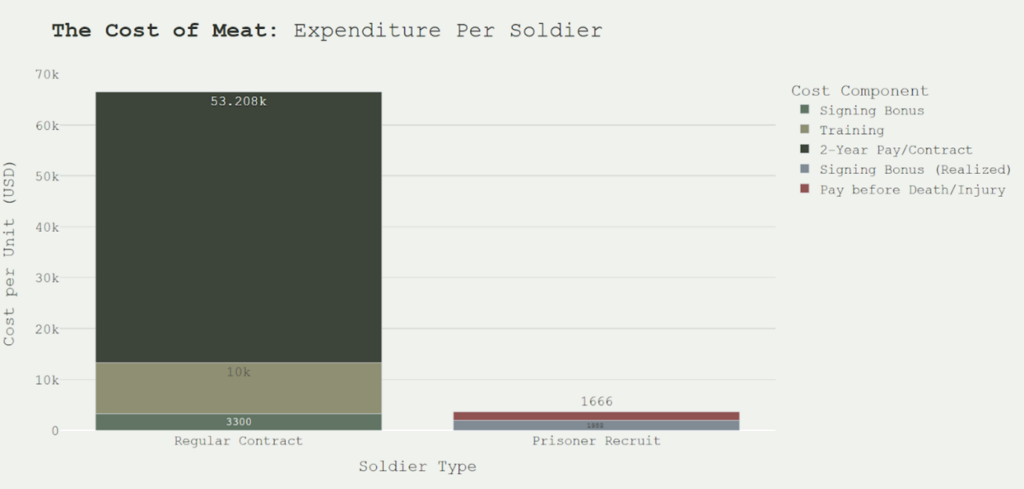
In the end, by getting 60% of the arithmetic mean between 195,000 and 400,000 rubles, we get 178,500 rubles of signing bonus per recruit, or around $1,983. Add in the only average monthly pay they get before dying, or getting captured, incapacitated, or bureaucratically entangled by the Russian apparatus — $1,666.5 — and, once multiplied by the total number of recruited prisoners (180,000), we get around $657 million total spent on them in 2022 and 2023.
In comparison, if these 180,000 soldiers were recruited and maintained as regular contract personnel, the Russian Armed Forces would spend: $3,300 for the signing bonus, around $10,000 for the training, $53,208 for a 2-year contract, then $3,000 for the veteran lump-sum demobilization pay, and $11,000 for accrual minimum 20-yr pension via treasury share.
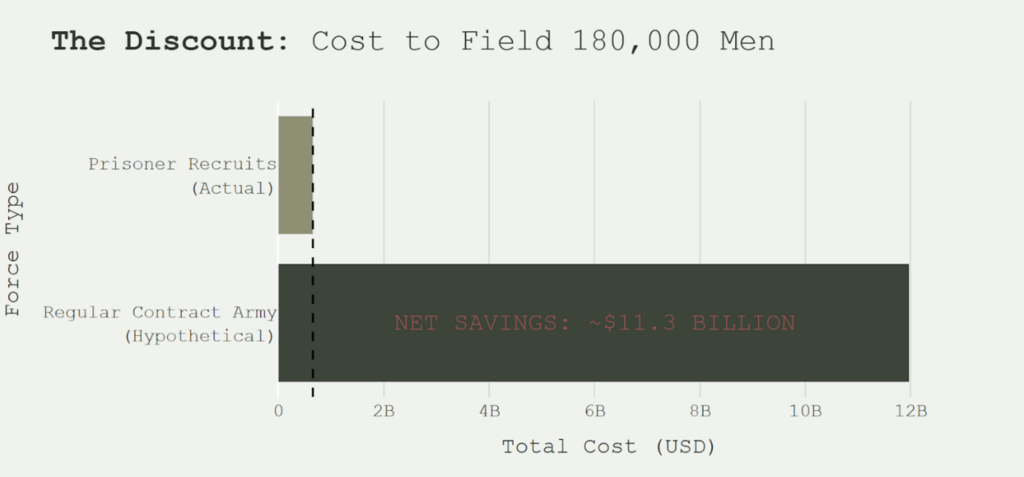
Let’s leave aside the post-duty benefits to render the calculations more accurate in comparison with what the prisoners get: only accounting for the signing bonus, the training and a 2022-2023 contract itself, $66,508 is obtained per soldier. Multiplied by 180,000, we get approximately $11.97 billion total. A far cry from $657 million, with a net difference of roughly $11.3 billion. To put it into perspective, the Russian defense budget for 2022 is estimated to be $86.4 billion.
As a result, the penitentiary recruitment allowed for around 6.53% cut/reallocation of the total military expenditure in 2022 alone.
Societal Shift
By February 2024, from 63,000 surviving and amnestied inmates, a given number of them reoffended. As reported by Mediazona, Russian military personnel convicted of murder increased by 900% in 2023 as compared to 2022. The same source claims that an Interior Ministry leak attributes around 200 serious crimes (e.g. murder, rape, or armed robbery) as well as 750 civilians killed/injured to ex-convicts who underwent the prison recruitment circuit, then got re-arrested as of April 2024. And at least some of those who got re-sentenced and re-imprisoned were ultimately sent back to the frontlines, thus creating a legal loop. For example, in Belgorod and Rostov-on-Don, prosecutors registered around 40 cases of amnestied fighters who went on a second military contract instead of prison, creating an explicit revolving door. Putin himself has publicly called repeat offending by pardoned fighters “inevitable” but “minimal,” signaling tolerance for this loop.
Indeed, Russia does not publish centralized recidivism figures for amnestied convicts and many courts no longer flag “SVO veteran” status in case files. Yet, from the leaks and numbers at our disposal, the re-arrest rate of ex-convict veterans is situated at 0.32%.
This re-offense rate can be considered a floor value: it only accounts for the cases that reached an arrest warrant and were entered into the Interior-MO I.D. database; it omits offences still under investigation, unreported crimes, and regions that have stopped flagging “SVO veteran” status in court files.
The real number can climb to at least 60%, if we take into account the results of the OSW & PONARS-Eurasia analysis that calculated that “around 63% of inmates in Russian prisons are re-offenders.” This future offending trajectory is aggravated by war-specific risk factors (PTSD, combat skills, alcohol, social exclusion) that push the expected rate even higher.
If we stay at 60% though, that’s at least 37,800 convict-veterans from 2022 and 2023 alone. These are people who know how to use firearms, who suffer from PTSD, and whose patriotism is disillusioned by the recruitment bureaucracy and its false promises. And at least 200 of them have already committed serious crimes, as stated earlier.
Despite such somber numbers, the Ministry of Internal Affairs (MVD) logged in the first half of 2025 a total of 940,500 criminal cases—the lowest half-year figure in at least 16 years.
A Difference of Values
More than $1.3 billion saved by FSIN, up to $12 billion diverted by the Russian Armed Forces, at least 180,000 new easy soldiers, and the criminal rate reduced to its lowest in 16 years. At least, according to the MVD.
Indeed, as Prigozhin once said, dead prisoners don’t reoffend.
Even as a thought experiment, the establishment of the same recruitment circuit is unimaginable in Western European nations. Despite all the possible pros, and despite the recent rise of the far-right in Europe, however radical it might be.
Even despite Ukraine desperately lacking manpower, despite overcrowded European prisons—by 123% in France, 113% in Belgium, 134% in Slovenia, 132% in Cyprus, while the representation of detained foreigners, as of 2021, is 24.6% in France, 44.2% in Belgium, 31.6% in Slovenia, and 43.3% in Cyprus,— and despite the per-prisoner cost in the EU—131.50€/day (48,000 €/year) on average, with a range between 13€/day in Bulgaria and 377€/day in Luxembourg.
Indeed, a “European Penal Legion”— volunteer-only detachment of the Ukraine Foreign Legion (which navigates the legal minefield of the European Convention on Human Rights), trained then incorporated in Ukraine, with EU citizenship as reward, targeting third-country nationals with suspended sentences—is highly unlikely in the current EU landscape. Even if it theoretically reduces foreign inmate populations in the eyes of the European far-right, saves/refunnels penitentiary funds, and supports Ukraine without German or French boys dying.
In the end, Ukraine’s Shkval Battalion and Russia’s Storm-Z detachments will remain a phenomenon unique to the post-Soviet reality of this war.
And yet, the discussions over sending European inmates into prisons abroad are already brewing in Sweden and, partially, in the United Kingdom. Under what jurisdiction is still up for debate though.
The views expressed in this article belong to the author(s) alone and do not necessarily reflect those of Geopoliticalmonitor.com.