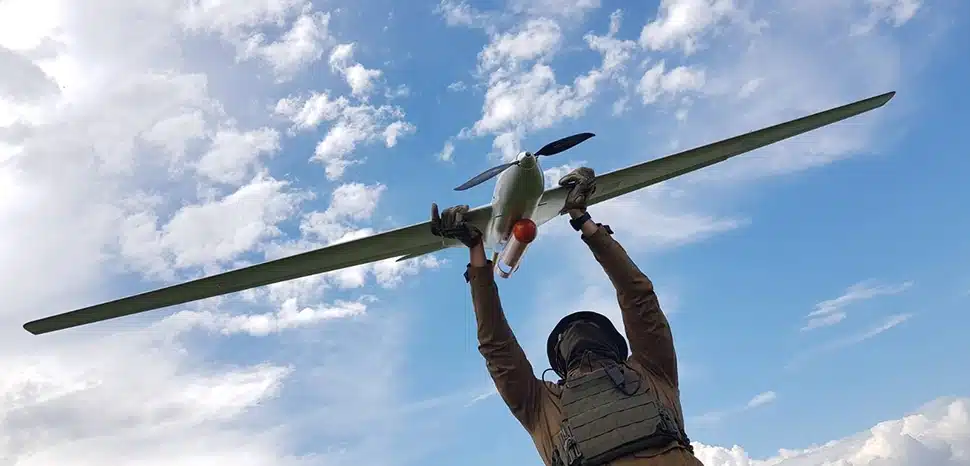
Operation Spiderweb, launched by Ukrainian forces on June 1, was a meticulously planned long-range drone strike that targeted Russian strategic air bases thousands of kilometers beyond the frontlines. These facilities (including Belaya, Dyagilevo, Ivanovo Severny, Olenya, and Ukrainka) hosted Russia’s long-range aviation assets, such as the Tu-95MS and Tu-22M3 bombers, essential for launching cruise missile strikes at Ukrainian territory.
Operation Spiderweb’s significance lies not in its ability to alter the territorial balance of the war, but rather in its exposure of certain vulnerabilities in Russia’s strategic depth. By striking as far as Eastern Siberia, Ukraine shattered the assumption that distance alone provides security. Russia’s bomber bases, once insulated by sheer geography, were unmasked as reachable and fragile. The revelation imposes new burdens on Russian military planners, compelling them to reconsider the dispersion and defense of high-value assets across vast expanses.
This was not a strategic breakthrough in the Clausewitzian sense: there was no seizure of ground, no disruption of command chains, and no inflection point on the battlefield. Instead, Operation Spiderweb functioned as a signal operation: it demonstrated growing technological reach, operational sophistication, and the erosion of assumed ‘safe zones.’
The Cost Ratio of Asymmetry
At the heart of Spiderweb lies a stark fiscal asymmetry: drones worth tens of thousands of dollars inflicted billions in damage by destroying or disabling strategic bombers. This cost-benefit disparity is not an anomaly; it is the structural expression of Ukraine’s military strategy.