Nevertheless, the five most recent departures share a pattern. Each producer faced one of three pressures: physical capacity above its OPEC+ quota, oilfields in long-term decline, or budgets making membership costlier than leaving. Each invoked national interest language nearly verbatim. OPEC’s share of global crude has fallen below 30 percent for the first time, and OPEC+ coverage sits at roughly 46 percent.
The question now turns to Kazakhstan, the bloc’s most consistent over-producer. The same pressures that drove Abu Dhabi out apply in Astana, with one physical obstacle (via the Caspian Pipeline Consortium) limiting how soon Kazakhstan could realistically leave.
Nevertheless, the base case for 2026 and 2027 is either a full-fledged exit or continued nominal membership combined with persistent non-compliance. Either pathway points to deepening fissures within OPEC+ and the diplomatic tightrope the bloc’s remaining members must traverse.
Background
Kazakhstan signed the Declaration of Cooperation in December 2016 as a non-member partner of OPEC, with no real penalties for producing above quota. The country’s compliance record since 2023 has been the dominant friction with the bloc. Kazakh output averaged 1.78 million barrels per day in 2025 against a quota of roughly 1.47 million, the largest absolute over-production of any member that year.
March 2025 output reached 1.85 million barrels per day after Chevron’s Tengiz Future Growth Project delivered first oil on January 24, 2025, adding approximately 260,000 barrels per day to a single field. OPEC’s compensation schedule of January 2026, a make-up plan offsetting earlier excess production, demanded Kazakhstan repay 3.49 million barrels per day cumulatively through June 2026, the steepest schedule of any member.
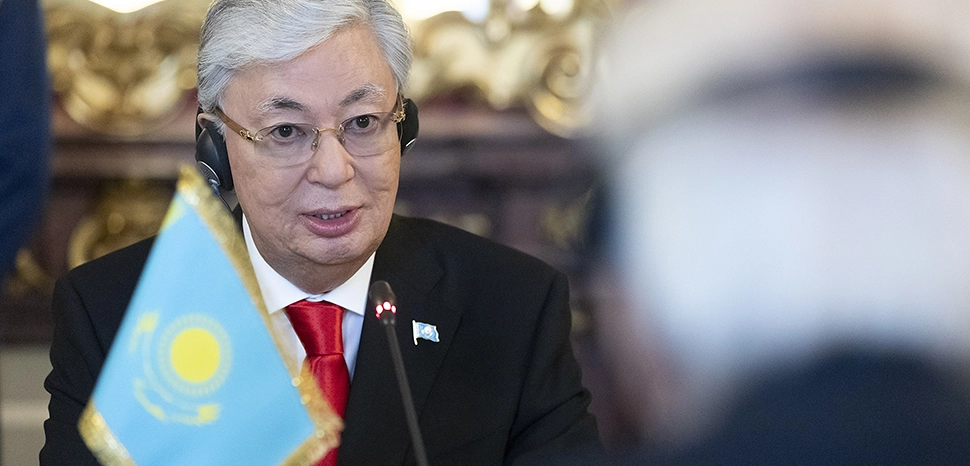
The compliance dispute has had political consequences inside Astana. President Kassym-Jomart Tokayev dismissed Energy Minister Almasadam Satkaliyev in March 2025 after his meetings with Chevron and ExxonMobil executives failed to yield production cuts. Successor Yerlan Akkenzhenov subsequently stated publicly that Kazakhstan would act on national interests “with all the ensuing consequences.”
Driving this issue are three flagship Kazakh hydrocarbon projects in Tengiz, Kashagan, and Karachaganak. These three sources account for approximately 70 percent of national output, operated under production-sharing agreements by Chevron, ExxonMobil, Shell, Eni, TotalEnergies, Lukoil, CNPC, and Inpex.
The hard constraint is how Kazakh oil reaches market. Approximately 80 percent of Kazakh crude transits Russian territory through the Caspian Pipeline Consortium to the Novorossiysk marine terminal, with Russian state and corporate entities holding 31 percent of CPC ownership against Kazakhstan’s 20.75 percent (KazMunayGas at 19 percent and Kazakhstan Pipeline Ventures at 1.75 percent). The 2022 sequence of Russian regulatory closures showed that Moscow can shut the pipeline down when politics requires it.
Ukrainian drone strikes through 2025 and 2026 have compounded the exposure. A November 29, 2025 naval drone strike significantly damaged SPM-2, one of the terminal’s three offshore loading buoys, with an April 2026 strike on the marine terminal following shortly after.

Figure 1. Approximate monthly values based on OPEC+ monthly oil market reports, Kazakhstan Ministry of Energy disclosures, and announced compensation schedules.
Impact on Oil Markets
A formal Kazakh exit would unbind production held back by quota rather than by infrastructure. Plausible 2027 production without a quota ceiling approaches 2.0 to 2.1 million barrels per day, with incremental supply of 150,000 to 400,000 barrels per day above current targets.
The EIA’s supply outlook already credits non-OPEC+ producers with most global growth through 2026, with Kazakh non-compliance already factored in regardless of any formal exit. The effects divide cleanly. Refiners gain access to a lighter, sweeter substitute for sanctioned Russian crude. Higher-cost OPEC+ producers absorb the price hit.
CPC Blend’s quality profile (lighter and sweeter than Russian Urals) makes it the natural replacement after October 2025 sanctions on Rosneft and Lukoil displaced Russian volumes from Indian refinery slates. Saudi Arabia, which needs higher prices to balance its budget than its 2026 plan assumes, faces the sharpest squeeze. Russian control over CPC flows partly offsets Moscow’s exposure to a weaker cartel.
The winners cluster in a few markets. Italy took roughly 23 percent of total Kazakh exports in 2024, with Italian refiners standing as the single largest destination for CPC Blend. Indian refiners, which lost approximately 800,000 barrels per day of Russian Urals supply after the October 2025 sanctions, have actively bid for CPC Blend as a near-perfect replacement. Mediterranean refiners and Asian spot buyers round out the demand.
The risk of cascading departures deserves attention. Iraq, the bloc’s second-largest over-producer, carries the same gap between physical capacity and OPEC+ quota that drove Abu Dhabi out, and Baghdad’s overproduction debt has grown alongside Astana’s. If Kazakhstan formalizes its exit, the cost of staying inside OPEC+ rises automatically for Iraq.
Impact on OPEC+
The bloc’s losses now add up to a meaningful share of the market. Five members have left in a decade, removing more output than coordinated cuts ever achieved. A Kazakh exit would pull OPEC+ coverage of global supply from roughly 46 percent toward 41 percent and reduce OPEC alone to its lowest share since formation.
Industry analysts have warned that further departures of compliant producers could eventually make OPEC irrelevant as a cartel. However, a contrary view from the Middle East Institute argues that a smaller, Gulf-led bloc could recover discipline even over a reduced share of global supply. Saudi-Russian coordination now holds the cartel together, with Riyadh’s room to maneuver narrowed by elevated breakeven prices and Moscow’s influence concentrated in pipeline control.
Table 2. OPEC and OPEC+ attrition since 2016
| Year |
Departing member |
Approximate production removed |
| 2016 |
Indonesia (suspended) |
Net importer; refused 37,000 bpd cut share |
| 2019 |
Qatar |
Approximately 600,000 bpd; LNG strategic pivot |
| 2020 |
Ecuador |
Approximately 540,000 bpd; fiscal sustainability |
| 2024 |
Angola |
Approximately 1.1 million bpd; quota dispute |
| 2026 |
UAE |
Approximately 3.4 million bpd at quota; 4.85 million bpd capacity |
| 2026 to 2027 |
Kazakhstan (potential) |
Approximately 1.78 million bpd at current output; 2.0 to 2.1 million bpd unconstrained |
Outlook
The political and economic case for a Kazakh exit is rising. Tokayev’s June 2022 refusal at the St. Petersburg International Economic Forum to recognize the Donetsk and Luhansk People’s Republics showed that Kazakhstan’s balancing policy could hold under Russian pressure. The November 6, 2025 C5+1 summit in Washington produced $17 billion in bilateral deals and Kazakhstan’s accession to the Abraham Accords.
EU-Kazakhstan trade reached $49.7 billion in 2024, with €12 billion in Global Gateway financing committed to Central Asia. Kazakhstan’s national interest framing matches the Emirati’s rationale almost word for word. Astana cannot order the Western companies running its three principal fields to cut output. The shrinking benefits of OPEC+ membership against rising compensation cuts that Kazakhstan cannot deliver point toward exit on their own.
The export route imposes the hard limit. The pipeline still moves roughly 80 percent of national exports through Russian territory. Russia holds 31 percent of CPC ownership. Moscow has shown at least three times in 2022 that regulatory rulings and weather closures can shut the line down. The April 29, 2026 Energy Ministry statement that any change to Kazakhstan’s participation is not under consideration should be read as a message to Moscow rather than a substantive commitment to compliance.
Thus, the prospect of a late 2026 or early 2027 exit of OPEC+ by Kazakhstan looms and appears likely. Otherwise, Kazakhstan’s over-production will persist and likely widen the deficit and encourage other producers on the fence about membership, such as Iraq & Nigeria, to mull their own plans. Kazakhstan will see Kashagan’s next phase come online by 2027 in addition to Middle Corridor capacity expansion, and Trans-Caspian pipeline progress, all culminating in opportunities to expand market share. The political and commercial logic behind the UAE departure is clearly present in the case of Kazakhstan and aligns with the country’s independent streak.