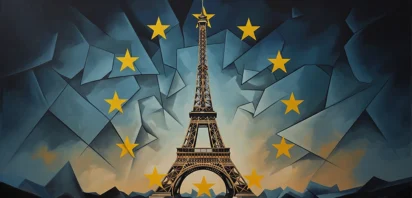
Georgian Dream is a baffling entity that defies most conventions of post-Soviet politics. Founded in 2012 by oligarch Bidzina Ivanishvili – the country’s wealthiest individual who made his fortune in Russia in the 1990s – the party openly claims to be “fulfilling Georgia’s European & Euro-Atlantic aspirations.” It has ruled the country continuously for the past twelve years, enshrined EU accession into the constitution and oversaw the granting of bloc candidate status last year. Today, not only does the EU flag adorn all government buildings, but its yellow stars have featured prominently in Georgian Dream’s most recent campaign logo.
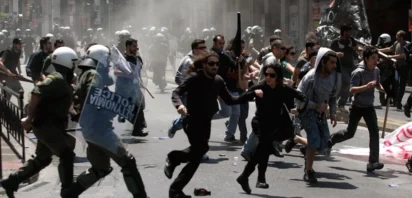
Yet, in the months following the disputed October 2024 election, authorities in Tbilisi have deployed water cannons and thugs against peaceful demonstrators, who are protesting the government’s decision to stall EU accession talks until 2028. The move, part of a bewildering anti-Western policy shift, comes a few weeks after Georgian Dream claimed victory in an election that most independent observers considered marred by fraud. Many fear the Kremlin – with whom Georgia has officially had no diplomatic relations since 2008 following a brief war – may be behind all of this.
For around a decade, the party mostly lived up to its lofty promises, bringing Georgia close to the EU and NATO – something a large portion of its people vigorously support. In 2018, it backed the candidacy of President Salome Zourabichvili, a staunchly pro-West figure, and presided over the signing of a slew of trade and cooperation deals with Brussels.
But Russia’s invasion of Ukraine in 2022 prompted a remarkable volte-face. While condemning the assault, Georgian Dream refused to sanction Moscow, citing economic pragmatism – Russia is Georgia’s second-largest trading partner. More cynically, it exploited public fears of a new conflict after Ukraine’s defence secretary unwisely suggested Georgia open a “second front.”
In an ominous crescendo, MPs and senior figures started to float wild theories such as the “global war party” – an alleged cartel of international actors and opposition members conspiring to revive the conflict with Russia. Out of the blue, the government last year began to mimic Moscow by passing illiberal legislation on foreign agent actors and “LGBTQ+ propaganda,” to defend what it calls “traditional values.”
Even relations with President Zourabichvili, who had been vocally condemning the drift away from Europe, soured to the point that the party attempted to impeach her. Zourabichvili’s term ended in December, and Georgian Dream nominated Mikheil Kavelashvili, a former Manchester City striker turned outspoken critic of the West, as her successor.
However, when questioned by reporters about the country’s direction, Georgian Dream’s officials claim that nothing has changed and they remain committed to Georgia’s Western path, albeit “on their own terms.” This sounds straight out of Viktor Orban’s opportunistic playbook vis-à-vis Brussels, with an important difference: today’s Hungary would never be allowed into the EU. One wonders why Georgia should be given a different treatment.
So what explains Georgian Dream’s sudden pivot towards Moscow?
We will probably never know if Ivanishvili, the éminence grise steering the party from his modernist hilltop mansion overlooking Tbilisi, directly answers to the Kremlin, or rather seeks to appease it on transactional grounds. Perhaps he was bought out by Moscow, outright threatened, or he is genuinely acting out of fear of his big neighbor.
But the disconnect between Georgian Dream’s words and deeds is all but unprecedented in modern politics. Even Viktor Yanukovych of Ukraine and Belarus’s Alexander Lukashenko never made secret of their pro-Russian sympathies while occasionally flirting with the EU to gain more leverage over Moscow.
Georgian Dream’s sinister ambivalence should concern the West. As the mask slips, it could reveal itself as the Kremlin’s most audacious experiment yet – staged in a country where Russia is highly unpopular – on how far political manipulation can be taken. If that proves effective, Europe will have a lot to worry about in the years to come.
Until now, pro-Russian European parties have proudly flaunted their allegiance, often wearing it as a badge of honour, while revering Vladimir Putin the ultimate defender of Christianity and “common sense.” This can be seen within far-right parties in Moldova, Hungary, Romania, and even in some Western EU nations such as Austria and Germany.
But what if the Kremlin successfully managed to infiltrate mainstream European parties, which show no apparent signs pro-Russian sympathies? And what if their actions, once in power, matched Georgian Dream’s devious duality? As Europe finds itself alone and vulnerable, facing an increasingly isolationist – if not plain hostile – US under President Donald Trump, the danger is enormous.
Marco Cacciati is the Latin America editor at bne Intellinews, where he covers geopolitics and economics in the region and across emerging markets.
The views expressed in this article belong to the author(s) alone and do not necessarily reflect those of Geopoliticalmonitor.com.