Disruptions in West Asia have generated far-reaching cross-regional repercussions, undermining economic and security stability for the majority while creating strategic opportunities for a few, including China. On February 28, 2026, the United States and Israel launched strikes on Iran, prompting Tehran to retaliate with attacks across the region. Since the onset of the war, the destruction of critical national and energy infrastructure, coupled with the blockade of the Strait of Hormuz, has triggered an energy crisis, exposed supply chain vulnerabilities, and fueled economic destabilization. These shockwaves have disproportionately affected Asian economies, which remain heavily dependent on the Gulf countries and the Strait of Hormuz for energy imports. Recognizing the adverse implications of these developments, China announced on March 5 the dispatch of Zhai Jun, its Special Envoy on the Middle East Issue, to West Asia to facilitate mediation and advance deescalation efforts.
While the conflict has intensified global challenges, it has simultaneously opened strategic avenues for China to strengthen its international and domestic position in a disrupted world order.
First, the Iran war has served as a crucial learning experience for Beijing, preparing it for a potential Taiwan conflict and US-led blockade of the Strait of Malacca. The unilateral actions undertaken by the US in Venezuela, threats over Greenland, and now Iran over the past year under President Trump have undermined the international security architecture, thereby strengthening China’s resolve and position on seizing Taiwan. Furthermore, the Iran conflict represents a shift from theory to practice in warfighting, and China has been closely tracking and analyzing Washington’s weapon systems, their performances, missile and air defense capabilities, strategies, strike patterns, as well as defense inventories and arising shortages. These insights into US military tactics will offer valuable lessons for China’s military and political establishment in terms of self-assessment, preparation for a Taiwan contingency and understanding modern warfare in practice. Given the strategic importance of the Strait of Malacca to China, Beijing is also carefully observing the US naval blockade of the Strait of Hormuz to assess whether Washington could successfully enforce a similar blockade in the Malacca Strait, the potential implications of such a move, and the role US regional partners might play in its execution. Additionally, the parallels between Iran, Taiwan, and the Malacca Strait – particularly the presence of critical maritime chokepoints that facilitate global trade, and asymmetries in military capabilities – offer important lessons for Beijing in navigating operational challenges and leveraging strategic advantages. In sum, the war has strengthened China’s position for a Taiwan contingency from both geopolitical and military perspectives.
Second, the conflict has provided major soft power benefits. For Beijing, balancing its ties with the parties involved in the war has been a challenge, given its complex relationship with Washington and its comprehensive strategic partnership with Tehran. Positioning itself as a responsible power, Zhai Jun led shuttle diplomacy by visiting countries in West Asia, while Wang Yi, China’s Minister of Foreign Affairs, engaged in phone discussions with his counterparts in Asia, West Asia, Europe, and North America. Last month, China also vetoed a resolution introduced by Bahrain in the UNSC calling for a reopening of the Strait of Hormuz. Beijing’s strong call for an immediate ceasefire, end of hostilities, dialogue and negotiations, through its diplomatic as well as political maneuvering, highlights its role as a “builder of peace and a promoter of development.” It has flagged the violation of the United Nations Charter and international law by the unilateral actions of the US and Israel, urging the international community to safeguard the world order. The ripple effect reinforces China’s projection as a provider of peace and security in a turbulent global order upended by US actions.
Third, the Iran war has made China’s clean energy technologies and electrification drive attractive to economies suffering from an energy crisis. This push to increase the share of renewable energy in the energy mix across the globe is pivotal for Beijing, as China’s advanced technological capabilities have led it to hold over 80% of global manufacturing capacity across solar, wind turbine, and battery sectors, making it a premier hub for transitioning away from fossil fuel-based products. The growing demand for Chinese clean energy products since the onset of the war is evident in record-high exports of solar, lithium-ion batteries, and electric vehicles, which reached $21.9 billion in March 2026. This rising demand, in turn, is benefiting the Chinese industry and the broader economy in the long run. Considering the competitive renewable energy market, this phase is viewed as a golden opportunity for Chinese brands to expand globally.
Fourth, while Beijing has banned exports of refined fuels, Chinese firms are reselling large volumes of the Liquefied Natural Gas (LNG) to Asian neighbors. The war in West Asia has created LNG shortages in Asian countries, adversely affecting their industrial production, power generation, heavy transportation and domestic consumption. According to the US Energy Information Administration (EIA), 83% of the LNG exported by Persian Gulf countries that passed through the Strait of Hormuz was directed to Asian markets in 2024. Currently, rising domestic production of gas, increased pipeline imports, and reduced reliance on LNG for energy generation have created an LNG surplus in China despite global scarcity. LNG prices in Asia have increased by 85% since the war began, thus creating a demand-driven market that benefits Beijing. Given the uncertain trajectory of the conflict and the ensuing LNG shortages across the region, China is well-positioned to resell LNG to LNG-deficient countries such as Japan, South Korea, and Thailand.
Fifth, China has demonstrated strategic foresight in preparing for potential energy crises by building one of the world’s largest strategic oil reserves. Recent data released by the US EIA shows that China holds the largest strategic crude oil inventories, amounting to 1,397 million barrels, followed by the US at 413 million barrels and Japan at 263 million barrels. According to the report, in 2025, Beijing added an average of 1.1 million barrels per day of crude oil to its strategic reserves and continued to expand these inventories in 2026. As the world’s largest crude importer, China sources approximately half of its oil imports and one-third of its LNG from West Asia. Over the past few years, Beijing has prioritized deepening its engagement with Gulf countries to secure its future energy supplies and mitigate market volatility, as reflected in its long-term agreements with the United Arab Emirates’ Abu Dhabi National Oil Company. The crisis in West Asia has negatively impacted China, including its trade and investments in the region, particularly with the Gulf Cooperation Council, and its broader bilateral relations. Nonetheless, considering Beijing’s preparedness, it remains better positioned than other Asian economies to weather the crisis.
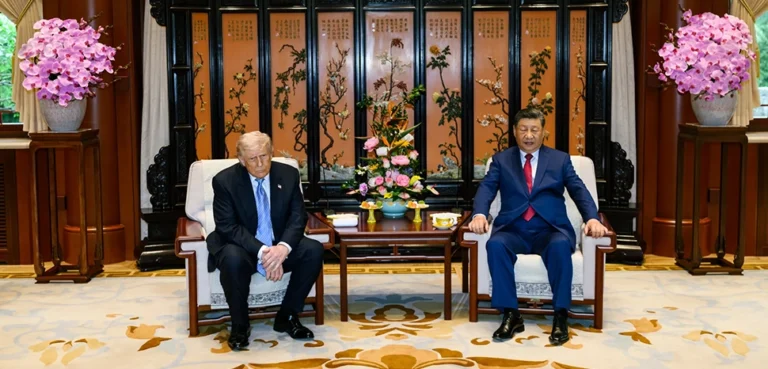
Lastly, the US is estimated to have only two months of rare earth reserves amid its extensive use of weaponry in the war. The US remains highly dependent on China for rare earth elements, which are critical to the manufacture of advanced defense systems, including laser systems, radars, jet engines, navigation systems, and electronic warfare and communication systems. As per the US Geological Survey’s Mineral Commodity Summaries report, the US imported 71% of its rare earth compounds and metals from China between 2021 and 2024. Furthermore, the imposition of high US tariffs on Beijing, coupled with China’s retaliatory export controls on critical minerals, has constrained the US’ ability to source rare earths. Consequently, this has provided Beijing with an opportunity to leverage this strategic vulnerability against Washington in trade and tariff negotiations, particularly during President Trump’s visit to China.
While a temporary ceasefire between the US and Iran has been reached, given the high potential for a resumption of hostilities, the normalization of supply chains and security conditions remains uncertain. China’s continued diplomatic initiatives and political cooperation with countries such as Pakistan, advocating a peaceful and dialogue-based resolution of the conflict, have enhanced its image in the fragile global order. At the same time, Beijing’s gains from the war, evident in its accelerating growth, expanding global markets, and advancing military and defense capabilities, have not gone unnoticed. While the international community awaits the restoration of stability, China appears prepared to capitalize on the situation in this geopolitical contest.