COVID-19 has now become entrenched on every continent, infecting over a hundred million people and counting. A consequence of this success is that the virus now has ample opportunity to mutate into strains that could be deadlier and/or more communicable than previous iterations. Of course, this is already happening, and strains like the ‘UK variant’ have already entered the lexicon of media and public health officials. And while it’s impossible to know just how many variants are out there (for one, many don’t show up on tests), three are of particular concern at the moment: B.1.1.7 (the ‘UK variant); B.1.351 (the ‘South Africa variant’); and P.1 (the ‘Brazil variant’).
How consequential are these COVID-19 variants in terms of public health measures? England’s recent experience may hold some clues – and the takeaways aren’t entirely positive.
Background
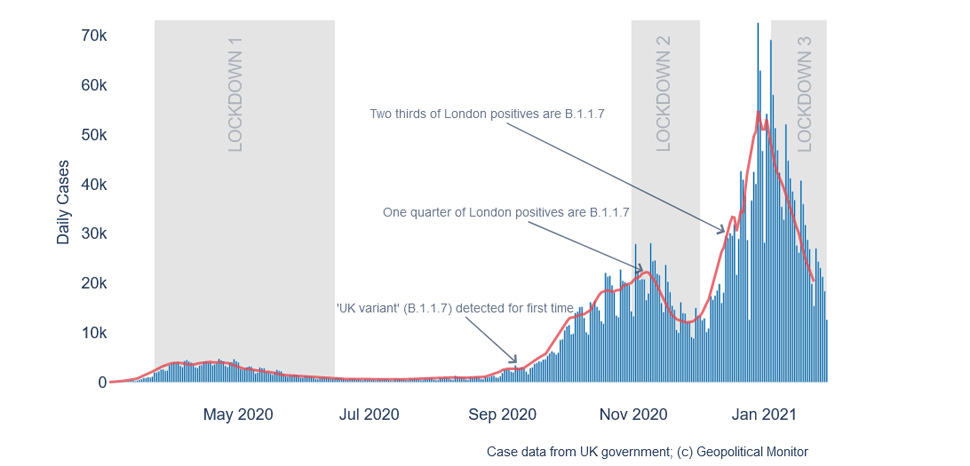
England’s public health struggles over the final few months of 2020 seems to be highly correlated with the emergence of its eponymous variant: B.1.1.7.
This ‘UK variant’ is the result of certain mutations, one of which involves the spike protein that vaccines use to target the virus. The primary consequence is a higher degree of communicability: the strain is up to 70% more infectious than the original virus by some estimates, equivalent to an increase in its reproduction number (R) of between 0.4 to 0.7.
Preliminary evidence suggests that B.1.1.7 may also be deadlier and/or more able to seriously sicken younger and healthier people, leading to higher mortality and hospitalization rates. One public health estimate cited by the Wall Street Journal put B.1.1.7 at anywhere between 30-40% deadlier than previous strains.
However, some scientists have cautioned on drawing early conclusions about the B.1.1.7, particularly given that its ascent largely coincides with two behavioral trends that fueled higher transmission rates throughout England’s recent peak: 1) lockdown fatigue; and 2) family get-togethers during the holiday season.
The severity of the NHS’ struggle with B.1.1.7 is borne out by daily case numbers and successive national lockdowns in England. One important qualifier here is that this is the first full winter of COVID-19 community infection; thus, it’s impossible to separate the influence of factors like lockdown fatigue and more time spent indoors from the epidemiological impact of new variants.