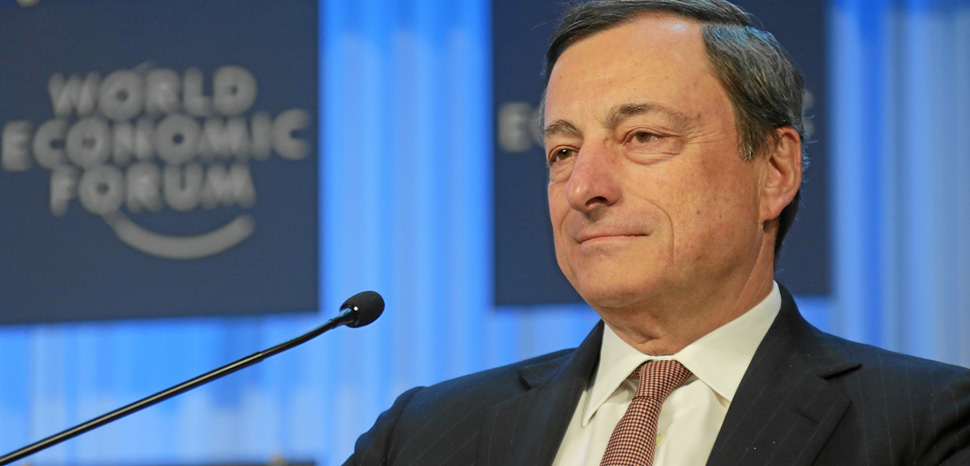
In one of the final acts of a highly eventful term as president of the European Central Bank (ECB), Mario Draghi has restarted the ECB’s bond-buying program just nine months after it was officially drawn to a close.
The ECB will begin buying €20 billion in bonds each month starting from November.
The return of quantitative easing comes as signs of recession continue to mount across the euro zone, particularly in the export engine of Germany. But this wasn’t the only trick that Draghi had up his sleeve before handing the reigns of monetary policy over to Christine Legarde.
Analysis
The economic outlook is worsening in Europe: German manufacturing is seeing steep declines, Italy is failing to grow itself out of a debt trap, and Brexit is as unpredictable and potentially calamitous as it has ever been. The gloom is reflected in the ECB’s latest projections, which slashed growth by 10 basis points to 1.1 percent in 2019 and 20 basis points to 1.2 percent in 2020.
Against this backdrop, Draghi has decided to adopt a full-court press of stimulus.
There’s the bond-buying, which at €20 billion a month falls well short of the €80 billion peak buying of 2016 and is more aligned with the €15 billion pace that the program ended on in December 2018. And there’s the cut in the ECB’s deposit rate, from minus 0.4 percent to a record of minus 0.5 percent. (The deposit rate is that which is paid to banks who park their money with the ECB; a negative rate encourages banks to lend their money elsewhere, to individuals or businesses). And finally the ECB also eased its lending terms to eurozone banks and offered favorable tiered rates in order to shore up their balance sheets.
The ECB’s forward guidance was also revised in light of lower inflation targets (down 10 basis points to 1.2 percent in 2019, down 40 basis points to 1.0 in 2020). Low (read: negative) interest rates are expected to remain in-place for a much longer period as a result.
Then in a finale only possible for an ECB head with one foot out the door, Draghi alluded to the euro zone’s elephant in the room: the fact that monetary stimulus can only go so far in the absence of fiscal stimulus. On this Draghi was unequivocal, indicating that there was ‘unanimity’ among the ECB governors that fiscal policies should take over as the main tool to head off a deeper continental recession. In the case of the European Union of course, said fiscal stimulus would be highly politically contentious as it would inevitably involve transfers from high-performing, fiscally sound member states to their more tenuous counterparts.
There are two main takeaways here. The first is that the ECB is seriously concerned about the short-term economic health of the euro zone, particularly with regards to avoiding spiraling deflation as the latest 2020 projections reveal much weaker inflation than previously expected, which should concern policymakers throughout the euro zone. Second, the stimulus dump came down as one of the final acts of Mario ‘whatever it takes’ Draghi, and in doing so he has kept the reputation of incoming president Cristine Legarde as a clean slate. In other words, Legarde has been spared having to make any overly ‘political’ decisions to start her term.
Though Draghi’s moves have been celebrated by many in Europe, one high-profile detractor is US President Donald Trump, who tweeted his dismay at what he sees as attempts to devaluate the euro earlier this morning: “[The ECB is] trying, and succeeding, in depreciating the Euro against the VERY strong Dollar, hurting U.S. exports…. And the Fed sits, and sits, and sits. They get paid to borrow money, while we are paying interest!” President Trump might be onto something, as these ECB moves will certainly put downward pressure on the euro moving forward, which could help kick-start Germany’s moribund manufacturing exports.
Forecast
As for whether or not the stimulus is enough to spur lending and economic activity, only time will tell. The level of bond-buying is low by recent historical standards, and the deposit rate cut was a marginal adjustment. The response for equity markets has been muted so far. But the real story lies in the open-ended nature of these policies. By doing the political heavy lighting of reinitiating the bond-buying program, Draghi has made it much easier for Legarde to expand it should she deem it necessary in the future. And given the arc of the euro zone economy, that’s a decision that might have to be made much sooner than many expect.