There is a moment in war when the machinery of statecraft reaches for something older than the language of national interest and deterrence. In the Trump administration’s confrontation with Iran, that turn did not emerge from classified intelligence assessments or the halls of the UN Security Council. It surfaced instead during an Easter Monday press conference. There, US Secretary of War Pete Hegseth linked a US military rescue operation in Iran to the resurrection of Jesus Christ. This was not a verbal slip or an ornamental metaphor. It was a public expression to a theological framework that has become increasingly visible in the language surrounding American war-making.
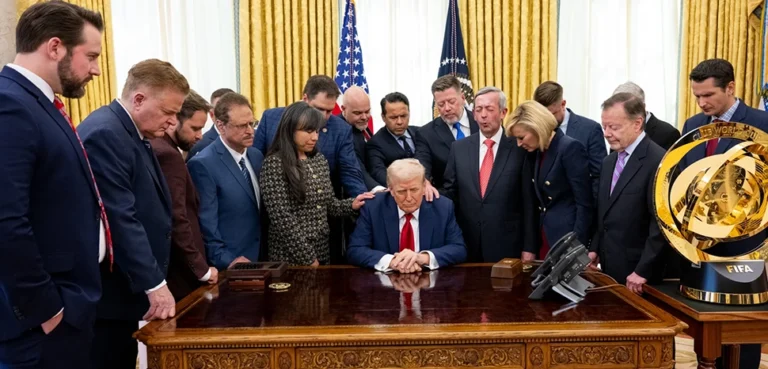
Shortly after, President Donald Trump offered his own divine endorsement of the campaign: “God supports the war,” he said, “because God is good, and God wants to see people taken care of.” His remark was delivered almost casually. That casualness is precisely what should alarm anyone who studies the relationship between language and power. It suggested that the theological framing of US warfare had moved from the margins of political discourse much closer to the center. This is not a trivial rhetorical shift. It may prove to be one of the most consequential and least examined developments in contemporary American war rhetoric.
Language with a Long Memory
The United States has repeatedly used religious language in the service of foreign policy. That, of course, is not a new observation. Scholars such as Andrew Preston, whose Sword of the Spirit, Shield of Faith traces the intimate relationship between American Christianity and American statecraft across four centuries, have shown how deeply religion has shaped US political purpose. Walter Russell Mead in God’s Country?, too, mapped the evangelical and Jacksonian currents beneath US strategic thinking. Together, these works documented how thoroughly religious conviction shapes the way Americans understand their country’s role in the world. This tradition has not remained confined to cultural background or private belief. Rather, it has repeatedly surfaced in the language through which American leaders have interpreted war, order, and national purpose.
Woodrow Wilson infused his vision of the Liberal International Order with a distinctly Calvinist Christian ethos. Similarly, Franklin D. Roosevelt cast the Second World War as a definitive struggle between the forces of Christian civilization and pagan barbarity. By 1983, Ronald Reagan’s characterization of the Soviet Union as an “evil empire,” delivered before an audience of evangelical Christians, was as theological as it was geopolitical. Religion has long supported the structure of US foreign policy, but it has usually remained behind the facade. What is different now is that it has been brought forward, load-bearing, and visible, into the official justification for lethal military action.
The last time a US president allowed the language of holy war to slip into public view this nakedly was in the days after September 11, 2001, when George W. Bush, standing on the South Lawn, described the coming response as a “crusade.” His aides scrambled within hours to retract it. The word, they understood, carried centuries of specific and devastating meaning across the Muslim world. It was a diplomatic catastrophe in miniature. The correction was swift because the administration understood what the word communicated across the Muslim world, where the Crusades are not a distant medieval abstraction but a formative historical trauma.
Unfortunately, no such correction has come this time. What once had to be disavowed as a diplomatic liability now appears to be embraced as a governing idiom of war.
Christian Nationalism Finds Its Command
What has changed is not merely the narrative; it is the institutional reality behind it. Pete Hegseth is not an incidental figure. For years, he has been vocal about his convictions, including his vision of the US military as a Christian fighting force. In his 2024 book, The War on Warriors: Behind the Betrayal of the Men Who Keep Us Free, he portrays the Pentagon as an institution corrupted by secular and progressive values, one that must be reclaimed for a warrior Christianity. His appointment was understood by both supporters and critics as an ideological statement about what the Trump administration believes the military is for.
This is the context in which his resurrection metaphor must be read. It was not a flourish. It signaled to a specific constituency that the war carries divine sanction, that American soldiers are doing God’s work, and that the enemy, by implication, stands on the wrong side of a cosmic order. That is a genuinely dangerous thing to communicate, for reasons that go well beyond diplomatic sensitivity.
The Theology of Certainty
The danger of “holy war” as a political concept lies not only in its fervor, but in how little room it leaves for doubt, restraint, or revision. When military operations are absorbed into a sacred narrative, the ordinary tools of statecraft, recalibration, and cost-benefit judgment begin to erode. One does not apply cost-benefit analysis to the resurrection nor call for a ceasefire in the middle of an act of God.
This is not a theoretical concern. Historians of the Crusades have long noted how the theology of just war, once it fused with the theology of sacred mission, produced campaigns of extraordinary violence that were sustained long past any rational strategic logic precisely because their participants understood them as participation in divine history. The sack of Jerusalem in 1099, in which the chronicler Raymond of Aguilers wrote that the crusaders rode through blood up to their horses’ bridles, was not understood by its perpetrators as an atrocity. It was understood as a fulfillment of prophecy.
One need not believe that US policymakers are capable of such extremity to recognize the pattern. Once military action is cast as a sacred obligation, it carries risks that secular strategic frameworks are poorly equipped to contain. Sacred obligations are not negotiated. They are fulfilled or failed.
How This Lands Elsewhere
There is a profound irony in this shift. This religious framing of US military action emerges just after two decades in which the United States insisted to Muslim-majority nations that its conflicts were not religious wars. For years, the argument was that the enemy was a specific extremist ideology, not Islam itself, and that America respects the Muslim people.
That argument, always under tension due to actual US policy, is now being hollowed out from within. When the war secretary frames an operation in Iran through the language of Jesus’s resurrection, he is not speaking into a vacuum. His remarks reverberate throughout the world media ecosystem and are immediately translated into Arabic, Persian, Urdu, Turkish, and Indonesian. In these regions, the historical memory of Christian missionary efforts as part of the larger pattern of European colonialism is still very much alive.
Groups like ISIS and Al-Qaeda have used the assertion that the West is waging a “Crusade” against Islam as a central part of their recruiting messages. For years, US officials and Western analysts have attempted to debunk this narrative, arguing that it is nothing more than a paranoid distortion designed to incite violence. Hegseth’s language hands these propagandists a gift they could never have manufactured themselves: a US Cabinet official using the dialect of Christian Holy War to describe a military operation.
Research into radicalization has consistently shown that the perception of civilizational aggression, the feeling that one’s faith and community are under existential attack, is one of the most powerful drivers of violent extremism. The religious framing coming out of Washington cannot be ignored; it is a serious strategic liability.
What the Analysts Are Missing
The coverage of US military action has understandably focused on the strategic and geopolitical dimensions — the regional balance of power, the fate of nuclear negotiations, the responses of allies and adversaries, and the humanitarian consequences. These things matter enormously. But the theological framing deserves sustained analytical attention, because it is not merely descriptive of what officials believe. It is prescriptive of how policy will be made.
When war is cast as an act of divine will, the domestic political constraints that might otherwise moderate its prosecution are weakened. Criticism ceases to be a policy disagreement and becomes something akin to impiety. Allies who express reservations are framed as obstructing a divine plan. Diplomatic off-ramps that require acknowledging an enemy’s legitimate interests become morally untenable; one does not compromise with the enemies of the Lord.
These are not hypothetical dynamics. They are the predictable outcomes of sacred thinking applied to interstate violence, a pattern visible from the European Wars of Religion in the 16th and 17th centuries to the sectarian conflicts of the post-colonial era. It is the responsibility of the analytical community to name this for what it is. It represents a way of thinking about war that places itself beyond the secular tools of diplomacy, law, and strategic logic on which the international order relies to manage violence between states.
A Reckoning That Cannot Be Deferred
There is a version of this story that treats the theological language as political theater — red meat for a domestic evangelical base, not a genuine guide to policy. Perhaps. But the distinction between sincere belief and political performance is less significant than the fact that the performance itself shapes the environment in which decisions are made. That occurs as allies recalibrate their relationship with Washington based on what US leadership communicates about national identity, and as adversaries interpret what Washington wants and intends to do.
The resurrection of Jesus, in Christian theology, is the definitive victory of God over death and evil. To invoke it as the frame for a military operation is to make a specific and enormously consequential claim: that the operation partakes of that same logic of final, divinely ordained triumph. There is no negotiating with the resurrection. There is no compromise at the empty tomb.
That is the implication of what is now being said from inside the Pentagon. The world should pay close attention to what those words mean.
The views expressed in this article belong to the author(s) alone and do not necessarily reflect those of Geopoliticalmonitor.com.