President-elect Joe Biden is facing calls from the progressive wing of the Democratic Party to push through student loan forgiveness as one of his first acts in office.
Supporters of an executive-initiated forgiveness scheme argue that unsustainable student debt levels will serve as a drag on the US economy’s post-COVID recovery. Forgiveness, they argue, would be a direct way of stimulating the economy and untethering the finances of young Americans. Detractors on the other hand maintain that forgiveness would squander taxpayer money, punish those who paid off their loans without help, and encourage price gauging by colleges and universities.
How big of a problem is US student debt, and what can we expect the Biden administration to do about it?
Analysis
A student debt bomb?
If there’s one thing that US policymakers agree on, it’s that student debt is now too large to ignore. Debt burdens are outstripping the economic opportunities of many graduates, resulting in over a million defaults a year. As for what to do about the problem – the consensus ends there. Some want the government to step in and act decisively, removing what are essentially toxic assets from its balance sheet; others want to allow the market to sort things out.
US student debt currently sits at around $1.6 trillion, held by over 43 million Americans. That’s about 7.5% of GDP (2019 numbers). By contrast, student debt in Canada was $28 billion in 2019, or 1.61% of GDP.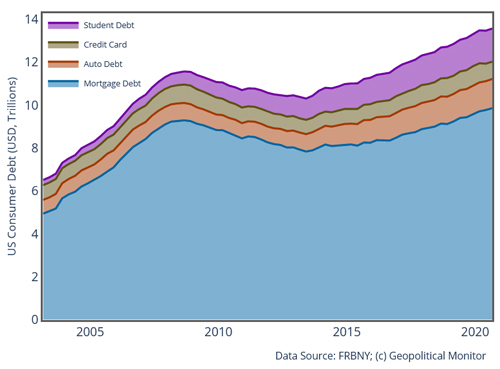
Another feature of US student debt is that its’ rapid accumulation is a relatively recent phenomenon. At the start of 2007, student loans amounted to approximately $500 billion. Fast-forward to 2020 and they account for the second largest slice of US consumer debt, behind only mortgages, and ahead of credit card debt and car loans.